The other question I would pose is...has it been demonstrated that black members now are experiencing a significantly more harmonious reception from white members because of the 100 years of racial discrimination the Church enacted upon them and their predecessors? This Reddit thread suggests it might be a false premise. Is it a fact that America now has a significantly more harmonious cross cultural society between white people and black people because of 250 years of slavery? (That's a rhetorical question).drumdude wrote: ↑Thu Aug 20, 2026 3:06 amI think Dan has the capacity to think and write much more deeply than he does. On the occasional topic that he is actually an expert in, I really enjoy what he writes.I Have Questions wrote: ↑Wed Aug 19, 2026 1:32 pmLet’s put even more of a spotlight on the Afore’s weasel words. Why isn’t he down on bended knee every day expressing his gratitude for Bradford expelling him from the Maxwell Institute? Surely Peterson’s relationships with the Church and the Maxwell and apologetics have blossomed more harmoniously because of the ouster, than they would have done had his summary dismissal never taken place. That’s his logic on the racial discrimination the church enacted on black people for 100 years, right?
When Peterson speaks, it’s unclear how much thinking, if any, has been done…
I think the apologetics and blogging has short circuited much of his output into a scattered disjointed set of random thoughts. None of which are really worth reading more than once.
It’s funnily enough what Christopher Hitchens also liked to do. Most of his columns aren’t worth reading again today. But he managed to find the willpower to produce some books that will still be read for decades.
I really would be interested in reading a book that Dan puts his full effort into. He’s not really doing himself or his readers any favors by being lazy and finding every excuse to not work on one of his many planned books.
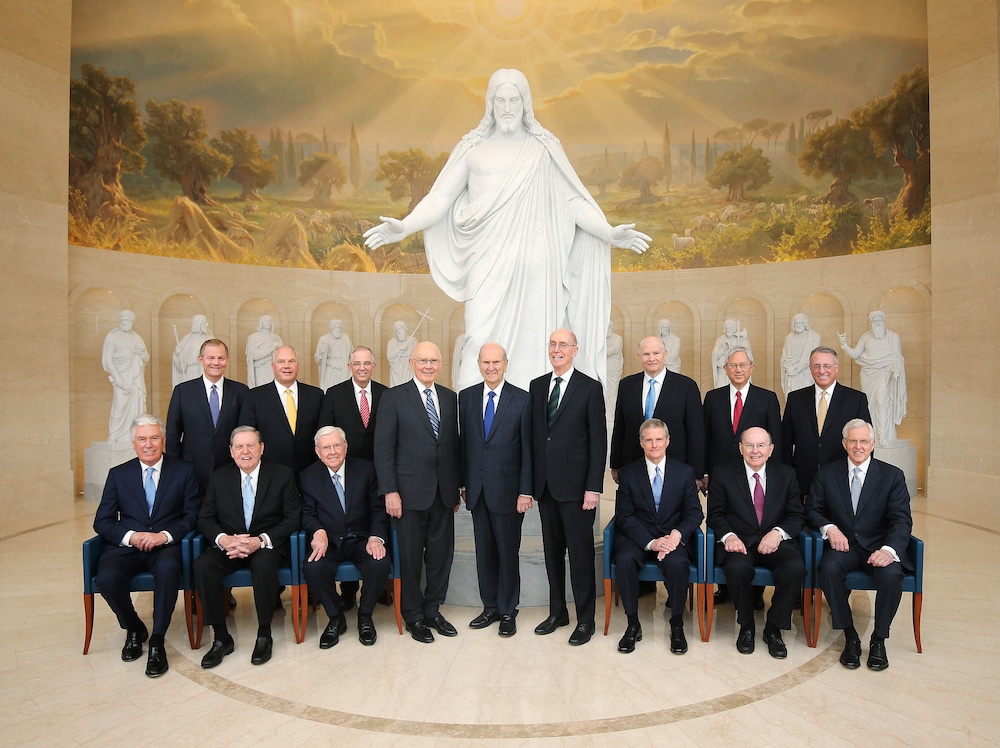
Perhaps Peterson has seen this elevated Racial unity for himself in Utah...
Oh. That doesn't sound particularly harmonious...Historically, students of color in Utah have faced a variety of barriers in feeling completely safe and welcome at school. After Brown v. Board of Education was ruled under the United States Supreme Court, Utah law didn’t change. Rather than focusing on direct segregation, Utah utilizes subversive policies and culture. This leads to a more normalized “quiet” form of racism.
This results in the “Utah Bubble”, where White Utah natives often subconsciously uphold cultural norms that quietly uphold racial divides. This stems from a lack of exposure to diverse communities, often bringing about ignorance or implicit violence.
Even within my own upbringing through the Utah County education system, I was often faced with sayings ranging from calling my lunches stinky to being called a “chink” right to my face. Still, almost eight years later, it seems as though Utah County has not changed.
Surely though this is significantly better than it would otherwise have been. Because 100 years of racism in the Church. And in conclusionIn Utah, racism isn’t usually openly hostile. Instead, it’s through subtle comments and a lack of institutional support. In high school, students in predominantly white neighborhoods, like Alpine, stick out like sore thumbs.
Lone Peak High School student Monia Dushimirimana was shocked when she moved to Utah County during seventh grade. In an interview, Monia said, “Everyone thought I was going to be like the ghetto girl or something like that, started a lot of fights, just because they think they know me.” Often ridiculed by peers through insults disguised as innocent jokes, high school students are forced to suffer in silence.
After falling victim to a long history of hearing and being told racial slurs, Monia decided to go online for school last year. When asked if she received institutional support after telling the administration, she said, “The principal just called their (the perpetrators’) parents and told them the situation, but they didn’t get suspended. Like nothing, they just went back to class the next day, acting like everything was fine.”
When asked why Utah County has certain patterns of ignoring racism, Monia said, “I feel like that has to do with our bubble and not really going out of our way to make friends with other people. And I feel like they (the Utah community) have an idea of what should be, instead of what could be.”
This is continued with cowardly acts of racism on campus at the U. Upon Gardner Commons being built, the construction site was vandalized with a racial slur. Even in 2023, campus police were given notice of handwritten racist slurs and swastikas left on papers at a tabling event on campus. Black students and staff in particular face hate crimes at the University of Utah. However, in person, Andre Hudson, a U student from Arizona, said that it’s rarely blatant actions. He said, “Here, it feels like you’re being watched and judged. The culture is a lot more judgmental than confrontational.”
Upon the closing of important campus resources, like the Black Cultural Center, students like Andre are left with little to no institutional help. When asked where one goes for support, Andre said, “I don’t know if there’s any real support systems that I’ve heard of. I’d say the U needs to create more spaces where people can be themselves and there’s more community.”
Across the varied perspectives throughout development, a theme appears. Students of color in Utah are expected to adapt to discomfort rather than push against it. From middle school to college, students are continuously overlooked. Utah needs further student counseling support and institutional guidelines for its minority populations.
Corbitt and Peterson don't know what they are talking about.Former University of Utah researcher Dr. Maeve Wall wrote about Utah’s education system. Wall found that Utah’s uniquely predominantly White and LDS influence led to “white-Niceness”, which describes a polite, color-evasive attitude that masked anti-Black racism under the guise of good intentions in the early 70’s. This sentiment is still being carried throughout Utah’s treatment of its students of color today.