Yeah. "Scripture salad" is not very interesting, and does not feed the soul. Only roughage to make the book longer.Agreed. And again, I think it is significant that we see Rigdon there at all--even given parameters that would tend to keep him off the road.
Why not Oliver?
-
_MCB
- _Emeritus
- Posts: 4078
- Joined: Sat Aug 29, 2009 3:14 pm
Re: Why not Oliver?
Huckelberry said:
I see the order and harmony to be the very image of God which smiles upon us each morning as we awake.
http://www.vatican.va/archive/ccc_css/a ... cc_toc.htm
I see the order and harmony to be the very image of God which smiles upon us each morning as we awake.
http://www.vatican.va/archive/ccc_css/a ... cc_toc.htm
-
_CaliforniaKid
- _Emeritus
- Posts: 4247
- Joined: Wed Jan 10, 2007 8:47 am
Re: Why not Oliver?
Danna wrote:I had a think about this. If they produce bias, the KJV word combinations should not actually bias the words towards one author or another, provided the candidate author samples excluded direct KJV quotations. They should simply contribute to the separation between the Book of Mormon and all of the candidate author clouds under the null hypothesis (none of the candidate authors wrote the Book of Mormon).
The trouble is that NSC as employed by Jockers does not allow for that particular null hypothesis.
To see how this would bias the method, let's take just one vector as an example. Imagine that all the test authors' frequencies of the word "and" are between .02 and .05, with Rigdon falling at the high end. But because of its KJV style and excessive use of "and it came to pass", the Book of Mormon's ratio is more like .07. Rigdon would appear the "closest" to the Book of Mormon in this vector. But since we have no way of knowing how much the KJV style increased the frequency-- maybe as little as .02 or as much as .05-- we have no way of knowing whether Rigdon would still be closest in this vector if there were some way to "correct" for the bias introduced by the KJV style. As a result, NSC's identification of Rigdon as probable author would be meaningless. Extended NSC, meanwhile, would attribute the text to a latent author, which would also be meaningless. In short, NSC will not be a useful method for authorship attribution of highly distinctive texts like the Book of Mormon until and unless we can isolate word vectors that are insensitive to the exogenous variables.
-
_MCB
- _Emeritus
- Posts: 4078
- Joined: Sat Aug 29, 2009 3:14 pm
Re: Why not Oliver?
And what is left, when one examines the samples of Rigdon's writings that we KNOW he wrote, is very little.provided the candidate author samples excluded direct KJV quotations.
My interest is not in what Rigdon contributed, but in what the others contributed.
Huckelberry said:
I see the order and harmony to be the very image of God which smiles upon us each morning as we awake.
http://www.vatican.va/archive/ccc_css/a ... cc_toc.htm
I see the order and harmony to be the very image of God which smiles upon us each morning as we awake.
http://www.vatican.va/archive/ccc_css/a ... cc_toc.htm
-
_Roger
- _Emeritus
- Posts: 1905
- Joined: Mon Mar 02, 2009 6:29 am
Re: Why not Oliver?
Chris:
Which is one of the reasons I don't place a huge amount of weight on word print studies. Perhaps as more and more tests are completed by both sides a discernible pattern will emerge with the weight of the data falling on one side or the other. Seems like right now, however, we have one side claiming X explains result A and then the other side says no, Y explains it, and neither side has a slam dunk.
What I would like to see is you, Chris, doing a series of tests in conjunction with Uncle Dale and Danna. I think you all should run as many tests as you can dream up and then see if the results lean in one direction or another.
As a result, NSC's identification of Rigdon as probable author would be meaningless. Extended NSC, meanwhile, would attribute the text to a latent author, which would also be meaningless. In short, NSC will not be a useful method for authorship attribution of highly distinctive texts like the Book of Mormon until and unless we can isolate word vectors that are insensitive to the exogenous variables.
Which is one of the reasons I don't place a huge amount of weight on word print studies. Perhaps as more and more tests are completed by both sides a discernible pattern will emerge with the weight of the data falling on one side or the other. Seems like right now, however, we have one side claiming X explains result A and then the other side says no, Y explains it, and neither side has a slam dunk.
What I would like to see is you, Chris, doing a series of tests in conjunction with Uncle Dale and Danna. I think you all should run as many tests as you can dream up and then see if the results lean in one direction or another.
"...a pious lie, you know, has a great deal more influence with an ignorant people than a profane one."
- Sidney Rigdon, as quoted in the Quincy Whig, June 8, 1839, vol 2 #6.
- Sidney Rigdon, as quoted in the Quincy Whig, June 8, 1839, vol 2 #6.
-
_CaliforniaKid
- _Emeritus
- Posts: 4247
- Joined: Wed Jan 10, 2007 8:47 am
Re: Why not Oliver?
Danna,
To answer the question of why NSC attributes some chapters to Rigdon rather than the latent author, we need to understand how the method works. Delta/NSC analysis assumes that each author's probability distribution for each word vector is roughly the same size. The chart below illustrates this principle. Case 3 shows how things can go wrong if there is a substantial size differential between two authors' distributions. In short, some texts will be misattributed.

Bruce's PCA chart illustrates, I think, that a size differential is precisely what we're dealing with in the present case. The "latent author" cloud is much larger than the Rigdon cloud, such that some texts in the latent author cloud are actually closer to the center of the Rigdon cloud than to the center of the latent author cloud. These will be misattributed, since NSC and Delta are attributing texts based on distance from the average. Yet when we look at the PCA chart visually, we can easily tell-- with the exception perhaps of two outliers-- which cloud they belong to.
Peace,
-Chris
To answer the question of why NSC attributes some chapters to Rigdon rather than the latent author, we need to understand how the method works. Delta/NSC analysis assumes that each author's probability distribution for each word vector is roughly the same size. The chart below illustrates this principle. Case 3 shows how things can go wrong if there is a substantial size differential between two authors' distributions. In short, some texts will be misattributed.
Bruce's PCA chart illustrates, I think, that a size differential is precisely what we're dealing with in the present case. The "latent author" cloud is much larger than the Rigdon cloud, such that some texts in the latent author cloud are actually closer to the center of the Rigdon cloud than to the center of the latent author cloud. These will be misattributed, since NSC and Delta are attributing texts based on distance from the average. Yet when we look at the PCA chart visually, we can easily tell-- with the exception perhaps of two outliers-- which cloud they belong to.
Peace,
-Chris
-
_Roger
- _Emeritus
- Posts: 1905
- Joined: Mon Mar 02, 2009 6:29 am
Re: Why not Oliver?
Chris:
Isn't it fair to note that KJV language is likely what separates Rigdon's "cloud" from the Book of Mormon? Wouldn't it be worth someone's time to come up with a test that (somehow) eliminates that factor, and if Rigdon moves closer or even into the Book of Mormon cloud, wouldn't that be significant?
Bruce's PCA chart illustrates, I think, that a size differential is precisely what we're dealing with in the present case. The "latent author" cloud is much larger than the Rigdon cloud, such that some texts in the latent author cloud are actually closer to the center of the Rigdon cloud than to the center of the latent author cloud. These will be misattributed, since NSC and Delta are attributing texts based on distance from the average. Yet when we look at the PCA chart visually, we can easily tell-- with the exception perhaps of two outliers-- which cloud they belong to.
Isn't it fair to note that KJV language is likely what separates Rigdon's "cloud" from the Book of Mormon? Wouldn't it be worth someone's time to come up with a test that (somehow) eliminates that factor, and if Rigdon moves closer or even into the Book of Mormon cloud, wouldn't that be significant?
"...a pious lie, you know, has a great deal more influence with an ignorant people than a profane one."
- Sidney Rigdon, as quoted in the Quincy Whig, June 8, 1839, vol 2 #6.
- Sidney Rigdon, as quoted in the Quincy Whig, June 8, 1839, vol 2 #6.
-
_CaliforniaKid
- _Emeritus
- Posts: 4247
- Joined: Wed Jan 10, 2007 8:47 am
Re: Why not Oliver?
Roger wrote:Wouldn't it be worth someone's time to come up with a test that (somehow) eliminates that factor, and if Rigdon moves closer or even into the Book of Mormon cloud, wouldn't that be significant?
Yes. But frankly, until that is done, we can draw no real conclusions from this data.
-
_MCB
- _Emeritus
- Posts: 4078
- Joined: Sat Aug 29, 2009 3:14 pm
Re: Why not Oliver?
I disagree, Chris. Serious questions about Rigdon's word-print do not invalidate the entire study. Particularly since I have found so many more possible sources worth testing.
Huckelberry said:
I see the order and harmony to be the very image of God which smiles upon us each morning as we awake.
http://www.vatican.va/archive/ccc_css/a ... cc_toc.htm
I see the order and harmony to be the very image of God which smiles upon us each morning as we awake.
http://www.vatican.va/archive/ccc_css/a ... cc_toc.htm
-
_Uncle Dale
- _Emeritus
- Posts: 3685
- Joined: Wed Feb 07, 2007 7:02 am
Re: Why not Oliver?
Danna wrote:...
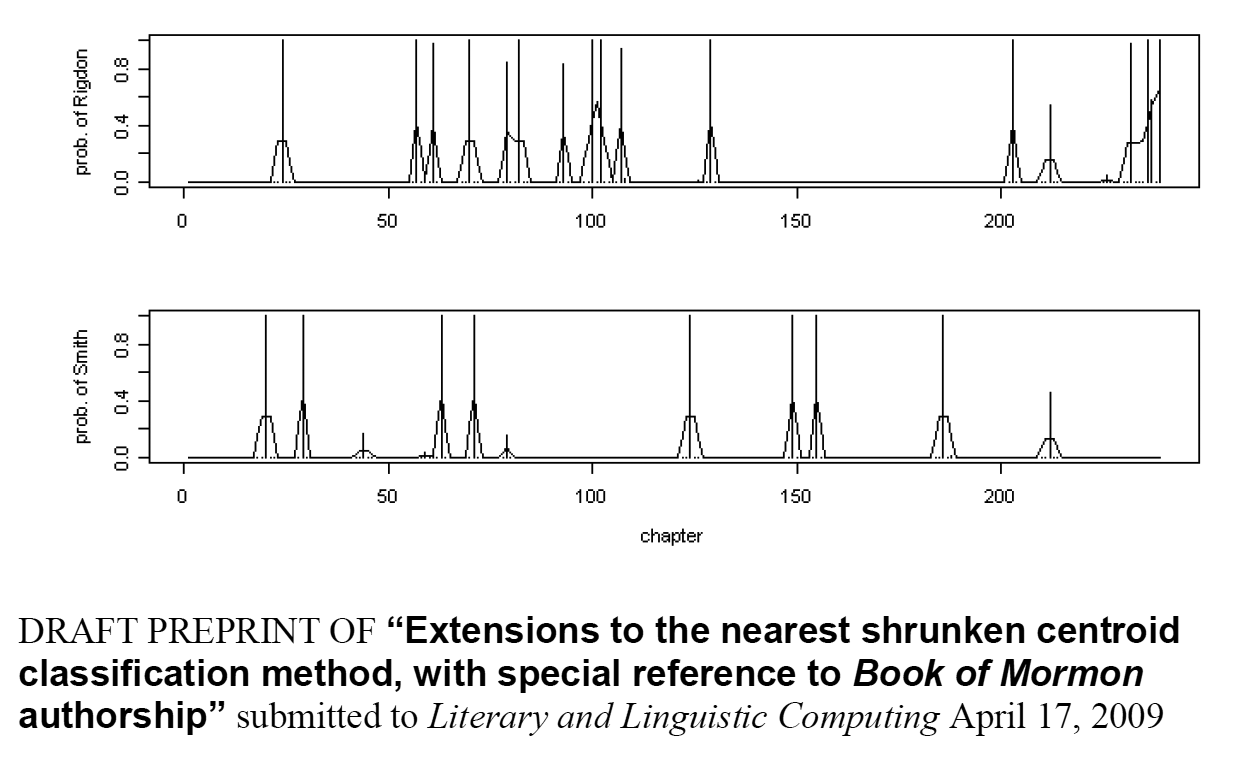
Uncle Dale, have you had a look at the Rigdon attributions on page 25 of Schaalje et al?
You could probably work out roughly where Rigdon is detected in spite of the latent author. Do these places match your predictions?
Not exactly. If the spike near x-axis 100 is Alma 5, that would be a strong "Rigdon hit" on
my subjective attributions. Without exact chapter attributions I cannot tell for certain.
For some reason this paper has never been accepted for publication. Part of
the reason may be the author's failure to provide the base data from which
his charts are constructed.
Another oddity -- I see "Smith" but not "Spalding" on the chart below:
UD
-- the discovery never seems to stop --
-
_Danna
Re: Why not Oliver?
CaliforniaKid wrote:Danna,
To answer the question of why NSC attributes some chapters to Rigdon rather than the latent author, we need to understand how the method works. Delta/NSC analysis assumes that each author's probability distribution for each word vector is roughly the same size. The chart below illustrates this principle. Case 3 shows how things can go wrong if there is a substantial size differential between two authors' distributions. In short, some texts will be misattributed.
Bruce's PCA chart illustrates, I think, that a size differential is precisely what we're dealing with in the present case. The "latent author" cloud is much larger than the Rigdon cloud, such that some texts in the latent author cloud are actually closer to the center of the Rigdon cloud than to the center of the latent author cloud. These will be misattributed, since NSC and Delta are attributing texts based on distance from the average. Yet when we look at the PCA chart visually, we can easily tell-- with the exception perhaps of two outliers-- which cloud they belong to.
Peace,
-Chris
Thank you for posting the examples. They nicely explain the issues some critics had with Jockers et al use of NSC (and those issues are debatable but that is not relevant here)
The point is that Extended NSC controls for this potential effect by requiring the test text to be outside of the distribution of Author 2 (latent text in your example) before attribution to Author 1 (the word limit also has the effect of reducing discrepancy in the the distributions as well). So treating case 3 with Extended NSC, even if the test text is closer to Rigdon, if it is within the distribution of the Latent Author, it will be attributed to the Latent Author. That was the aim of the whole endeavor in the first place.
With the large number of chapters tested, we should not be concerned to see some falling outside of the Latent Author distribution by chance, and getting attributed to another author. How much is 'some'? Schaalje et al don't tell us. All we have is the finding that 17/239 chapters (7.11%) were attributed to Rigdon, 8 (3.35%) to Smith, and 2 each to Spalding and Cowdery.
I have noted above that Jockers et al have serious questions of the authorship of the Smith material used here - some of this material has a high probability of actually including Rigdon as joint author. (Recall the fuss over Jockers not having a Smith corpus in their study). I would be interested to know who the second-place author was for the Smith chapters - Rigdon, or the Latent Author? If the questionable Smith material was removed, or non-questionable material used, which author would get the attribution for those 8 chapters? That is another interesting issue for anyone interested in replicating the Extended NSC study.
From a S/R theorist point of view, the Latent Author is an amalgam of Rigdon and Spalding, which would have the effect of reducing the likelihood of recognizing either of them separately in a 'joint' authored chapter. But, Uncle Dale has identified, using his qualitative methods (down here we would say his eye-o-meter), chapters that are largely the work of Rigdon. In these cases we would expect that the test text would actually fall outside of the Latent Author distribution, and closer to Rigdon. Is this what we are seeing with at least some of the 17 Rigdon chapters?