DCP doubles down on semantics to salvage Brigham’s racist legacy
-
Moksha

- God
- Posts: 8266
- Joined: Wed Oct 28, 2020 3:13 am
- Location: Koloburbia
Re: DCP doubles down on semantics to salvage Brigham’s racist legacy
Somebody has been shielding Dr. Peterson from all of Brigham Young's racist quotes. Do you think it was somebody from SeN or FAIR, or the Interpreter Foundation?
Cry Heaven and let loose the Penguins of Peace
-
Doctor Steuss
- God
- Posts: 2584
- Joined: Tue Oct 27, 2020 8:48 pm
Re: DCP doubles down on semantics to salvage Brigham’s racist legacy
I imagine if someone told Green Flake that Brigham Young was opposed to slavery, he might have been a bit skeptical of the claim.
-
drumdude
- God
- Posts: 8042
- Joined: Thu Oct 29, 2020 5:29 am
Re: DCP doubles down on semantics to salvage Brigham’s racist legacy
Brigham Young owned a slave, sure, but he set him free.
I’m going to use this logic next time I cheat on my wife. I cheated, sure, but I stopped! Get off my back, apostates!
I’m going to use this logic next time I cheat on my wife. I cheated, sure, but I stopped! Get off my back, apostates!
-
Rivendale

- God
- Posts: 1951
- Joined: Tue Mar 16, 2021 5:21 pm

-
drumdude
- God
- Posts: 8042
- Joined: Thu Oct 29, 2020 5:29 am
-
drumdude
- God
- Posts: 8042
- Joined: Thu Oct 29, 2020 5:29 am
Re: DCP doubles down on semantics to salvage Brigham’s racist legacy
Wikipedia:
When Mormon pioneers entered Utah, they introduced African slavery and provided a local market for Indian slavery. After the Mexican–American War, Utah became part of the United States and slavery was officially legalized in Utah Territory on February 4, 1852, with the passing of the Act in Relation to Service.
SeN:In 1847, the Mormon pioneers arrived with African slaves, which was the first time African slavery was in the area.[2] Three blacks who arrived in Utah with Brigham Young's party were slaves.[14] Mormons arrived in the middle of the Mexican–American War and ignored the Mexican ban on slavery. Instead, slavery was recognized by custom, which has been seen as naturally coming from the Mormon view on blacks.[15] Like many Christians of the day, Mormons believed in the Curse of Cain and Curse of Ham. Early Mormon leaders taught that God decreed that blacks should be "servants of servants" and that governments did not have the power to reverse God's decree.[16] Three slaves arrived in the first company of pioneers, but more arrived in later companies.
Dan is literally rewriting history! Amazing groundbreaking stuff you can only find at SeN.Patrice: "Do you happen to have more details on this? Unlike Utah, California outlawed slavery and involuntary servitude in 1849. Selling and buying slaves in California was punishable up to 10 years in jail. Was Agnes really planning on attempting to sell Green?"
That's what I recall off the top of my head. But the details seem to be a bit unclear and, anyway, my copies of the best current treatments -- the book by Amy Tanner Thiriot and the book by Reeve, Rich, and Carruth -- are hundreds of miles beyond my reach at the moment.
Incidentally, unlike California, which may have "outlawed" slavery, Utah never legally recognized slavery in the first place.
Patrice - DanielPeterson
11 minutes ago
Thanks. I was always taught slavery was officially legalized in Utah Territory on February 4, 1852, with the passing of the Act in Relation to Service, and this allowed and legalized the enslavement of both African Americans and Native Americans until it was repealed on June 19, 1862, when Congress prohibited slavery in all U.S. territories, which marked the end of legal slavery in Utah, aligning it with the broader national movement towards abolition.
Maybe this is incorrect and I was taught wrong?
DanielPeterson - Patrice
10 minutes ago
Patrice: "Maybe this is incorrect and I was taught wrong?"
Yes to both.
-
Everybody Wang Chung

- God
- Posts: 3819
- Joined: Wed Oct 28, 2020 1:52 am
Re: DCP doubles down on semantics to salvage Brigham’s racist legacy
Good Lord! This has to make Dr. Scratch's Top 10 list, or at least an honorable mention.drumdude wrote: ↑Wed Sep 03, 2025 12:25 amWikipedia:
When Mormon pioneers entered Utah, they introduced African slavery and provided a local market for Indian slavery. After the Mexican–American War, Utah became part of the United States and slavery was officially legalized in Utah Territory on February 4, 1852, with the passing of the Act in Relation to Service.SeN:In 1847, the Mormon pioneers arrived with African slaves, which was the first time African slavery was in the area.[2] Three blacks who arrived in Utah with Brigham Young's party were slaves.[14] Mormons arrived in the middle of the Mexican–American War and ignored the Mexican ban on slavery. Instead, slavery was recognized by custom, which has been seen as naturally coming from the Mormon view on blacks.[15] Like many Christians of the day, Mormons believed in the Curse of Cain and Curse of Ham. Early Mormon leaders taught that God decreed that blacks should be "servants of servants" and that governments did not have the power to reverse God's decree.[16] Three slaves arrived in the first company of pioneers, but more arrived in later companies.
Dan is literally rewriting history! Amazing groundbreaking stuff you can only find at SeN.Patrice: "Do you happen to have more details on this? Unlike Utah, California outlawed slavery and involuntary servitude in 1849. Selling and buying slaves in California was punishable up to 10 years in jail. Was Agnes really planning on attempting to sell Green?"
That's what I recall off the top of my head. But the details seem to be a bit unclear and, anyway, my copies of the best current treatments -- the book by Amy Tanner Thiriot and the book by Reeve, Rich, and Carruth -- are hundreds of miles beyond my reach at the moment.
Incidentally, unlike California, which may have "outlawed" slavery, Utah never legally recognized slavery in the first place.
Patrice - DanielPeterson
11 minutes ago
Thanks. I was always taught slavery was officially legalized in Utah Territory on February 4, 1852, with the passing of the Act in Relation to Service, and this allowed and legalized the enslavement of both African Americans and Native Americans until it was repealed on June 19, 1862, when Congress prohibited slavery in all U.S. territories, which marked the end of legal slavery in Utah, aligning it with the broader national movement towards abolition.
Maybe this is incorrect and I was taught wrong?
DanielPeterson - Patrice
10 minutes ago
Patrice: "Maybe this is incorrect and I was taught wrong?"
Yes to both.
If you've ever doubted that Mopologists lie, it's time to doubt those doubts.

"I'm on paid sabbatical from BYU in exchange for my promise to use this time to finish two books."
Daniel C. Peterson, 2014
Daniel C. Peterson, 2014
-
Doctor Scratch

- B.H. Roberts Chair of Mopologetic Studies
- Posts: 1747
- Joined: Wed Oct 28, 2020 7:24 pm
- Location: Cassius University
Re: DCP doubles down on semantics to salvage Brigham’s racist legacy
Doesn’t the Afore believe that there will be “servants”/“slavery” in the afterlife? Isn’t that one of the big reasons why he has devoted so much of his life to Mormonism? I.e., so that he’ll get to live in a great and spacious “Added Upon” mansion, where he’ll be attended to by a legion of less-valiant servants?
So you wonder why he’s tying himself up into pretzel shapes in an effort to pretend that BY wasn’t a racist.
So you wonder why he’s tying himself up into pretzel shapes in an effort to pretend that BY wasn’t a racist.
"If, while hoping that everybody else will be honest and so forth, I can personally prosper through unethical and immoral acts without being detected and without risk, why should I not?." --Daniel Peterson, 6/4/14
-
drumdude
- God
- Posts: 8042
- Joined: Thu Oct 29, 2020 5:29 am
Re: DCP doubles down on semantics to salvage Brigham’s racist legacy
Another source:
https://www.dialoguejournal.com/article ... overview-2Dialogue wrote:In his request Brigham Young made a definite distinction between Indian and Negro. After condemning the Indian slave trade, he observed, “Human flesh to be dealt in as property, is not consistent or compatible with the true principles of government. My own feelings are, that no property can or should be recognized as existing in slaves, wither Indian or African.” However, in view of the “present low and degraded situation of the Indian race” and their current practices of “gambling, selling, and otherwise disposing of their children,” the Governor would condone a “new feature in the traffic of human beings”— “essentially purchasing them into freedom, instead of slavery.” This was not simply buying the children and setting them free, but also caring for them and elevating them to “an equal footing with the more favored portions of the human race.” There were, of course, certain economic considerations, and “if in return for favors and expenses which may have been incurred on their account, service should be considered due, it would become necessary that some law should provide the suitable regulations under which all such indebtedness should be defrayed.”
Negro slavery was different:
The suitable regulations were shortly forthcoming, and within a few weeks Young signed into law acts legalizing both Negro and Indian slavery.[78] Though Negro slaves could no longer choose to leave their masters, some elements of consent were included. Slaves brought into the Territory had to come “of their own free will and choice;” and they could not be sold or taken from the Terri tory against their will.[79] Though a fixed period of servitude was not prescribed for Negroes, the law provided “that no contract shall bind the heirs of the servant . . . for a longer period than will satisfy the debt due his [master]. … ” Several unique provisions were included which terminated the owner’s contract in the event that the master had sexual intercourse with a servant “of the African race,” neglected to feed, clothe, shelter, or otherwise abused the servant, or attempted to take him from the Territory against his will. Some schooling was also required for slaves between the ages of six and twenty.Brigham Young wrote:It has long since ceased to become a query with me, who were the most amenable to the laws of righteousness; those who through the instrumentality of human power brought into servitude human beings, who naturally were their own equals, or those who, acting upon the principle of nature’s law, brought into this position or situation, those who were naturally designed for that purpose, and whose capacities are more befitting that, than any other station in society. Thus, while servitude may and should exist, and that too upon those who are naturally designed to occupy the position of ‘servant of servants’ yet we should not fall into the other extreme, and make them as beasts of the field, regarding not the humanity which attaches to the colored race; nor yet elevate them, as some seem disposed, to an equality with those whom Nature and Nature’s God has indicated to be their masters, their superiors. . . .[77]
-
drumdude
- God
- Posts: 8042
- Joined: Thu Oct 29, 2020 5:29 am
Re: DCP doubles down on semantics to salvage Brigham’s racist legacy
To ensure this doesn't get lost in the weeds, here is DCP's claim:
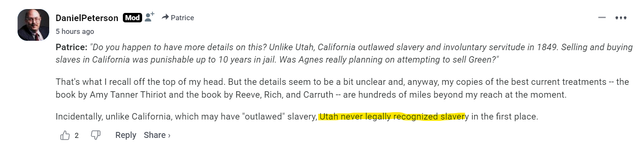
I find this remarkably similar to the claims that Joseph Smith didn't practice polygamy.
I find this remarkably similar to the claims that Joseph Smith didn't practice polygamy.