You claimed BY stated that Joseph Smith thought they were authentic, and that the Church taught they were until 1980. Like I said, the references you cited do not support your claim.
Oh for heaven's sake, the evidence is conclusive.Even Richard Bushman had to admit the embarrassing truth: "Church historians continued to insist on the authenticity of the Kinderhook plates until 1980." But not just historians. Apostles and Prophets alike.
Two months after the "discovery," the
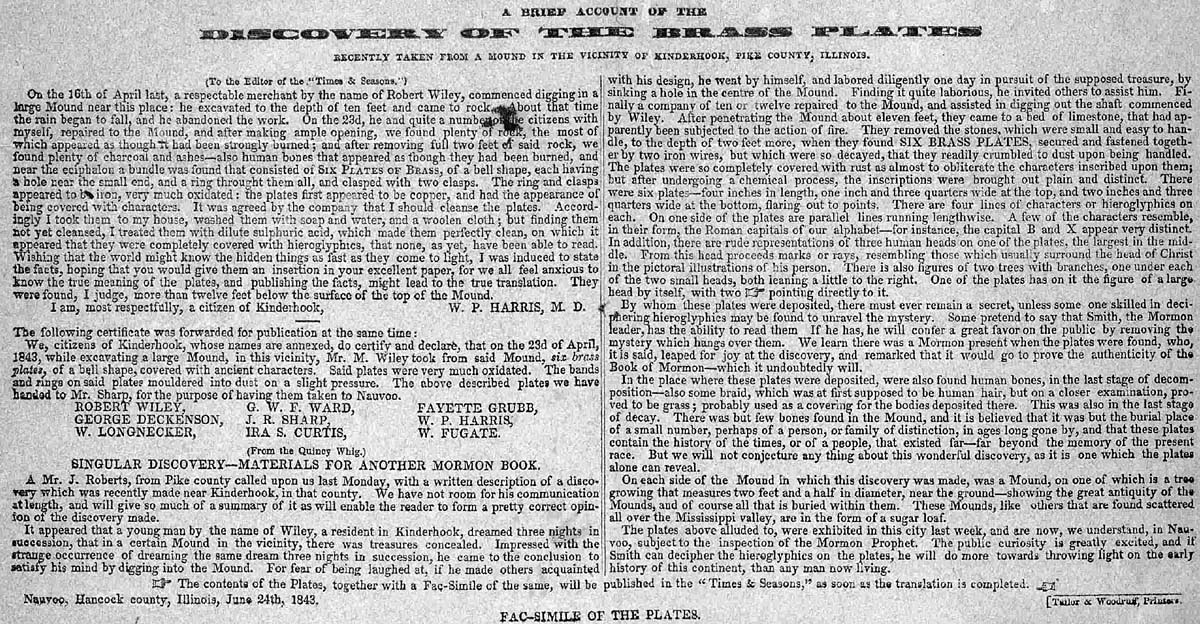
Nauvoo Neighbor published this on June 24, 1843:

Here is a close up of the text:
http://www.sidneyrigdon.com/dbroadhu/IL/kndrfac2.jpgThis was published by two apostles, (Taylor and Woodruff), both of whom would move on to become Prophets of the Church. The last part of the article says:
The public curiosity is greatly excited, and if Smith can decipher the hieroglyphics on the plates, he will do more towards throwing light on the early history of this continent, than any man now living. The contents of the Plates, together with a Fac-Simile of the same, will be published in the "Times and Seasons," as soon as the translation is completed.
Three subsequent issues of the
Times and Seasons addressed the plates again:
"The brass plates had characters or hieroglyphics on them which nobody was able to read. The bones found in the mound might have belonged to, "a person, or a family of distinction, in ages long gone by, and that these plates contain the history of the times, or of a people, that existed far - far beyond the memory of the present race." (Times and Seasons, vol. 4, page 187.)
"Why does the circumstance of the plates recently found in a mound in Pike county, III., by Mr. Wiley, together with ethnology and a thousand other things, go to prove the Book of Mormon true? - Answer: Because it is true!" (Times and Seasons, Vol. 5, page 406)
"We learn there was a Mormon present when the plates were found, who it is said, leaped for joy at the discovery, and remarked that it would go to prove the authenticity of the Book of Mormon--which it undoubtedly will. " (Times and Seasons, Vol.4, p.187)
Obviously the ruse worked, as the entire Church was "excited" about it, thinking it gave more proof for the Book of Mormon. We're supposed to believe that while the entire Church fell for the ruse, Joseph Smith just let them remain deceived without informing them it was a hoax, or that he never translated anything and that no forthcoming publication would ever include a translation? There is no evidence that Smith felt it was a hoax. None. All we have are ignorant assertions by irrelevant apologetic cheerleaders like why me and Yahoo Bot. But moving on...
A similar quote in History of the Church: "A person present when the plates were found remarked that it would go to prove the authenticity of the Book of Mormon, which it undoubtedly will." (History of the Church, Vol. 5, p.378) In a March 1904, decades after the hoax admission, an issue of the
Improvement Era shows the Church placing the spotlight on the plates yet again, claiming to have answered the question of translation in the affirmative!:
Certain bell-shaped plates are said to have been discovered in a mound, in the vicinity of Kinderhook, Pike county, Illinois, by Robert Wiley, in 1843, and taken to Joseph Smith. Now, I wish to ask: 1. Were these plates translated by Joseph Smith? 2. If so, what were their contents? 3. Where are they? 4. Are they considered of any value in confirming the Book of Mormon? 5. Is there anything about them in any of the Church works?
"1 and 2. Near Kinderhook, in Pike county, Illinois-between fifty and sixty miles south and east of Nauvoo-on April 23, 1843, a Mr. Robert Wiley, while excavating a large mound, took from said mound six brass plates of bell shape, fastened by a ring passing through the small end, and fastened with two clasps, and covered with ancient characters. Human bones together with charcoal and ashes were found in the mound, in connection with the plates which evidently had been buried with the person whose bones were discovered. The plates were submitted to the Prophet, and speaking of them in his journal, under date of May 1, 1843, he says: "I have translated a portion of them, and find they contain the history of the person with whom they were found. He was a descendant of Ham, through the loins of Pharaoh, king of Egypt, and that he received his kingdom from the Ruler of heaven and earth."
"3. The plates were later placed in a museum in St. Louis, known as McDowell's, which was afterward destroyed by fire, and the plates were lost.
"4. The event would go very far towards confirming the idea that in very ancient times, there was intercourse between the eastern and western hemispheres; and the statement of the prophet would mean that the remains were Egyptian. The fair implication, also, from the prophet's words is that this descendant of the Pharaohs possessed a kingdom in the new world; and this circumstance may account for the evidence of a dash of Egyptian civilization in our American antiquities.
"5. The whole account of the finding of the plates, together with the testimony of eight witnesses, besides Mr. Wiley, who were acquainted with the finding of the relics, as also the statement from the prophet's history, is found in the Millennial Star, vol. 21: pp. 40-44."
During that same period, the famous Church Historian, B.H. Roberts addressed the "hoax admission" by calling it a lie.
Of this presentation of the matter it is only necessary to say that it is a little singular that Mr. Fugate alone out of the three said to be in collusion in perpetrating the fraud should disclose it, and that he should wait from 1843 to 1879-a period of thirty-six years-before doing so, when he and those said to be associated with him had such an excellent opportunity to expose the vain pretensions of the Prophet-if Fugate's tale be true? For while the statement in the text of the Prophet's Journal to the effect that the find was genuine, and that he had translated some of the characters and learned certain historical facts concerning the person with whose remains the plates were found, may not have been known at the time to the alleged conspiritors to deceive him, still the editor of the Times and Seasons-John Taylor, the close personal friend of the Prophet-took the find seriously, and expressed at once explicit confidence in an editorial in the Times and Seasons, of May 1st, 1843, that the Prophet could give a translation of the plates. And this attitude the Church, continued to maintain; for in The Prophet, (a Mormon weekly periodical, published in New York) of the 15th of February, 1845, there was published a fac-simile of the Kinderhook plates, together with the Times and Seasons editorial and all the above matter of the text. How easy to have covered Joseph Smith and his followers with ridicule by proclaiming the hoax as soon as they accepted the Kinderhook plates as genuine! Why was it not done? The fact that Fugate's story was not told until thirty-six years after the event, and that he alone of all those who were connected with the event gives that version of it, is rather strong evidence that his story is the hoax, not the discovery of the plates, nor the engravings upon them. (New Witnesses for God, p. 63)
In 1921, LDS Apostle John A. Widstoe follows the Clayton account and writes that Joseph Smith translated the plates:
May 1. Translates a portion of certain brass plates discovered at Kinderhook, Iowa." (John A. Widtsoe, "Joseph Smith--Seeker after Truth," Prophet of God/i], p. 366)
In 1955, George Reynolds and Janne M. Sjodahl wrote:
But, on the other hand, we have the fact before us, that the skeleton of the Pharaoh, found in Kinderhook, Illinois, referred to previously, was dug out of a large mound. After penetrating about eleven feet the workers came to a bed of limestone that had been subjected to the action of fire. They removed the stones, which were small and easy to handle, to the depth of two feet more, when they found the skeleton. This was evidently a burial chamber, as with the bones, which appeared to have been burned, was found plenty of charcoal and ashes. From this fact it is evident that some of the mounds are of very ancient date, as it is not supposable that this man would be the only one of his race and nation to be buried in this manner. We also suggest that this colony of Egyptians may have originated the style of architecture in this country in which so many find resemblances to the Egyptian, and which is specially characterized by the erection of vast truncated pyramids." (George Reynolds and Janne M. Sjodahl, [i]Commentary on the Book of Mormon, edited and arranged by Philip C. Reynolds, 7 vols., 6:, p.232).
In 1962, Welby W. Ricks, who was president of the BYU Archaeological Society, wrote the following:
A recent rediscovery of one of the Kinderhook plates which was examined by Joseph Smith, Jun., reaffirms his prophetic calling and reveals the false statements made by one of the finders...The plates are now back in their original category of genuine.... Joseph Smith, Jun., stands as a true prophet and translator of ancient records by divine means and all the world is invited to investigate the truth which has sprung out of the earth not only of the Kinderhook plates, but of the Book of Mormon as well." (The Kinderhook Plates)
Of course we now know that is the "world is invited to investigate the truth," then it should be prepared to be called anti-Mormon. And moving on...
In 1979
Apostle Mark E. Peterson wrote a book called “Those Gold Plates!”. In the first chapter Peterson describes various ancient cultures that have written records on metal plates. Then Peterson claims,
There are the Kinderhook plates, too, found in America and now in the possession of the Chicago Historical Society. Controversy has surrounded these plates and their engravings, but most experts agree they are of ancient vintage. (page 3, Those Gold Plates, Mark E. Peterson)
In 1981 the Church published the following:
Six plates having the appearance of Brass have lately been dug out of a mound by a gentleman in Pike Co. Illinois. They are small and filled with engravings in Egyptian language and contain the genealogy of one of the ancient Jaredites back to Ham the son of Noah. His bones were found in the same vase (made of Cement). Part of the bones were 15 ft. underground. ... A large number of Citizens have seen them and compared the characters with those on the Egyptian papyrus which is now in this city. - Apostle Parley Pratt, May 7, 1843, (reprinted in The Ensign, August 1981, page 73).
So ultimately we've proven that the Fugate hoax succeeded beyond his wildest imagination. I just wish I could have seen the look on his face after finding out that the Church refused to believe it was a hoax, even after he came clean! We've also proven that a complete translation of the plates was expected by high ranking Church members as early as May 1843 and many people close to Smith believed he had already started one.