EAllusion wrote: I think someone may have mentioned that humans aren't evolving much because our ability to manipulate our environment has taken off selective pressure. This is not correct. In fact, humans actually have been evolving extremely quickly in the past few thousand years. And there is tremendous selective pressure on human populations due to how radically we continue to alter the environment in which we find ourselves. Coupled with explosive fluctuations in population and that's why human evolution has become so accelerated.
Hi EAllusion. That was me and I appreciate the feedback. I may have been imprecise. I was really only talking about negative selection -- in other words, modern medicine, improved sanitation, etc. have slowed the rate at which [previously?] deleterious mutations are removed from the genome. With that clarification, would my statement be correct. Or am I still off the mark?
Interesting information about the raccoons. Thanks for your posts on this topic.
“The ideal subject of totalitarian rule is not the convinced Nazi or the dedicated communist, but people for whom the distinction between fact and fiction, true and false, no longer exists.”
― Hannah Arendt, The Origins of Totalitarianism, 1951
Darth J wrote:ETA: Note that Franktalk also omits point 1, which directly answers his original question---some species have not experienced environmental changes that would select morphological changes, which is why they have not changed in form for several million years.
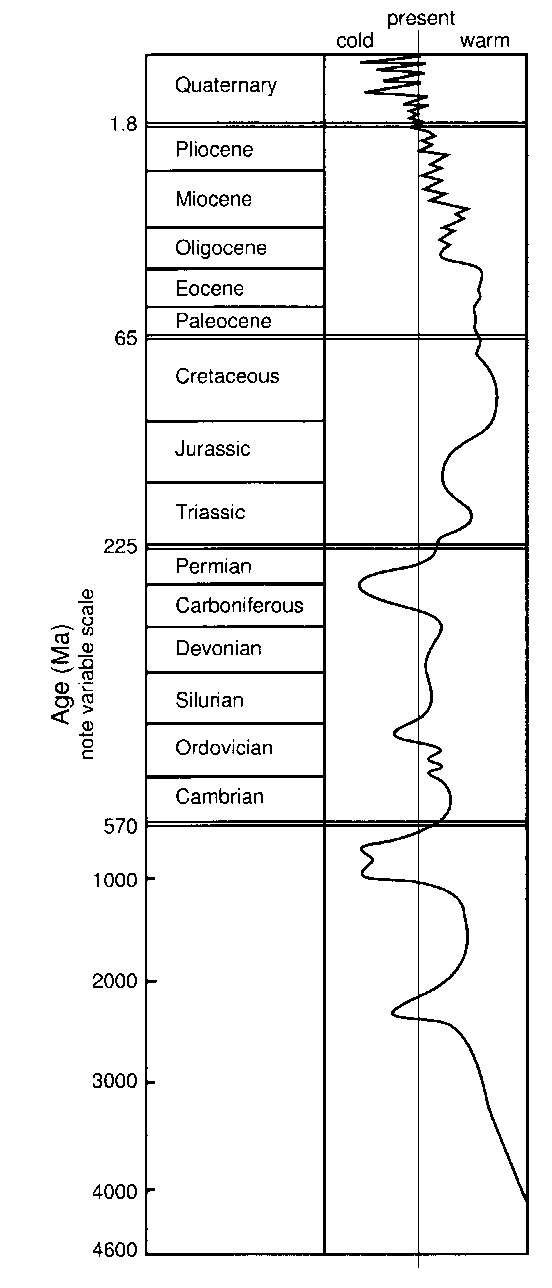
According to science all creatures from the dawn of time have experienced a changing environment.
Since there are no flat spots the temperature over long periods is in constant change. And since temperature directs so many life cycles I would guess that life even that in the sea has changes. But I do acknowledge that the sea does moderate temperature swings in short cycles. But the long cycles would effect the sea as well. It is obvious that due to the time scale that some areas are almost flat for some pretty long times. If someone wants to do the work of showing all life stays the same in quiet times in the environment I would be happy to see that.
Note that Franktalk continues to act like he is responding to "my" idea, rather than acknowledging that he did not read the website he claims to be responding to.
Followed up with this straw man:
Franktalk wrote: If someone wants to do the work of showing all life stays the same in quiet times in the environment I would be happy to see that.
Which is promulgated by no one (remember the statement that horseshoe crabs, although being pretty much the same morphologically over long periods of time, have most likely undergone more subtle changes, like changes in their immune system).
Sammy Jankins wrote:I have some experience playing with genetic algorithms and have seen that often the parts of the 'population' will reach a point where they hit a balance with their 'environment.'
I have looked into the models used in population genetics. Here is one of the best easy to read papers on the subject.
Reading this paper will give you a feel for how close the models are to the actual systems that they are trying to mimic in math. I also enjoyed the history of the subject as laid out in the paper.
Darth J wrote:Note that Franktalk continues to act like he is responding to "my" idea, rather than acknowledging that he did not read the website he claims to be responding to.
I did not read the site. I asked for a summary to be given to answer this question:
"According to theory we came from a common ancestor somewhere between 6 and 10 million years ago. So even allowing that to be true then add 2500 years and you find the end of the species as it appears today. Yet we see species last for 100 million years apparently unchanged. Please give me the summary of CB 930 that answers this issue."
I don't think that what might have happened to a crab answers a thing. But hey you can believe what ever you wish.
Franktalk wrote: I did not read the site. I asked for a summary to be given to answer this question:
"According to theory we came from a common ancestor somewhere between 6 and 10 million years ago. So even allowing that to be true then add 2500 years and you find the end of the species as it appears today. Yet we see species last for 100 million years apparently unchanged. Please give me the summary of CB 930 that answers this issue."...
Why the heck should anyone be bothered to summarize an article which is no longer than this:
Claim CB930: Some species, such as the tuatara, horseshoe crab, cockroach, ginkgo, and coelacanth, are "fossil species." They have not evolved for millions of years.
Source: Whitcomb, John C. Jr. and Henry M. Morris, 1961. The Genesis Flood. Philadephia, PA: Presbyterian and Reformed Publishing Co., pp. 176-180. Response: 1. The theory of evolution does not say that organisms must evolve morphologically. In fact, in an unchanging environment, stabilizing selection would tend to keep an organism largely unchanged. Many environments around today are not greatly different from environments of millions of years ago.
2. Some so-called fossil species have evolved significantly. Cockroaches, for example, include over 4,000 species of various shapes and sizes. Species may also evolve in ways that are not obvious. For example, the immune system of horseshoe crabs today is probably quite different from that of horseshoe crabs of millions of years ago.
Zadok: I did not have a faith crisis. I discovered that the Church was having a truth crisis. Maksutov: That's the problem with this supernatural stuff, it doesn't really solve anything. It's a placeholder for ignorance.
Chap wrote:Why the heck should anyone be bothered to summarize an article which is no longer than this:
So the job of making a summary is no big deal. What is your point? Why not quote the article? But I guess it gives you something to complain about. After all isn't that why you lurk around these threads?
Chap wrote:Why the heck should anyone be bothered to summarize an article which is no longer than this:
So the job of making a summary is no big deal. What is your point? Why not quote the article?
Why not click on the link you were given and read it? It's not exactly as if you are sparing in asking people to follow links yourself.
Zadok: I did not have a faith crisis. I discovered that the Church was having a truth crisis. Maksutov: That's the problem with this supernatural stuff, it doesn't really solve anything. It's a placeholder for ignorance.
Darth J wrote:...... Which is promulgated by no one (remember the statement that horseshoe crabs, although being pretty much the same morphologically over long periods of time, have most likely undergone more subtle changes, like changes in their immune system).
So changes we can't see are important but changes we can see are no big deal? Is that your theory? Is your theory that changes we have no evidence are the basic building blocks of modern evolutionary theory? Please explain because that makes no sense what so ever.
Chap wrote:Why not click on the link you were given and read it? It's not exactly as if you are sparing in asking people to follow links yourself.
That is true. But when I come across a small amount of data to present I do quote it. But I also supply the link for the whole article. Are we done with this non-sense? Or are you going to drive this point until everyone leaves this thread because you have made it a joke and painful to read?