The Spaulding Fable...over at BCC

The catch-all forum for general topics and debates. Minimal moderation. Rated PG to PG-13.
Post Reply
_Uncle Dale
_Emeritus
Posts: 3685
Joined: Wed Feb 07, 2007 7:02 am

Re: The Spaulding Fable...over at BCC

Post by _Uncle Dale »

Roger wrote:...
I recently decided to list the names of the main characters I could remember after 25+ years.
I got the majority of them right.
...


Let's consider the situation of the Conneaut witnesses, Roger.

In 1812 there was no American literature. On the Ohio frontier there was essentially no
literature at all. Perhaps a couple of the richer folks had a British novel or two. That was it.

Spalding's readers and auditors had no competing literature to hold in their minds from
that period. Perhaps a decade or two later they may have read a little Washington Irving
or James Fenimore Cooper. But, from 1812, perhaps all they had in their memory was Spalding.
It is easier to recall SPECIAL PAST EVENTS, for which there are no competing memories.

Spalding's auditors should be separated from Spalding's readers. Those who heard his
fictional account (of their own ancient mounds!!) read aloud in installments, would have had
a special experience -- separate from readers. Memorable for several different reasons.

For example the readers might pass over a passage of cynical wit, not realizing its intent;
while auditors might hear Spalding's special enunciation of the words of that passage,
catching at once his intended humor.

The readers might pass over the mention of a man's stature -- while the auditors might
hear Spalding pause and give a brief reprise of some such fact. he might even summarize
the previous night's reading, for those listeners who had missed that prior episode. It is
easier to recall GROUP-SHARED PAST EVENTS, which can be supplemented/complemented
by reference to memories from other members of that group.

In 1833, when D. P. Hurlbut showed up -- he only needed to hear the names "Nephi"
and "Lehi" from one or two individuals. In other words, only a quarter of the witnesses
needed to recall 5% of the unique names in Spalding's writings, in order to supply the
necessary information for the 1833 statements. After that, as Wade says, D. P. Hurlbut
could have prompted his statement-givers, asking them if they recalled the names.

But, we ask, why did the witnesses not recall names like Teancum and Pahoran? Why
do they speak mostly of names that occur in the first part of our current Book of Mormon?
"Nephites" and "Lamanites" occur early in the story -- They would certainly have been
present in the lost "Book of Lehi." "Laban" occurs early in the book -- probably was also
in the Book of Lehi. That leaves only "Zarahemla" and "Moroni" from the latter part.

My working hypothesis is that Spalding's readers and auditors were recalling names
from his "Book of Lehi" and not from Helaman, 3rd Nephi, etc. Spalding may have never
got that far with his chronology, in the "Book of Lehi." Or, not all of his readers/auditors
ever got that far in their own encounters with the text (whether read or listened to).

The part of the Book of Mormon which most resembles Spalding's use of language is
the latter third of Alma and the first part of Helman. It is a nearly solid block of plot
narrative which sounds like his prose -- which "word-prints" as his prose. If the
Conneaut witnesses were first drawn to the Book of Mormon, as a text that resembled
Spalding's writings, we would logically expect most of their recollection examples to
come from THAT section of the Book of Mormon. But they do NOT.

Why not?

1. Perhaps the Conneaut witnesses, in 1832-33, never bothered to read that far into the LDS book.
Since they never read the 3rd Nephi Christophany, they had no reason to remark upon it, etc.

2. Perhaps the Conneaut witnesses, in 1811-12, mostly heard/read accounts from the first
part of Spalding's "Israelite" story -- that is, from the "Book of Lehi."

or (Wade can supply his answer here):

3. _______________________

Wade still refuses to believe that readers of the Book of Mormon in 1829-30-31 noticed any
mentions of large people in that narrative. In other words, all LDS perceptions of large people
in the Book of Mormon derive from an 1832 faulty mention in a Mormon newspaper.

Correct me if I am wrong -- but he now says that Martha's recollection of large people in
Spalding's "Israelite" story is a false memory, planted by D. P. Hurlbut, who HAD read the
1832 newspaper opinion?

Or -- was Martha's mention of large people in the story a fragment of memory taken from
her exposure to the Roman story? If so, then why did D. P. Hurlbut not suppress that odd
and ill-fitting remark? Because he HAD read the 1832 newspaper?

I keep asking Wade to give us something new -- transcribe a hitherto unreported source --
cite some obscure Conneaut area history -- quote from Erastus Rudd's journal -- anything
in order to add some new information to this discussion.

Since he perhaps does not have the time and resources for such a contribution, I will
instead recommend a useful exercise he can accomplish in an hour with no new research.

1. Color-code all true (or very likely true) statements in the witnesses' testimony BLUE.
2. Color-code all false (or very likely false) statements in their testimony RED.
3. Underline all false memories implanted by D. P. Hurlbut.
4. Capitalize all memories mistakenly derived from Spalding's Roman story.
5. Embolden all statements obviously copied straight out of the 1830 Book of Mormon.

That would at least be a useful contribution -- easily presented right here in MB postings,
which provide all of the above text formatting features.

THEN we could see at a glance what Wade means when he talks about Martha's giants.
THEN we could see at a glance which parts of the testimony we can rely upon -- or not.

Am I asking for too much here?
I'll save Wade some time, by color-coding one of the affidavits myself --

"In the month of October, 1811, I went from the township of Madison to Conneaut, for the purpose of
securing a debt due me from Solomon Spalding. I tarried with him nearly two days, for the purpose
of accomplishing my object, which I was finally unable to do. I found him destitute of the means of paying
his debts. His only hope of ever paying his debts, appeared to be upon the sale of a book, which he had
been writing. He endeavored to convince me from the nature and character of the work, that it would
meet with a ready sale. Before showing me his manuscripts, he went into a verbal relation of its
outlines, saying that it was a fabulous or romantic history of the first settlement of this country, and as
it purported to have been a record found buried in the earth
, or IN A CAVE, he had adopted the ancient or
scripture style of writing.
He then presented his manuscripts, when we sat down and spent a good share
of the night, in reading them, and conversing upon them.
I well remember the name of Nephi, which
appeared to be the principal hero of the story. The frequent repetition of the phrase, "I Nephi," I recollect as
distinctly as though it was but yesterday,
although the general features of the story have passed from my
memory, through the lapse of 22 years. He attempted to account for the numerous antiquities which are
found upon this continent, and remarked that, after this generation had passed away, his account of the
first inhabitants of America would be considered as authentic as any other history.
The Mormon Bible I
have partially examined, and am fully of the opinion that Solomon Spalding had written its outlines
before he left Conneaut.
"


UD
-- the discovery never seems to stop --
_wenglund
_Emeritus
Posts: 4947
Joined: Fri Oct 27, 2006 7:25 pm

Re: The Spaulding Fable...over at BCC

Post by _wenglund »

Roger wrote:Wade: your assessment here is interesting in any case.... please elaborate.... why cannot: "an LDS editor's extra-textual extrapolation 20 or so years after the fact," "in no reasonable way be viewed as evidence to support the accuracy of Martha's statement about what she read 21 years earlier"? On what basis do you rule that out?


Try the first part of the experiment that I suggested, and the results should make my point obvious. Here is the first part of the experiment again:

Just for fun, have a group of people, who are relatively unfamiliar with the Book of Mormon or the Spalding theory, read the book of Ether, and without leading them in any way, have them give you their general impression of the story line. See if any of them mention anything about "large people".

The question is, given all that we have now considered, do you stick by your original assessment that Martha had a bona-fide memory (as opposed to a false one implanted) when she recounts "large people"? It's a simple yes or no question.


I thought I did answer the question. But, here it is again for your benefit: "yes".

Thanks, -Wade Englund-
"Why should I care about being consistent?" --Mister Scratch (MD, '08)
_wenglund
_Emeritus
Posts: 4947
Joined: Fri Oct 27, 2006 7:25 pm

Re: The Spaulding Fable...over at BCC

Post by _wenglund »

Roger wrote: Forgive me but this is one of those arguments that sounds reasonable in theory but is not in reality. I know this from personal experience.


Actually, as I indicated, I did, in fact, experience my "argument" in reality and from personal experience (do I need to have you "track with me" by quoting what I said?).

Perhaps your long-term memory of such things is better than mine. Who knows?

Whatever the case, your anecdotal experience doesn't negate mine. Whether your memory capacity or mine is the norm and more similar to the Conneaut witnesses, is anyone's guess. I will leave it to the reader to decide.

Dale does bring up a good point about the different amounts of literary exposure between now and then. Today, we tend to be saturated with stories in print and movies, and so one would expect a greater likelyhood today that specific names in one story may get lost in the cacophany of stories being mentally archived. So, this should be taken into consideration when analyzing the accuracy of the Conneaut witnesses distant recollections.

Weighing in on the other side of the balance, though, is the complexity of the stories. I mentioned Tom Sawyer, and you mentioned War and Peace. Each are lengthy novels. However, they both pretty much tell a single storyline. Whereas, the Book of Mormon tells a number of different storieslines, some more memorable than others. This should also be factored into the analysis.

With these things in mind, I will post my comparison between John Spalding's 1833 statement and his 1851 statements, to see if there is any possibility of false memories. It should prove interesting.

Thanks, -Wade Englund-
"Why should I care about being consistent?" --Mister Scratch (MD, '08)
_Roger
_Emeritus
Posts: 1905
Joined: Mon Mar 02, 2009 6:29 am

Re: The Spaulding Fable...over at BCC

Post by _Roger »

Wade:

I wrote:
Wade: your assessment here is interesting in any case.... please elaborate.... why cannot: "an LDS editor's extra-textual extrapolation 20 or so years after the fact," "in no reasonable way be viewed as evidence to support the accuracy of Martha's statement about what she read 21 years earlier"? On what basis do you rule that out?


You responded:
Try the first part of the experiment that I suggested, and the results should make my point obvious. Here is the first part of the experiment again:

Just for fun, have a group of people, who are relatively unfamiliar with the Book of Mormon or the Spalding theory, read the book of Ether, and without leading them in any way, have them give you their general impression of the story line. See if any of them mention anything about "large people".


There are several fallacies here. First, the Book of Ether is not necessarily MF. In other words, if S/R is correct, the Book of Mormon has undergone several changes since Spalding wrote MF. It is impossible to know how much and which sections remain untouched. Second, Spalding could have easily emphasized "large people" thereby making an impression on Martha--see Dale's post above for more on this. Or, third, the concept of large people may have clicked with something in her own experience--maybe she had seen large bones in the mounds. There are any number of valid explanations, Wade.

What I find amusing here, is that you are apparently still willing to grant that "large people" was indeed a valid memory of Martha's--you just rule out MF as a possible source! In other words it's okay if Martha's valid memory comes from her exposure to Relief Society since that is your theory, but it's not okay if Martha's memory comes from MF because you don't believe in hypothesized manuscripts!

I note that either way her valid memory would have been over 20 years old.

All the best,

Roger
"...a pious lie, you know, has a great deal more influence with an ignorant people than a profane one."

- Sidney Rigdon, as quoted in the Quincy Whig, June 8, 1839, vol 2 #6.
_marg

Re: The Spaulding Fable...over at BCC

Post by _marg »

Wade wrote:names of somewhat more prominent men in the Book of Mormon (like Alma or Mormon or Moroni, particularly given that the Book of Mormon is named after one of those men and the other is said to have appeared as an angel to Joseph), or prominent areas like Zarahemla.


I was under the impression that at that time back in 1830 the Book of Mormon was referred to as the Golden Bible, not Book of Mormon...and if so Mormon mane wouldn't have been as important to Conneaut witnesses as to you Wade, nor would Moroni. Either way though, if the information was available to them, if they had the Book of Mormon to review before or during giving their statement it wouldn't matter what names they gave.
_Roger
_Emeritus
Posts: 1905
Joined: Mon Mar 02, 2009 6:29 am

Re: The Spaulding Fable...over at BCC

Post by _Roger »

Wade:

Forgive me but this is one of those arguments that sounds reasonable in theory but is not in reality. I know this from personal experience.


Actually, as I indicated, I did, in fact, experience my "argument" in reality and from personal experience (do I need to have you "track with me" by quoting what I said?).

Perhaps your long-term memory of such things is better than mine. Who knows?


I doubt it. My memory--whether long term or short term--is not all that great. I am amazed, for example, at my wife's memory. She can remember telephone numbers perfectly from decades back. She can often remember phone numbers of people she only called once several months back. The kids and I have learned to rely on her as a short-cut... instead of bothering to look up a phone number we just ask her.

My memory, on the other hand, stinks by comparison. I tend to remember generalities but not details unless something made a pretty decent impression on me.

When I read Winds of War and War & Remembrance I was interested in WWII. (Still am, as a matter of fact). I'm pretty sure that's why I can remember the main characters in the story 25+ years later.

Whatever the case, your anecdotal experience doesn't negate mine. Whether your memory capacity or mine is the norm and more similar to the Conneaut witnesses, is anyone's guess. I will leave it to the reader to decide.


I am content to do that as well, Wade, but I know from my own experience that the 21+ years argument perpetuated by LDS apologists is nonsense.

Dale makes some additional excellent points on this in his post above. It's not like there was a ton of competing literature to crowd out available hard-disc brain space in early nineteenth century Conneaut & Amity. Not only that, but there was no internet, no TV, no movies, no cell phones--but there were ancient burial mounds all around them. There were indeed living Native Americans who had to have come from somewhere. Yeah I think Spalding's novel could easily have made lasting impressions.

Dale does bring up a good point about the different amounts of literary exposure between now and then. Today, we tend to be saturated with stories in print and movies, and so one would expect a greater likelyhood today that specific names in one story may get lost in the cacophany of stories being mentally archived. So, this should be taken into consideration when analyzing the accuracy of the Conneaut witnesses distant recollections.


Good to see you acknowledge this.

Weighing in on the other side of the balance, though, is the complexity of the stories. I mentioned Tom Sawyer, and you mentioned War and Peace. Each are lengthy novels. However, they both pretty much tell a single storyline. Whereas, the Book of Mormon tells a number of different storieslines, some more memorable than others. This should also be factored into the analysis.


Actually I mentioned War & Remembrance. It is indeed a lengthy novel, but there are multiple story lines following the lives of the main characters.

You are oversimplifying, however when you state:
Whereas, the Book of Mormon tells a number of different storieslines, some more memorable than others.


As it stands the Book of Mormon is a composite. It is a set of overlapping "abridgments." It even admits that about itself. The question is whether those abridgements are ancient or not. I don't think so.

With these things in mind, I will post my comparison between John Spalding's 1833 statement and his 1851 statements, to see if there is any possibility of false memories. It should prove interesting.

Thanks, -Wade Englund-


I find all of this interesting, Wade. I find your attacks on S/R to be logical and reasonable... just not compelling when considering all the evidence and likelihoods--and especially in light of what I constantly hear from other S/R critics... namely that S/R is allegedly "all holes and no substance."

S/R explains the data in a way that is far more reasonable than either of the other two approaches. In a nutshell it is more reasonable to attribute the complexity of the Book of Mormon (not intellectual complexity but structural complexity) to a group of contributors rather than to Joseph Smith & plagiarism alone. And it is more reasonable to accept that a manuscript was destroyed or lost than that a set of golden plates was whisked off to heaven.
"...a pious lie, you know, has a great deal more influence with an ignorant people than a profane one."

- Sidney Rigdon, as quoted in the Quincy Whig, June 8, 1839, vol 2 #6.
_Uncle Dale
_Emeritus
Posts: 3685
Joined: Wed Feb 07, 2007 7:02 am

Re: The Spaulding Fable...over at BCC

Post by _Uncle Dale »

Roger wrote:...
what I constantly hear from other S/R critics... namely that S/R is allegedly
"all holes and no substance."
...


I suppose that you mostly hear that sort of thing from faithful Mormons, Roger. It is their only
option. For them to admit parts of the S/R authorship explanation as "possibly true." amounts
to saying that parts of their testimony of the book, prophet and church are "possibly false."

But I wonder about your other encounters with "S/R critics" such as Sandra Tanner or Brent Metcalfe.
What stake do they have in trying to maintain the "all holes and no substance" stance?

On its face, its an absurd position for them to take, because it predicts that all future discoveries
impacting the S/R authorship explanation will either prove it false, or be false positives. So far as
I know, Mrs. Tanner still refuses to study the recent word-print analysis -- or even respond to
the multitude of documentary material in Art Vanick's book.

How does their rejection of the S/R explanation serve the purposes of Evangelical anti-Mormons?
Is just that the "Smith-alone" theory is easier to state in a few simple sentences?

I've given up on the LDS and RLDS.
I've given up on the Dan Vogels of this world.
But I wonder now, if there is anyone else listening?
Anyone else thinking about this issue?

UD
-- the discovery never seems to stop --
_marg

Re: The Spaulding Fable...over at BCC

Post by _marg »

Uncle Dale wrote: I've given up on the LDS and RLDS.
I've given up on the Dan Vogels of this world.
But I wonder now, if there is anyone else listening?
Anyone else thinking about this issue?


:sad: Aw that's seems sad.

I'm listening.

The Smith alone theory is obviously the easiest theory to present to those who know little and who have no interest in knowing much.

But if one is interested in truth...if one wishes to apply some supply critical thinking objectively, the S/R theory far surpasses anything else being offered as an explanation. No other theory comes remotely close to explaining the data as the S/R theory.

My background is non religious, didn't come across Mormonism until about 10 years ago, used the internet as well as books for source information. I have no involvement with religion in my life other than the internet participation on message boards. I've focussed on Mormonism only because I came across it first and it seemed interestingly weird.

I'm not interested in what is easiest when evaluating who wrote the Book of Mormon..I'm interested in what accounts for the information best to arrive at likely truth.

I know Craig Criddle has that attitude as well having observed his participation on another board for a few years. I didn't talk much about the S/R theory on that board, nor did he. I'm simply commenting on his critical thinking or approach to issues generally.

So there are people who have an interest in seeking truth in regards to this but in general few people are motivated because there are few if any rewards. It seems to be more of a sacrifice required than something which generates rewards. So the only reward is the satisifaction of holding to personal prinicipals of doing what is right, maintaining personal integrity and attempting for this issue of determining what accounts best for the information as a whole available.
_Benjamin McGuire
_Emeritus
Posts: 508
Joined: Mon Jan 15, 2007 6:42 pm

Re: The Spaulding Fable...over at BCC

Post by _Benjamin McGuire »

I won't have a lot of time for a bit to respond to several things I want to, but I did want to ask UD about this comment:
In 1812 there was no American literature. On the Ohio frontier there was essentially no literature at all. Perhaps a couple of the richer folks had a British novel or two. That was it.
I want to know what the basis is for this comment.

The first american novel is published in 1789. By 1800, there are 350 american novels. Of course, american novels weren't always the most popular. Up until around 1820, the author made about 30% of the sale price - making it quite a lucrative thing (thus the basis for Spalding's thinking about the book making him some money). Of course the books had to be popular to sell well, but authors like Cooper and Irving were making about $5,000 a year from their publications. By 1820, more than a half million copies of Scott's novels had been sold in the US. The problem wasn't finding buyers in the early 19th century for novels, but in getting them to the willing customers. Of course, profits for authors rapidly went downhill and in the 1830s and 1840s, profit margins shrunk dramatically for authors.

It is true that we hadn't seen stereotype plates in the US in 1812 (we don't get them until 1813), but we did have circulating libraries and so on. Novels had become quite popular during that period, and American literacy in the early 19th century was quite high. And, of course, we don't see a lot prior to 1790 (when we get the first federal copyright laws).
Spalding's readers and auditors had no competing literature to hold in their minds from that period. Perhaps a decade or two later they may have read a little Washington Irving or James Fenimore Cooper. But, from 1812, perhaps all they had in their memory was Spalding. It is easier to recall SPECIAL PAST EVENTS, for which there are no competing memories.
Irving's first novel - Knickerbocker's History of New York - was published in 1809 and met very early wide success. Walter Scott's novels - particularly the early 3 - The Lay of the Last Minstrel (1805 - first published in the US in 1806 in Philadelphia), Marmion (1808), and The Lady of the Lake (1810). Scott was so well known that in 1813 (in part due to the war of 1812), a parody by the name of The Lay of the Scotish Fiddle: a Tale of Havre de Grace (claiming as its author Walter Scott) was published in America.

I think Dale, that this argument doesn't work well for you. Additionally, it is almost certainly the case that whatever limited competition it had in 1812, by 1833, there was plenty of competition in the memories of those individuals.
_Uncle Dale
_Emeritus
Posts: 3685
Joined: Wed Feb 07, 2007 7:02 am

Re: The Spaulding Fable...over at BCC

Post by _Uncle Dale »

Benjamin McGuire wrote:...
I think Dale, that this argument doesn't work well for you.
...


Oh, I think it does.

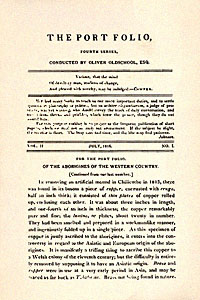
If we went over to Pittsburgh, in 1812, I'll agree that there was literature available.

Image
http://www.sidneyrigdon.com/dbroadhu/PA/pennmag1.htm
http://www.sidneyrigdon.com/dbroadhu/PA ... htm#P6-220

In Conneaut, in 1812, I doubt that most folks could have afforded a new comb,
let alone a new book, mailed out from Buffalo or some such place.

A few newspapers did circulate, though. Occasionally they serialized something
by Sir Walter Scott or another European novelist.

Up until the day that the newspaper was needed for more important use,
it probably went through the hands of numerous readers.

That was literature on the Ohio frontier in 1812.

UD
-- the discovery never seems to stop --
Post Reply