The religious experience vs. the experience of reality

The catch-all forum for general topics and debates. Minimal moderation. Rated PG to PG-13.
Post Reply
_Runtu
_Emeritus
Posts: 16721
Joined: Sun Nov 05, 2006 5:06 am

Re: The religious experience vs. the experience of reality

Post by _Runtu »

mfbukowski wrote:Well I am not saying it is not "Phenomenological". Perhaps the problem is that it is "unspeakable" as Wittgenstein would say.

I am not about to say that an experience which can change your life is not "real".


That which is unspeakable is meaningless. By interpreting the spiritual experience, you have already spoken.

You are shoveling snow and suddenly feel a deep crushing pain in your chest.

Oh well, it's only subjective. Probably a hallucination.

After all, one should not take subjective experience as something "real".


I love it when others make my point for me. That deep crushing pain in your chest doesn't mean anything unless you understand that pain is usually a result of something very wrong. If you didn't understand what pain was, you'd obviously be uncomfortable, even in agony, but you wouldn't know why--even in a basic sense--or what to do about it.

That you would know to go to the ER means that the pain has a context, which you understand, and that you have properly interpreted it as pain and something to take care of.

Yes, you might go to the ER and have it "cross-checked"- but why bother? Just one of those pesky feelings I guess. It would be irrational to act upon it.


Not irrational at all. The feelings have meaning because of context and experience. Same with spiritual experiences. How they are interpreted and acted upon depends entirely on context: we have to be told what they mean and what to do with them.

But I do recognize the reality of the problem. It was one of those things which Wittgenstein just left to the "unspeakable" and that may be the only solution until another one comes along.


I don't believe there is anything that is entirely unspeakable, which to me suggests complete detachment from language and context.

Dunno if everyone here is up to speed on Witt on religion- but this is not a bad article.

http://www.infidels.org/library/modern/ ... stein.html


I'll have to check it out.
Runtu's Rincón

If you just talk, I find that your mouth comes out with stuff. -- Karl Pilkington
_mfbukowski
_Emeritus
Posts: 1202
Joined: Thu Jan 28, 2010 9:35 pm

Re: The religious experience vs. the experience of reality

Post by _mfbukowski »

Runtu wrote:
I would. Perception involves processing and interpreting stimuli and information. Dreams don't mean anything until and unless one interprets them; otherwise, they are just random streams of meaningless stimuli. ....

Taking stimuli (images, smells, words, thoughts) and structuring them into something meaningful is a creative act, so in a sense, the making of meaning is an act of fiction writing.

We've gone back and forth on this before. You seem to think that there's some class of experience that exists outside of interpretation, outside of context. I can't think of a single human experience that does.


Yes, I am aware of all this, and ordinarily I would applaud the approach, but lately it just seems to me that there is something lacking here.

I am re-reading Rorty's "Contingency Irony and Solidarity" right now- and I have always championed Rorty- who is right in there with the position you are taking- but I am really starting to think that he is a off on this point especially when looking at the problem of the "self". I think the question is parallel to what we are discussing- I think that if all experience is essentially linguistic, as Rorty asserts, we also lose the "self" with the notion of an incommunicable experience.

I would ultimately return to a Wittgensteinian position which would put all of these private experiences- for lack of a better term- into the category of the "unspeakable", hence his position on private language. That view lacks some clarity, but I think it is ultimately an unassailable shelter for my position. The solution is not speaking of private experience philosophically and leaving it to the poets. It is I think the ultimate triumph of mysticism.

But I still want to talk about that and it feels like that is not the whole answer.

I think there is a middle ground somewhere and that is perhaps what I am struggling to find. Maybe that is an illusion, but it is good to finally be talking about SOMETHING- first time in my entire forum experience where I may acknowledge that I have something to learn.

But jumping from experience to the "self"-- what of the experience of "organizing" or "interpreting" itself?

What do your semiotics guys say about that?

If we are nothing more than bundles of vocabularies- as Rorty might actually say, who or what is it that is doing the interpreting- and as this thread shows, interpreting the same data in a way different from others?

Who or what is it that stares at the screen composing just the "right" sentence to convey "what is in my head" and who or what is it that knows when you have it "right"?? How do you yourself know that a given sentence is what your yourself "mean to say"? Who is it that is making that decision?

"Do ya unnahstan' what I'm sayin''?"

What is it that feels satisfied when you get the sentence to say "what you want" - and what does that even mean on your view?

I don't think you can answer that.

People around here think that I believe nothing is "real"- (not true) but telling them that they don't have a "self"- I think that would be an even harder sell.
_Runtu
_Emeritus
Posts: 16721
Joined: Sun Nov 05, 2006 5:06 am

Re: The religious experience vs. the experience of reality

Post by _Runtu »

mfbukowski wrote:Yes, I am aware of all this, and ordinarily I would applaud the approach, but lately it just seems to me that there is something lacking here.

I am re-reading Rorty's "Contingency Irony and Solidarity" right now- and I have always championed Rorty- who is right in there with the position you are taking- but I am really starting to think that he is a off on this point especially when looking at the problem of the "self". I think the question is parallel to what we are discussing- I think that if all experience is essentially linguistic, as Rorty asserts, we also lose the "self" with the notion of an incommunicable experience.


As I discussed in my overly obtuse series on postmodernism, the notion of the self is ideologically based; it is a way of seeing human consciousness in the world. If experience is linguistic (or poetic, as the poststructuralists would say), there is no such thing as incommunicable experience; all experience requires the ordering and interpretation of stimuli, or nothing means anything. On a very basic level, what you may not be able to express to someone else is still linguistic because you are expressing it to yourself. You understand what you mean, not because you have access to pre-linguistic "incommunicable experience" but because you know how to structure your experience and interpret it.

I would ultimately return to a Wittgensteinian position which would put all of these private experiences- for lack of a better term- into the category of the "unspeakable", hence his position on private language.


That's not far off from my position. Where we differ, I think, is that you see something special (for want of a better word) in private experience, whereas I recognize that even the most private "ineffable" experience is still linguistic in nature and thus can never be entirely private or subjective.

That view lacks some clarity, but I think it is ultimately an unassailable shelter for my position. The solution is not speaking of private experience philosophically and leaving it to the poets. It is I think the ultimate triumph of mysticism.


I can't see why that's an unassailable shelter for your position. Mysticism, poetry, intuition--all of that is still linguistic in nature.

I think where we're hitting the wall is that you want a clear boundary between the self and everything else, but there really is no distinct line. What I think and feel and experience is inextricably bound to everything around me. If I recall correctly, Foucault spoke of reality being a net woven out of language; we want to think we're a definite spot with an inside and outside, but really, we are just part of the net.

But I still want to talk about that and it feels like that is not the whole answer.

I think there is a middle ground somewhere and that is perhaps what I am struggling to find. Maybe that is an illusion, but it is good to finally be talking about SOMETHING- first time in my entire forum experience where I may acknowledge that I have something to learn.


Not me, man. I have nothing left to learn. :)

But jumping from experience to the "self"-- what of the experience of "organizing" or "interpreting" itself?

What do your semiotics guys say about that?

If we are nothing more than bundles of vocabularies- as Rorty might actually say, who or what is it that is doing the interpreting- and as this thread shows, interpreting the same data in a way different from others?


What we think and feel and interpret depends on the broader linguistic horizon around us. That our experience--our place in the net--is different does not suggest that we are immune from the act of structuring and organizing the world around us.

You seem to want to define the limits between the self and whatever else is out there. I don't have much interest in that because it always goes back to an ever-receding origin. The more I think "this is me," the more I realize that "me" incorporates all kinds of things that I would like to think are outside of me.

Who or what is it that stares at the screen composing just the "right" sentence to convey "what is in my head" and who or what is it that knows when you have it "right"?? How do you yourself know that a given sentence is what your yourself "mean to say"? Who is it that is making that decision?

"Do ya unnahstan' what I'm sayin''?"

What is it that feels satisfied when you get the sentence to say "what you want" - and what does that even mean on your view?

I don't think you can answer that.

People around here think that I believe nothing is "real"- (not true) but telling them that they don't have a "self"- I think that would be an even harder sell.


Oh, I'm not going to say that the self doesn't exist, but from where I sit, it's next to impossible to define the limits of the self. To have a productive discussion about what it means to have a "self," you would have to define where the self begins and ends, and I don't think anyone can do that.
Runtu's Rincón

If you just talk, I find that your mouth comes out with stuff. -- Karl Pilkington
_mfbukowski
_Emeritus
Posts: 1202
Joined: Thu Jan 28, 2010 9:35 pm

Re: The religious experience vs. the experience of reality

Post by _mfbukowski »

Runtu wrote:Oh, I'm not going to say that the self doesn't exist, but from where I sit, it's next to impossible to define the limits of the self. To have a productive discussion about what it means to have a "self," you would have to define where the self begins and ends, and I don't think anyone can do that.

Just off the top of my head then I think - and I may be talking myself into a corner- there has to be a "cogito" experience in there somewhere.

I haven't decided that I would want to argue that one or not.

Kind of a "what it's like to be me" experience. I know you will say that is linguistic- I am not saying you would be wrong

But back to Fales- does that make it a "perception"? You will say "yes" but at some point it becomes vacuous because you are defining the word "perception" to include it.

Can I see your "self" please? Certainly it is not observable to others.
_Facsimile 3
_Emeritus
Posts: 113
Joined: Tue Feb 16, 2010 4:20 am

Re: The religious experience vs. the experience of reality

Post by _Facsimile 3 »

mfbukowski wrote:
Runtu wrote:
I would. Perception involves processing and interpreting stimuli and information. Dreams don't mean anything until and unless one interprets them; otherwise, they are just random streams of meaningless stimuli. ....

Taking stimuli (images, smells, words, thoughts) and structuring them into something meaningful is a creative act, so in a sense, the making of meaning is an act of fiction writing.

We've gone back and forth on this before. You seem to think that there's some class of experience that exists outside of interpretation, outside of context. I can't think of a single human experience that does.


Yes, I am aware of all this, and ordinarily I would applaud the approach, but lately it just seems to me that there is something lacking here.

I am re-reading Rorty's "Contingency Irony and Solidarity" right now- and I have always championed Rorty- who is right in there with the position you are taking- but I am really starting to think that he is a off on this point especially when looking at the problem of the "self". I think the question is parallel to what we are discussing- I think that if all experience is essentially linguistic, as Rorty asserts, we also lose the "self" with the notion of an incommunicable experience.

I would ultimately return to a Wittgensteinian position which would put all of these private experiences- for lack of a better term- into the category of the "unspeakable", hence his position on private language. That view lacks some clarity, but I think it is ultimately an unassailable shelter for my position. The solution is not speaking of private experience philosophically and leaving it to the poets. It is I think the ultimate triumph of mysticism.

But I still want to talk about that and it feels like that is not the whole answer.

I think there is a middle ground somewhere and that is perhaps what I am struggling to find. Maybe that is an illusion, but it is good to finally be talking about SOMETHING- first time in my entire forum experience where I may acknowledge that I have something to learn.

But jumping from experience to the "self"-- what of the experience of "organizing" or "interpreting" itself?

What do your semiotics guys say about that?

If we are nothing more than bundles of vocabularies- as Rorty might actually say, who or what is it that is doing the interpreting- and as this thread shows, interpreting the same data in a way different from others?

Who or what is it that stares at the screen composing just the "right" sentence to convey "what is in my head" and who or what is it that knows when you have it "right"?? How do you yourself know that a given sentence is what your yourself "mean to say"? Who is it that is making that decision?

"Do ya unnahstan' what I'm sayin''?"

What is it that feels satisfied when you get the sentence to say "what you want" - and what does that even mean on your view?

I don't think you can answer that.

People around here think that I believe nothing is "real"- (not true) but telling them that they don't have a "self"- I think that would be an even harder sell.


We have much to discuss.

"Character is the interpenetration of habits. If each habit existed in an insulated compartment and operated without affecting or being effected by others, character could not exist. That is, conduct would lack unity being only a juxtaposition of disconnected reactions to separated situations."

John Dewey
Toadie to Jr. Apologists.
_mfbukowski
_Emeritus
Posts: 1202
Joined: Thu Jan 28, 2010 9:35 pm

Re: The religious experience vs. the experience of reality

Post by _mfbukowski »

MrStakhanovite wrote:Evan Fales from University of Iowa is one of the topic thinkers in Religious Epsitemology was often the one invited to comment on papers given by Alvin Plantinga and wrote a book that in all probability, will become a standard read for Anglophone Philosophy's treatment of mystcism.

But hey, he don't get it, because a spiritual experince isn't Phenomenological.


Right.

I am not impressed by arguments from Authority.

This is a dangerous attitude for a young philosopher. You need to be out there slaying dragons instead of letting them cover you with their wings.
_Runtu
_Emeritus
Posts: 16721
Joined: Sun Nov 05, 2006 5:06 am

Re: The religious experience vs. the experience of reality

Post by _Runtu »

mfbukowski wrote:Just off the top of my head then I think - and I may be talking myself into a corner- there has to be a "cogito" experience in there somewhere.


Sure, but it's kind of hopeless trying to separate the subjective from the objective. Where is the line between you and the rest of the world?

I haven't decided that I would want to argue that one or not.

Kind of a "what it's like to be me" experience. I know you will say that is linguistic- I am not saying you would be wrong


Because I wouldn't be wrong. ;-)

To save time, I'll just quote one of my earlier posts:

Jacques Lacan sees the individual person as a signifier whose identity is established only because it is not everything else around it. A child learns its identity by becoming part of the symbolic order, by learning its relationship to language. As Terry Eagleton summarizes, "Language is 'empty' because it is just an endless process of difference and absence: instead of being able to possess anything in its fullness, the child will now simply move from one signifier to another, along a linguistic chain which is potentially infinite...; but no object or person can ever be fully 'present' in this chain, because as we have seen with Derrida its effect is to divide and differentiate all identities." So, even the "I," the subject, is just a signifier that cannot express something "fully present." Lacan turns Descartes's famous statement on its head: "I am not where I think, and I think where I am not." Even the unconscious, Lacan argues, is a projection of linguistic processes, not some primeval form of "me."


We understand "what it's like to be me" because we have become part of the "symbolic order" and have defined ourselves in terms of our place within that order.

But back to Fales- does that make it a "perception"? You will say "yes" but at some point it becomes vacuous because you are defining the word "perception" to include it.


I'm not sure what "it" refers to in your statement. I'll venture a guess: to me, perception involves interpretation. I keep getting the feeling that you believer that there is some sort of prelinguistic, uninterpreted "perception" that only individuals have access to. That sounds suspiciously like the notion of "raw feels." These "feels" may exist, but they do not mean anything until they are interpreted.

Can I see your "self" please? Certainly it is not observable to others.


Well, there is that swimsuit photo of me floating around out there. :-)

I guess I'm wondering how you define the self. What is uniquely and exclusively you and independent of the broader symbolic systems? What do you experience alone that is not affected by the broader system?
Runtu's Rincón

If you just talk, I find that your mouth comes out with stuff. -- Karl Pilkington
_Facsimile 3
_Emeritus
Posts: 113
Joined: Tue Feb 16, 2010 4:20 am

Re: The religious experience vs. the experience of reality

Post by _Facsimile 3 »

Runtu,

Perhaps the reason why your semiotics seems so hard to swallow is because Pragmatism under Peirce also embarked down a path of Semiotics that was contemporary but different than the Semiotics of Ferdinand de Saussure (Peirce's was not based in linguistics).

One of the things that Pragmatists rejected when they went on one of their A priori killing sprees was the notion from British empiricism that images are a given observation. With the image theory thrown out the window Peirce replaced it with signs.

Peirce thought that our minds continued to rapidly develop symbols until they finally terminated into an action. And there are some symbols culturally that are institutionalized. For example, a weather vein being associated with wind.

But there is still tons of room for the mind to continually whip out infinite amounts of symbols that really have no hope for being institutionalized because they are so "personal." Or as Wittgenstein might say it "things that could never be experienced in the 3rd person."

All the pragmatists picked up at some level or another on Peirce's semiotics.

"With the animals, an experience perishes as it happens, and each new doing or suffering stands alone. But man lives in a world where each occurrence is charged with echoes and reminiscences of what has gone before, where each event is a reminder of other things. Hence he lives not, like the beasts of the field, in a world of merely physical things but in a world of signs and symbols. A stone is not merely hard, a thing into which one bumps; but it is a monument of a deceased ancestor. A flam is not merely something which warms or burns, but is a symbol of the enduring life of the household, or the abiding source of cheer, nourishment and shelter to which a man returns from his casual wanderings. Instead of being a quick fork of fire which may sting and hurt, it is the hearth at which one worships and for which one fights. And all this which marks the difference between bestiality and humanity, between culture and merely physical nature, is because man remembers, preserving and recording his experiences."

John Dewey

A Wikipedia entry on Peirce's Semiotics:

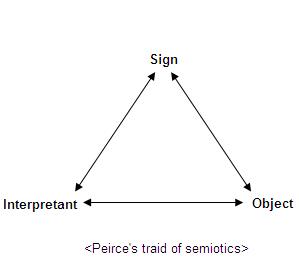
Charles Sanders Peirce (1839–1914), a notable logician who founded philosophical pragmatism, defined semiosis as an irreducibly triadic process wherein something, as an object, logically determines or influences something as a sign to determine or influence something as an interpretation or interpretant, itself a sign, thus leading to further interpretants. Semiosis is logically structured to perpetuate itself. The object can be quality, fact, rule, or even fictional (Hamlet), and can be (1) immediate to the sign, the object as represented in the sign, or (2) dynamic, the object as it really is, on which the immediate object is founded. The interpretant can be (1) immediate to the sign, all that the sign immediately expresses, such as a word's usual meaning; or (2) dynamic, such as a state of agitation; or (3) final or normal, the ultimate ramifications of the sign about its object, to which inquiry taken far enough would be destined and with which any actual interpretant can at most coincide. His semiotic covered not only artificial, linguistic, and symbolic signs, but also semblances such as kindred sensible qualities, and indices such as reactions. He came circa 1903 to classify any sign by three interdependent trichotomies, intersecting to form ten (rather than 27) classes of sign. Signs also enter into various kinds of meaningful combinations; Peirce covered both semantic and syntactical issues in his speculative grammar. He regarded formal semiotic as logic per se and part of philosophy; as also encompassing study of arguments (hypothetical, deductive, and inductive) and inquiry's methods including pragmatism; and as allied to but distinct from logic's pure mathematics.


Here is what a Peircean Triad looks like:

Image
http://csmt.uchicago.edu/glossary2004/semiotics.htm

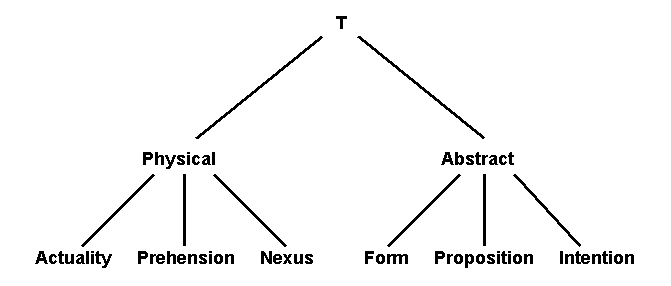
On a side note for MFB this is what a Peircean Triad looks like for Whitehead:

Image
http://www.jfsowa.com/pubs/signproc.htm
Toadie to Jr. Apologists.
_Runtu
_Emeritus
Posts: 16721
Joined: Sun Nov 05, 2006 5:06 am

Re: The religious experience vs. the experience of reality

Post by _Runtu »

Facsimile 3 wrote:Runtu,

Perhaps the reason why your semiotics seems so hard to swallow is because Pragmatism under Peirce also embarked down a path of Semiotics that was contemporary but different than the Semiotics of Ferdinand de Saussure (Peirce's was not based in linguistics).

One of the things that Pragmatists rejected when they went on one of their A priori killing sprees was the notion from British empiricism that images are a given observation. With the image theory thrown out the window Peirce replaced it with signs.

Peirce thought that our minds continued to rapidly develop symbols until they finally terminated into an action. And there are some symbols culturally that are institutionalized. For example, a weather vein being associated with wind.

But there is still tons of room for the mind to continually whip out infinite amounts of symbols that really have no hope for being institutionalized because they are so "personal." Or as Wittgenstein might say it "things that could never be experienced in the 3rd person."


I understand what you're getting at, but I'm not really talking about institutionalized meaning as opposed to personal meaning. Both are acts of interpretation, which involves structuring symbols, prioritizing them, so that they mean something. It really doesn't matter what can be said in the third person or not because it's all being said on some level. And for something to be said or interpreted, there must exist some larger symbolic system. That to me is the insurmountable problem with Mark's position: you never can get outside of that system.

Maybe I'm just approaching this from a different perspective, but I'm still not seeing why you guys seem to privilege private acts of interpretation from social or communal acts as if the private is somehow more pristine than the public.

All the pragmatists picked up at some level or another on Peirce's semiotics.

"With the animals, an experience perishes as it happens, and each new doing or suffering stands alone. But man lives in a world where each occurrence is charged with echoes and reminiscences of what has gone before, where each event is a reminder of other things. Hence he lives not, like the beasts of the field, in a world of merely physical things but in a world of signs and symbols. A stone is not merely hard, a thing into which one bumps; but it is a monument of a deceased ancestor. A flame is not merely something which warms or burns, but is a symbol of the enduring life of the household, or the abiding source of cheer, nourishment and shelter to which a man returns from his casual wanderings. Instead of being a quick fork of fire which may sting and hurt, it is the hearth at which one worships and for which one fights. And all this which marks the difference between bestiality and humanity, between culture and merely physical nature, is because man remembers, preserving and recording his experiences."

John Dewey


This is nicely said, and it echoes what I've been saying.

A Wikipedia entry on Peirce's Semiotics:

Charles Sanders Peirce (1839–1914), a notable logician who founded philosophical pragmatism, defined semiosis as an irreducibly triadic process wherein something, as an object, logically determines or influences something as a sign to determine or influence something as an interpretation or interpretant, itself a sign, thus leading to further interpretants. Semiosis is logically structured to perpetuate itself. The object can be quality, fact, rule, or even fictional (Hamlet), and can be (1) immediate to the sign, the object as represented in the sign, or (2) dynamic, the object as it really is, on which the immediate object is founded. The interpretant can be (1) immediate to the sign, all that the sign immediately expresses, such as a word's usual meaning; or (2) dynamic, such as a state of agitation; or (3) final or normal, the ultimate ramifications of the sign about its object, to which inquiry taken far enough would be destined and with which any actual interpretant can at most coincide. His semiotic covered not only artificial, linguistic, and symbolic signs, but also semblances such as kindred sensible qualities, and indices such as reactions. He came circa 1903 to classify any sign by three interdependent trichotomies, intersecting to form ten (rather than 27) classes of sign. Signs also enter into various kinds of meaningful combinations; Peirce covered both semantic and syntactical issues in his speculative grammar. He regarded formal semiotic as logic per se and part of philosophy; as also encompassing study of arguments (hypothetical, deductive, and inductive) and inquiry's methods including pragmatism; and as allied to but distinct from logic's pure mathematics.


Here is what a Peircean Triad looks like:

Image
http://csmt.uchicago.edu/glossary2004/semiotics.htm


I'm familiar with Peirce.

On a side note for MFB this is what a Peircean Triad looks like for Whitehead:

Image
http://www.jfsowa.com/pubs/signproc.htm


I don't think we're that far apart. My disagreement with Mark is pretty basic:

What kinds of experience exist outside of the symbolic system?

What experience can we have that is immediate and does not require interpretation?

Is there any form of nonlinguistic interpretation?

What part of us is the "self" that is not bound up by the linguistic/symbolic system within which we operate?
Runtu's Rincón

If you just talk, I find that your mouth comes out with stuff. -- Karl Pilkington
_mfbukowski
_Emeritus
Posts: 1202
Joined: Thu Jan 28, 2010 9:35 pm

Re: The religious experience vs. the experience of reality

Post by _mfbukowski »

Runtu wrote:Sure, but it's kind of hopeless trying to separate the subjective from the objective. Where is the line between you and the rest of the world?

Wherever the line is, I am sure it is pre-linguistic, or at least so basic and primitive that one would have to stretch the definition of "language" to the point of including ANY interaction between the organism and the environment, which surely then would include animals interacting with one another.

Could one say about a dog that he "experienced" cruel treatment, which caused him to be vicious? I think so. And that would be a pre-linguistic "experience".

"This rock has experienced wind erosion"

??

Whitehead would include that as "experience" though I am not horribly comfortable with that.

But- I think that it can be safely said that babies have in-utero "experiences" which are pre-linguistic- at least I would define them as such.

http://www.birthpsychology.com/lifebefore/earlymem.html

I am growing stronger in my belief that experience is prior in some way to language.
Post Reply