The religious experience vs. the experience of reality

The catch-all forum for general topics and debates. Minimal moderation. Rated PG to PG-13.
Post Reply
_Runtu
_Emeritus
Posts: 16721
Joined: Sun Nov 05, 2006 5:06 am

Re: The religious experience vs. the experience of reality

Post by _Runtu »

mfbukowski wrote:I am growing stronger in my belief that experience is prior in some way to language.


Of course experience is prior to language, but it doesn't mean anything until it's interpreted. As you mentioned earlier, you can experience chest pains, and you know something is wrong. And you might know enough to go to the ER.

But how do you know what pain means? You interpret, which requires language.

This really isn't that hard, is it?

ETA: Perhaps a better way of saying what I mean is to ask where is the dividing line between perception and interpretation? Can I see something or hear something or taste or smell something without interpreting it? Is it possible to experience something as pure experience without interpreting it? I don't think so.
Runtu's Rincón

If you just talk, I find that your mouth comes out with stuff. -- Karl Pilkington
_mfbukowski
_Emeritus
Posts: 1202
Joined: Thu Jan 28, 2010 9:35 pm

Re: The religious experience vs. the experience of reality

Post by _mfbukowski »

Facsimile 3 wrote:Runtu,

Perhaps the reason why your semiotics seems so hard to swallow is because Pragmatism under Peirce also embarked down a path of Semiotics that was contemporary but different than the Semiotics of Ferdinand de Saussure (Peirce's was not based in linguistics).

One of the things that Pragmatists rejected when they went on one of their A priori killing sprees was the notion from British empiricism that images are a given observation. With the image theory thrown out the window Peirce replaced it with signs.

Peirce thought that our minds continued to rapidly develop symbols until they finally terminated into an action. And there are some symbols culturally that are institutionalized. For example, a weather vein being associated with wind.

But there is still tons of room for the mind to continually whip out infinite amounts of symbols that really have no hope for being institutionalized because they are so "personal." Or as Wittgenstein might say it "things that could never be experienced in the 3rd person."

All the pragmatists picked up at some level or another on Peirce's semiotics.

"With the animals, an experience perishes as it happens, and each new doing or suffering stands alone. But man lives in a world where each occurrence is charged with echoes and reminiscences of what has gone before, where each event is a reminder of other things. Hence he lives not, like the beasts of the field, in a world of merely physical things but in a world of signs and symbols. A stone is not merely hard, a thing into which one bumps; but it is a monument of a deceased ancestor. A flam is not merely something which warms or burns, but is a symbol of the enduring life of the household, or the abiding source of cheer, nourishment and shelter to which a man returns from his casual wanderings. Instead of being a quick fork of fire which may sting and hurt, it is the hearth at which one worships and for which one fights. And all this which marks the difference between bestiality and humanity, between culture and merely physical nature, is because man remembers, preserving and recording his experiences."

John Dewey

A Wikipedia entry on Peirce's Semiotics:

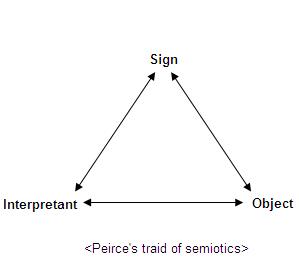
Charles Sanders Peirce (1839–1914), a notable logician who founded philosophical pragmatism, defined semiosis as an irreducibly triadic process wherein something, as an object, logically determines or influences something as a sign to determine or influence something as an interpretation or interpretant, itself a sign, thus leading to further interpretants. Semiosis is logically structured to perpetuate itself. The object can be quality, fact, rule, or even fictional (Hamlet), and can be (1) immediate to the sign, the object as represented in the sign, or (2) dynamic, the object as it really is, on which the immediate object is founded. The interpretant can be (1) immediate to the sign, all that the sign immediately expresses, such as a word's usual meaning; or (2) dynamic, such as a state of agitation; or (3) final or normal, the ultimate ramifications of the sign about its object, to which inquiry taken far enough would be destined and with which any actual interpretant can at most coincide. His semiotic covered not only artificial, linguistic, and symbolic signs, but also semblances such as kindred sensible qualities, and indices such as reactions. He came circa 1903 to classify any sign by three interdependent trichotomies, intersecting to form ten (rather than 27) classes of sign. Signs also enter into various kinds of meaningful combinations; Peirce covered both semantic and syntactical issues in his speculative grammar. He regarded formal semiotic as logic per se and part of philosophy; as also encompassing study of arguments (hypothetical, deductive, and inductive) and inquiry's methods including pragmatism; and as allied to but distinct from logic's pure mathematics.


Here is what a Peircean Triad looks like:

Image
http://csmt.uchicago.edu/glossary2004/semiotics.htm

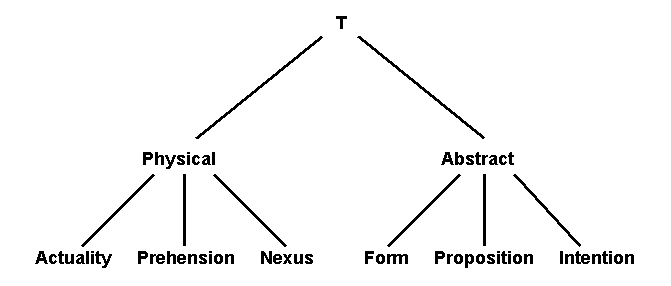
On a side note for MFB this is what a Peircean Triad looks like for Whitehead:

Image
http://www.jfsowa.com/pubs/signproc.htm

I have never been into Peirce, as you know- and now dang, dude- you understand him better than I do!

Thanks for this!
_mfbukowski
_Emeritus
Posts: 1202
Joined: Thu Jan 28, 2010 9:35 pm

Re: The religious experience vs. the experience of reality

Post by _mfbukowski »

Runtu wrote:Of course experience is prior to language, but it doesn't mean anything until it's interpreted. As you mentioned earlier, you can experience chest pains, and you know something is wrong. And you might know enough to go to the ER.

But how do you know what pain means? You interpret, which requires language.


Meh....

My point here was to show that "subjective experience" is indeed important to our lives, so you are taking it a bit out of context, methinks. It was contra the position that subjective experience was somehow worthless and irrational to rely on.

I really think that when you hit your thumb with a hammer, it requires no language or interpretation to "experience" it. I am fairly certain that in most cases, however, a linguistic explosion is virtually guaranteed after the experience itself.

I have actually described a spiritual experience as "getting spiritually whupped upside the head by a two-by-four", so for me, the metaphor is apt.
_Runtu
_Emeritus
Posts: 16721
Joined: Sun Nov 05, 2006 5:06 am

Re: The religious experience vs. the experience of reality

Post by _Runtu »

mfbukowski wrote:Meh....

My point here was to show that "subjective experience" is indeed important to our lives, so you are taking it a bit out of context, methinks. It was contra the position that subjective experience was somehow worthless and irrational to rely on.


I don't recall ever having taken that position. What I have said is that there is absolutely no reason to privilege subjective experience as "unassailable" and inherently different or superior to any other experience.

I really think that when you hit your thumb with a hammer, it requires no language to experience it. I am fairly certain that in most cases, however, a linguistic explosion is virtually guaranteed after the experience itself.

I have actually described a spiritual experience as "getting spiritually whupped upside the head by a two-by-four", so for me, the metaphor is apt.


How did you know it was a spiritual experience? How did you determine that it was, actually, God or the Holy Ghost speaking to you?

Like it or not, you interpreted that experience, gave it a context, assigned a meaning to it.
Runtu's Rincón

If you just talk, I find that your mouth comes out with stuff. -- Karl Pilkington
_mfbukowski
_Emeritus
Posts: 1202
Joined: Thu Jan 28, 2010 9:35 pm

Re: The religious experience vs. the experience of reality

Post by _mfbukowski »

Runtu wrote:
I understand what you're getting at, but I'm not really talking about institutionalized meaning as opposed to personal meaning. Both are acts of interpretation, which involves structuring symbols, prioritizing them, so that they mean something. It really doesn't matter what can be said in the third person or not because it's all being said on some level. And for something to be said or interpreted, there must exist some larger symbolic system. That to me is the insurmountable problem with Mark's position: you never can get outside of that system.

Maybe I'm just approaching this from a different perspective, but I'm still not seeing why you guys seem to privilege private acts of interpretation from social or communal acts as if the private is somehow more pristine than the public.


Well that is an excellent question, one of which I am now re-evaluating with my reading of Rorty.

It's funny- as a young student radical atheist commie pinko yippie I had no problem with what he was saying, but now being LDS and all I see it with a different perspective. I still think he is right, but for different reasons than I did then and he is helping me to sort out this whole question of the contingency of language and of the self.

The way he discusses Nietzsche and the death of God is fascinating, because now I see it all as the "death of the Neo-Platonic God" and the birth of a God who is human with the Restoration. That all becomes pretty interesting stuff in the context of Nietzsche.

So it may be that ultimately I agree with you and figure out that it is not necessary for my position to contend for the inexpressibility of spiritual experience.

But I still believe that is the way it "happens" regardless of how the logic relates to the system- it may not be necessary for me to contend for it- but I still believe it is true.

The key for me is Wittgenstein and how willing I am to keep spiritual experience "unspeakable".

It is also kind of funny to read Rorty though because it seems that he doesn't realize that Wittgenstein was a life-long devout Roman Catholic.

How could you not know that- and BE Rorty the Magnificent?
_Facsimile 3
_Emeritus
Posts: 113
Joined: Tue Feb 16, 2010 4:20 am

Re: The religious experience vs. the experience of reality

Post by _Facsimile 3 »

I really don't think the 3 of us really disagree on this. It really seems like the 3 of us are just giving different sides of the same elephant.

This all comes down to language games. How are defining "experience" and "linguistic."

I think for Whitehead "experience" would tie into William James's concept of "emotions."

An emotion for William James is the behavior. The feeling of fear is the physiological things the body is doing when it feels fear. So for James pondering on the word fear or even seeing someone express the outward emotions of fear would not bring to you the 1st person fear experience.

A basic example. A person hiking in the woods sees a tree trunk that from far away looks like a bear and has a full body reaction of the behavior/ emotion.

Add in Whitehead and you get. A person hiking in the woods sees a tree trunk that from far away looks like a bear and has a full body reaction of the experience (behavior) fear.

Another James / Whitehead example.

You are sitting at a table eating lunch and you begin to experience something (behave/ have an emotion) in such a way that causes you to reason in some kind of constructed system of signs or language that someone has been watching you for sometime. You ask the person you are at the table with if this is true and he confirms it.

Experience or Emotion would come before signs or language in this case.

On a side note. I would have to disagree with Dewey that only humans understand signs. It seems perfectly plausible that dogs would. How else would we be able to train them with hand signals. Also, how would an abused dog know to cower when someone raises their hand in the face slapping position.

So I guess what I am trying to say is that even though in one language game behavior alone is seen as no evidence for mystical experience, I think in James case and then extending the same meaning to Whitehead you would get a safe haven and respectable shelter for mystical experience.

The anti Mormon might say, "well your mystical experience is really just a physiological behavior" and you could easily say, I know, isn't it amazing. And both of you would feel like you were validated. Wittgenstein is totally right and so is Rorty, crossing language games is impossible.
Toadie to Jr. Apologists.
_Facsimile 3
_Emeritus
Posts: 113
Joined: Tue Feb 16, 2010 4:20 am

Re: The religious experience vs. the experience of reality

Post by _Facsimile 3 »

Runtu wrote:I don't think we're that far apart. My disagreement with Mark is pretty basic:

What kinds of experience exist outside of the symbolic system?

What experience can we have that is immediate and does not require interpretation?

Is there any form of nonlinguistic interpretation?

What part of us is the "self" that is not bound up by the linguistic/symbolic system within which we operate?


Going with the Peirce angle I would say there is non linguistic interpretation, but I'm not sure if we are talking about the same definition for linguistic.

I would go with the symbols leading to other symbols until they terminate in an action as a more basic buliding block in interpretation coming before language.

Unless you are find calling symbols without institutionalized words and grammar language.
Toadie to Jr. Apologists.
_Facsimile 3
_Emeritus
Posts: 113
Joined: Tue Feb 16, 2010 4:20 am

Re: The religious experience vs. the experience of reality

Post by _Facsimile 3 »

mfbukowski wrote:I have never been into Peirce, as you know- and now dang, dude- you understand him better than I do!

Thanks for this!


Peirce is either really right at times or really wrong. But I guess that is bound to happen when you just keep coming up with endless original ideas!
Toadie to Jr. Apologists.
_Runtu
_Emeritus
Posts: 16721
Joined: Sun Nov 05, 2006 5:06 am

Re: The religious experience vs. the experience of reality

Post by _Runtu »

Facsimile 3 wrote:Going with the Peirce angle I would say there is non linguistic interpretation, but I'm not sure if we are talking about the same definition for linguistic.

I would go with the symbols leading to other symbols until they terminate in an action as a more basic buliding block in interpretation coming before language.

Unless you are find calling symbols without institutionalized words and grammar language.


I was specifically thinking of Lacan's ideas about how we become human by becoming part of the symbolic system.
Runtu's Rincón

If you just talk, I find that your mouth comes out with stuff. -- Karl Pilkington
_mfbukowski
_Emeritus
Posts: 1202
Joined: Thu Jan 28, 2010 9:35 pm

Re: The religious experience vs. the experience of reality

Post by _mfbukowski »

Runtu wrote:
mfbukowski wrote:How did you know it was a spiritual experience? How did you determine that it was, actually, God or the Holy Ghost speaking to you?

Like it or not, you interpreted that experience, gave it a context, assigned a meaning to it.

See that's the point of this.

I just knew. And yes I did assign a context to it, but after the fact.

How do you know you just hit your thumb with a hammer?

Then, after it happens, you assign the context and utter the proper expletive.

And you never answered about the other experiences- prenatal and the experiences of animals.

You are good on questions but not so good on answers!
Post Reply