Marg: have you read JOSEPH SMITH THE MAKING OF A PROPHET from DAN VOGEL.
I'm almost done with it now. Some of his thoughts are iffy for me, but some are bull eyes, things I never saw or heard before. He goes through the time Joseph Smith was translating the Book of Mormon. He shows what was going on in the area and what is going on in the book.
I'm trying to find the part where his ancestor Solomon Mack wrote a personal history and started out that he was born of "goodly parents". I didn't see the date he wrote that but the way it is presented it seems that it was prior to the "translation" process.
The Spaulding Fable...over at BCC
-
_karl61
- _Emeritus
- Posts: 2983
- Joined: Sat Aug 11, 2007 6:29 pm
Re: The Spaulding Fable...over at BCC
I want to fly!
-
_marg
Re: The Spaulding Fable...over at BCC
Mikwut wrote:It is interesting to me that you, marg and UD place these wierd, bizarre gateways to dialogue about a purely natural historical question. When history of the United States, political histories, etc.. are commonly discussed in scholarly circles, after I have professed my belief, no such attack of it is considered necessary.
Well Mikwut the difference between that situation and this, is that your beliefs are part and parcel of a theory you subscribe to in this situation. If your beliefs and your methodology for evaluating did not impinge on determining how the Book of Mormon was written then your beliefs would be irrelevant.
When asked where the plates are , you replied that most Mormons believe they were taken away by an angel. That was a dodge of the question, the answer should have been where you think the plates are and I suspect you gave that answer because you see nothing wrong with it and you believe an angel took them away I suppose to a heaven.
No one is stopping you from arguing any theory, and you can argue one which includes the supernatural, but then we rightfully would expect you to apply a consistent standard of proof that you apply to all the data.
As far as your comment that the Smith alone is the best theory, it isn't by a long shot. It doesn't even come close to be adequate as does the S/R theory. It ignores a huge chunk of data without adequate warrant for doing so. And no matter what authority you appeal to, if they promote the Smith alone, they present inadequate warrants for rejecting Spalding witnesses. I've seen Vogel do this, and in Brodie's appendix she too does it. No one has stopped you presenting whatever theory you think is best, but whatever theory you present it better be based on more than just prayer. You probably wonder "why is that?" It is because prayer is not a reliable way of evaluating evidence, of reaching best fit truths to questions.
-
_marg
Re: The Spaulding Fable...over at BCC
At the time I got the book Vogel was participating on this board, and I wasn't impressed with his evaluation process, and it put me off reading it, because I don't trust him as an historian. I know he's a nice guy and all. So I've only looked at portions, particularly when I was interested in one particular thing I would look on occasion what he said, especially if I didn't have another source. So no, let me know your overall assessment.
karl61 wrote:Marg: have you read JOSEPH SMITH THE MAKING OF A PROPHET from DAN VOGEL.
I'm almost done with it now. Some of his thoughts are iffy for me, but some are bull eyes, things I never saw or heard before. He goes through the time Joseph Smith was translating the Book of Mormon. He shows what was going on in the area and what is going on in the book.
I'm trying to find the part where his ancestor Solomon Mack wrote a personal history and started out that he was born of "goodly parents". I didn't see the date he wrote that but the way it is presented it seems that it was prior to the "translation" process.
-
_Uncle Dale
- _Emeritus
- Posts: 3685
- Joined: Wed Feb 07, 2007 7:02 am
Re: The Spaulding Fable...over at BCC
Nevo wrote:...
This is precisely the sort of tenuous "evidence" that the Spalding-Rigdon theory is built on.
...
At least you admit it is "evidence" -- that is a step beyond those Mormons who assert that
there is "Absolutely no evidence to support the Spaulding Lie."
But I just had an idea. --- Let's create a time/distribution graph for all the 19th century claims
for Book of Mormon origins. One point on the graph would be Manchester, 1823 -- another
point on the graph would be Fayette, 1829, etc. etc.
Adding in all the 19th century claims we can locate, on a graph that extends from 1800 to 1830,
(on the x-axis) and covers the area between New England and Ohio (on the y-axis), where
do you suppose that just the CLAIMS for Book of Mormon writing/composition/translating
would cluster?
I'd say that the greatest cluster would occur in Geauga County, Ohio, in 1826-28 -- with
secondary clusters at Harmony, PA and Fayette, NY.
Agreed?
If so -- then what populations of possible "adjacent observers" should we focus our investigative
energies upon? Vermont - 1825??? ... New Jersey - 1829??? ... Maine - 1823???
Since so many authorship claims cluster in Geauga County, Ohio in the late 1820s, ought we
not to spend some time looking there? That is what Clark Braden did, in 1883-84, in preparation
for his Kirtland debate with Elder Kelley. Rev. Braden sent out his assistant, Arthur B. Deming,
to locate and document people who claimed to have recollections of events associated with
early Mormonism.
One of the "hot spots" for Deming's discoveries was Auburn township, Geauga County, Ohio --
with some extension into adjacent Bainbridge township. THAT is where Deming was discovering
people who claimed to know something about early Mormonism, or about Mormon origins.
That is the same "hot spot" of testimony investigated by Carl M. Brewster in the 1940s -- whose
Brewster ancestors lived in Auburn township. Brewster's investigations resulted in his writing
"Did Sidney Rigdon write the Book of Mormon?" in 1945.
http://www.sidneyrigdon.com/books/Brew1945.htm
Unfortunately the main portion of Brewster's historical discoveries are missing from the set of 1945
manuscript pages sold at the E-bay auction on February 26, 2006. From the extant pages of his report,
the following findings and speculations may be outlined:
1. Auburn township, in southern Geauga Co., Ohio, was largely settled by pioneers moving there
during the late 1810s and 1820s, from Ontario County, New York (and from the Palmyra-Manchester
area in particular).
2. A number of these early pioneers were Baptists and there was at an early date a Baptist community
in Auburn, that extended across the Portage Co. boundary into Mantua township. The "Reformed Baptist"
preacher, Rev. Sidney Rigdon, visited among these Auburn-Mantua Baptists during the early 1820s, and
then returned to live within that same community during the winter of 1825-26, at which time he took up
residence in adjacent Bainbridge township (see map above).
3. In the spring of 1826, Joseph Smith, Jr., "in company with a notorious ruffian," arrived in Auburn on a
temporary visit. According to Brewster, Smith and his companion arrived with a party of emigrants
originating in Manchester, Ontario Co., New York.
4. During the early part of 1826, Joseph Smith, Jr. and the Rev. Sidney Rigdon met, first in Auburn and
then again in neighboring Bainbridge. The two men became mutually interested in each other and
Rev. Rigdon accompanied Smith to Pennsylvania, and perhaps also to Ontario Co., New York.
5. Following his return from this trip to the east, Sidney Rigdon completed a thick "religious manuscript"
he had written (or re-written) during the winter of 1825-26. Upon his finishing his writing, Rev. Rigdon took
a "great interest in the Baptists of Auburn... and Mantua" and "made frequent visits to... Aurora [Portage
township bordering Bainbridge]... Auburn... Mantua and Hiram." [The latter is a Portage township
bordering Mantua.]
6. Rigdon then moved north about 30 miles to take up new duties as the pastor of the Baptist congregation
at Mentor, but he continued to visit Auburn, Mantua and Hiram on a frequent basis. He induced two members
of the "Reformed Baptists" in Portage Co. (Darwin Atwater and Zeb Rudolph) to accompany him to Mentor,
where these students became of Rigdon's "strange absences" from that place, as well as his supposed
visits to western New York -- all prior to his conversion to Mormonism in November of 1830.
Professor Brewster make two significant errors in his findings, however. At one point in his extant pages,
he makes the assumption that when Joseph Smith, Jr. allegedly visited Auburn in the spring of 1826, that
he was accompanied by his Manchester friend, Orrin Porter Rockwell, and that the two young men stayed
in Auburn with the family of Rockwell's sister, Emily Rockwell Stafford. However, Emily did not move from
Manchester, New York to Auburn, Ohio until 1831 -- so it is very unlikely that she was living in Ohio as early
as 1826. Brewster's second faulty assumption was that "Rockwell, Smith and Rigdon" could have been
seen together in Auburn, only "several months before the Book of Mormon was readied for the press" in
Palmyra, New York.
Brewster alludes to an 1826 pamphlet written and published by Elder Lawrence Greatrake -- though he
does not mention Greatrake by name. It appears that Brewster located a copy of this 1826 Ohio tract
in the library of Hiram College -- if so, it has disappeared from that library's shelves. Two interesting
allegations were gleaned from Greatrake (or from some contemporary source) 1. That Sidney Rigdon
was then (1826) associating with a glass-looker or "juggler;" and 2. That Auburn, Ohio was the scene
of a money-digging speculation during the mid-1820s. These are my interpretations of ambiguous notes
taken from a cursory inspection of Brewster's unpublished work -- they may be inaccurate. For example,
it may not have been Greatrake who reported the Auburn money-digging episode, but rather the
Geauga Republican of a few years later. If I had the time and resources, I would investigate more
thoroughly Brewsters preserved papers (at Spokane), as well as back-files of Geauga Co. newspapers.
Also this: http://www.sidneyrigdon.com/1826Grtk.htm#1826RBap

Site of Elder Sidney Rigdon's home (1826-27) in Bainbridge Twp., Geauga Co., Ohio
All I can currently do, is to point out logical areas for possible productive research. And my suggestion
is that somebody spend some time studying southwestern Geauga County in the mid-1820s.
UD
-- the discovery never seems to stop --
-
_marg
Re: The Spaulding Fable...over at BCC
Dale wrote: If I had the time and resources, I would investigate more
thoroughly Brewsters preserved papers (at Spokane), as well as back-files of Geauga Co. newspapers.
What would that entail, just wondering I live within driving distance.
-
_Uncle Dale
- _Emeritus
- Posts: 3685
- Joined: Wed Feb 07, 2007 7:02 am
Re: The Spaulding Fable...over at BCC
marg wrote:Dale wrote: If I had the time and resources, I would investigate more
thoroughly Brewsters preserved papers (at Spokane), as well as back-files of Geauga Co. newspapers.
What would that entail, just wondering I live within driving distance.
The Carl M.Brewster Papers are on file at Pullman (not Spokane -- sorry) --
http://www.wsulibs.wsu.edu/holland/masc ... s/cg44.htm
Although the collection guide gives a rough idea what is in each folder and box, the exact
contents are not detailed. The discarded extra pages of his 1945 essay I obtained, were
never in the University collection. They were thrown out before the collection was boxed
and cataloged.
From other Brewster papers obtained along with the pages from his 1945 essay, I
suspect that the final copy of the essay will be filed with his correspondence to his
cousin, Frederick A. Henry --
http://sidneyrigdon.com/books/Hnry1942.htm#comments
Brewster also carried on correspondence with various libraries and individuals, trying to
locate and copy historical information on Sidney Rigdon. Some of that correspondence
should be preserved somewhere in his papers.
My own attempts to follow up on this probable source have been frustrated in several ways.
I get the impression that the library staff at Pullman is not interested in helping researchers
read through these Brewster documents -- and that certain parts of the collection may not
be open to the public.
That's about all I can think of right now.
UD
-- the discovery never seems to stop --
-
_Uncle Dale
- _Emeritus
- Posts: 3685
- Joined: Wed Feb 07, 2007 7:02 am
Re: The Spaulding Fable...over at BCC
Uncle Dale wrote:...
there is a strong tradition in southwestern Geauga County, of local pioneers reporting that Rigdon wrote
the Book of Mormon. This quote is taken from the 1953 second edition:
...
One of the earliest allegations of this sort came from John Henry, an early pioneer in
Bainbridge township, Geauga County, Ohio, whose farm was located about a mile or
two from Rigdon's cabin in 1826-27. John's report was:
Among the many Disciples of Christ, or "Campbellites," on the Western Reserve, who were attracted for
a season into the Mormon fold, Sidney Rigdon stood easily first. Ambitious, erratic, and eloquent, but not
over-scrupulous, he became at once the brains of Mormondom. Grandfather John Henry maintained that he
probably compiled the Book of Mormon while sojourning one winter (1825-1826) in Bainbridge. In his quarters
south of the Center, he seemed always to be writing, sometimes far into the night; and though he
received courteously all who called, he would first lift the lid of his desk and lock his mysterious manuscript
away therein before admitting them.
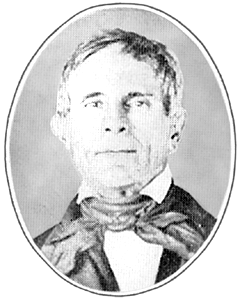
John Henry -- Rigdon's neighbor at Bainbridge.
UD
-- the discovery never seems to stop --
-
_Nevo
- _Emeritus
- Posts: 1500
- Joined: Sat Feb 24, 2007 4:05 pm
Re: The Spaulding Fable...over at BCC
Uncle Dale wrote:The fact that a documented associate of Joseph Smith, and participant in his supernatural claims and activities, lived so close to Sidney Rigdon in the same mid-1820s, is a fact worthy of further study -- and a fact which rebuts Mormon claims that Rigdon and Smith could not possibly have known of each other's existence during that early period.
By "documented associate of Joseph Smith" you mean documented by one source, Pomeroy Tucker, whose recollection may not even be accurate. But assuming for the sake of argument that Gad Stafford did participate in money-digging activities in the mid-1820s with a group of neighbors that included Joseph Smith père and fils, I still don't see how his purchasing land in Auburn in late 1828, after Rigdon had already moved north to Mentor, "rebuts Mormon claims that Rigdon and Smith could not possibly have known of each other's existence during that early period."
Uncle Dale wrote:Traveling two miles east, Rigdon entered Auburn, and almost immediately thereafter encountered farms then being pioneered by recent migrants from the Palmyra-Manchester area of western New York. There was a regular colony of these former New Yorkers residing in "Kirtland," which was the land-office name for Auburn Center. In other words, Rigdon's neighbors on the east were former Smith family neighbors.
I'm guessing there are upwards of a hundred lots shown on the map of Auburn in 1830. What proportion of these were occupied by Palmyra-Manchester residents ca. 1826-27? Were any of these Baptists? Is there any reason to believe that any of them were acquainted with Sidney Rigdon? Assuming the answer to both of these questions is yes, at best this shows that Sidney may have known of Joseph Smith's existence—although I am at a loss to imagine why Joseph Smith's name would ever come up in casual conversation. How close were these "neighbors" to the Smiths? When did they leave the Palmyra-Manchester area?
Uncle Dale wrote:What I am saying, is that the presence of so many previous Smith family neighbors, immediately to the east of Rigdon's 1826-27 residence, adds strength to the claim of George Wilber, saying that Joseph Smith was in the Auburn-Bainbridge area in 1826.
Where can I find Wilber's statement? Is his report firsthand? When did he make his statement? Under what circumstances?
Uncle Dale wrote:When we study that over-all pattern of settlement, we see people like Isaac Butts, moving back and forth between Manchester and Auburn, and knowing BOTH Sidney Rigdon and Joseph Smith in the 1820s.
Do we see anyone other than Isaac Butts who did this, who was acquainted with both Rigdon and Smith? Obviously Sidney didn't hear about Joseph from Butts.
-
_Uncle Dale
- _Emeritus
- Posts: 3685
- Joined: Wed Feb 07, 2007 7:02 am
Re: The Spaulding Fable...over at BCC
Nevo wrote:...
By "documented associate of Joseph Smith" you mean documented by one source, Pomeroy Tucker,
whose recollection may not even be accurate.
By "documented," I mean that Mormons themselves have claimed Gad Stafford as an early associate
of Joseph Smith. Aside from LDS Palmyra historian Willard Bean, we can find the same assertion in
various Mormon writings during the last century. For example, from Sister Carolyn Griffith Hall, in
the Palmyra Courier-Journal of Aug. 6, 1959:
"Many converts were added to the new faith started by Joseph Smith.... Orin Rockwell and Gad Stafford
from Manchester. In all about twenty converts were baptized by Joseph and Oliver."
Ms. Hall links Gad Stafford with Porter Rockwell -- whom nobody denies was a money-digger and then
a Mormon. Rockwell's sister married into the Stafford family. How long she was a Mormon history does
not record -- another sister came to Kirtland with Lucy Mack Smith in 1831 and married Horton Smith,
also of Geauga Co., Ohio. That sister also left the Church. Can we be 100% positive that Gad Stafford
was never baptized -- or 100% that he was baptized? No -- but we can document the baptisms of his
relatives, the Rockwells. That is what I meant by "documented." Documentation may be inconclusive,
but it exists and can be researched.
The Stafford family lived immediately south of the Smiths in Manchester. Their farms were adjoining.
If there were not too many trees in the way, along Stafford Road, they could see each others' houses.
But assuming for the sake of argument that Gad Stafford did participate in money-digging activities
in the mid-1820s with a group of neighbors that included Joseph Smith père and fils, I still don't
see how his purchasing land in Auburn in late 1828, after Rigdon had already moved north to Mentor,
"rebuts Mormon claims that Rigdon and Smith could not possibly have known of each other's existence during
that early period."
Not a total, unequivocal rebuttal -- but that fact keeps the dialog open. It is not shut down by the LDS claims
that Smith and Rigdon had no way of knowing of each other's existence in the 1820s.
I'm guessing there are upwards of a hundred lots shown on the map of Auburn in 1830. What proportion
of these were occupied by Palmyra-Manchester residents ca. 1826-27?
If we include near relatives of Palmyra-Manchester people, and restrict our sample to the Kirtland lot,
I would say half of the settlers within a two mile radius of Auburn Centre had a former Palmyra-Manchester
resident as a member of their family. Perhaps 1/4 to 1/3 of that entire population were from Wayne Co.,
New York or Ontario Co., NY -- mostly from Palmyra-Manchester. I know of no other similar concentration
of such pioneer settlers, until we look at Kirtland Mills in 1831-32.
Kirtland in Auburn had a concentration of Palmyra-Manchester residents, mainly because one of the first
large land-owners there came from Gorham, Ontario Co., NY -- and he sold land to his NY associates.
Were any of these Baptists?
The Butts family (from Manchester) were -- Sidney Rigdon preached at the funeral of Isaac Butts brother (Uriah?)
in 1822.the Harringtons were Baptists -- their farm was the first one Sidney would have come upon, traveling
east into Auburn. They were later prominent in the Geauga Baptist Association. On the far side of Auburn the
Snows were Baptists -- this was Eliza's and Lorenzo's grandfather. There were others, but I do not have my list.
Is there any reason to believe that any of them were acquainted with Sidney Rigdon?
Rigdon was the only only ordained minister in the area for a couple of years. A Methodist circuit rider came
through occasionally -- but Rigdon would have conducted funerals, solemnized marriages, preached sermons,
and baptized any Baptist converts.
Assuming the answer to both of these questions is yes, at best this shows that Sidney may have
known of Joseph Smith's existence—although I am at a loss to imagine why Joseph Smith's name would ever
come up in casual conversation. How close were these "neighbors" to the Smiths? When did they leave the
Palmyra-Manchester area?
Half of the Antisdale family came west just before Joseph Sr. moved his family from Palmyra to Manchester.
The half that remained in New York occupied the farm immediately to the west of the Smiths. The Butts
came with the Antisdales.
Where can I find Wilber's statement? Is his report firsthand? When did he make his statement?
Under what circumstances?
I am still researching that material -- but you can start here:
http://www.sidneyrigdon.com/dbroadhu/OH ... htm#031486
Do we see anyone other than Isaac Butts who did this, who was acquainted with both Rigdon and Smith?
Obviously Sidney didn't hear about Joseph from Butts.
The Rockwells, of course -- but they did not permanently settle in Geauga until 1830 at the earliest.
The Caprons knew Rigdon and the Smiths -- see Henry Capron's statement in Howe and his 1835
meeting with Joseph Smith (while on his way to Auburn to visit his pioneer settler son).
There were others, but I do not have a list.
All I am saying is that here is a topic worthy of some additional research. Van Wagoner decided to pass
over Sidney's residence at Bainbridge and concentrate on his history at Mentor. Mormons have ignored
the story of Sidney at Bainbridge -- even though one of Lorenzo Snow's wives came from Rigdon's
1826 Baptist congregation there. Perhaps an inspection of her preserved papers would be useful --
as would some further research into the Snow family itself.
UD
-- the discovery never seems to stop --
-
_Nevo
- _Emeritus
- Posts: 1500
- Joined: Sat Feb 24, 2007 4:05 pm
Re: The Spaulding Fable...over at BCC
Uncle Dale wrote:3. In the spring of 1826, Joseph Smith, Jr., "in company with a notorious ruffian," arrived in Auburn on a temporary visit. According to Brewster, Smith and his companion arrived with a party of emigrants originating in Manchester, Ontario Co., New York.
4. During the early part of 1826, Joseph Smith, Jr. and the Rev. Sidney Rigdon met, first in Auburn and then again in neighboring Bainbridge. The two men became mutually interested in each other and Rev. Rigdon accompanied Smith to Pennsylvania, and perhaps also to Ontario Co., New York.
All of Joseph Smith's known movements during this period were north-south. No contemporary account mentions any trips east. We have documentary evidence that he was in South Bainbridge, New York on March 20, 1826. Dan Vogel argues, plausibly in my view, that immediately after the March 20th examination Joseph unlawfully crossed the county line into Colesville, presumably to the home of Joseph Knight. Since this was a breach of the conditions of his release (Joseph had been released on his own recognizance to appear at the forthcoming trial), Justice Neely on learning of this issued a mittimus to have Joseph returned to South Bainbridge. Vogel speculates that "upon being returned to South Bainbridge, Smith must have managed to work out an off-the-record agreement with Neely" (Vogel, Joseph Smith: The Making of a Prophet, 85).
Since Sidney Rigdon apparently left on a six-month preaching tour in mid-April this doesn't leave much time for Joseph to have returned to Manchester and then joined a caravan headed to Auburn for a spring 1826 meeting with Rigdon. Rigdon apparently returned to the area in October, but according to Willard Chase (and Joseph himself), Joseph was in Manchester in the fall of 1826.
Significantly, none of Joseph's family members or neighbors reported any extended absence from the Manchester area from his return from South Bainbridge ca. April 1826 (?) to his (second) departure for South Bainbridge in November 1826. David Stafford, in fact, said he worked with Joseph making a coal-pit during this period.
In short, Brewster's chronology doesn't strike me as very promising at all.