The Spaulding Fable...over at BCC

The catch-all forum for general topics and debates. Minimal moderation. Rated PG to PG-13.
Post Reply
_Uncle Dale
_Emeritus
Posts: 3685
Joined: Wed Feb 07, 2007 7:02 am

Re: The Spaulding Fable...over at BCC

Post by _Uncle Dale »

Nevo wrote:...
All of Joseph Smith's known movements during this period were north-south. No contemporary account mentions
any trips east.


We are not talking about trips east -- we are talking about trips west. At his Bainbridge examination before
Judge Neeley, Joseph Smith reportedly related an account of his previous trip west, along the Great Lakes,
to the Pennsylvania panhandle -- to retrieve a seer-stone.

Then, in what must have been the period immediately following the outcome of that examination (in which
several sources say that Smith was compelled/allowed to leave the area to escape sentencing -- John Reed,
who may have been his attorney even as early as 1826, reports that Smith, "had a revelation from God to
go to the west about eighty miles, to his father's, in which neighborhood he should find hid in the earth, an
old history written on golden plates... Joseph Knight, one of the fathers of your church, a worthy man, and
my intimate friend, went with him."

So -- we already see Smith traveling westward (northwestward) in March of 1826 -- ostensibly to Manchester,
in order to recover "an old history." Thurlow Weed (whom Smith subsequently met at Rochester) says that
at this approximate time Smith traveled west: "In 1824 or '5, he went a vagabonding off into Western
Pennsylvania, where, nobody knows how, he got possession of the manuscript"
http://www.sidneyrigdon.com/dbroadhu/NY ... htm#121045

Samuel D. Green, who reports that Smith "Smith knew well the road from Canandaigua to Buffalo," relates that
he came as far west as Batavia in 1826. http://www.sidneyrigdon.com/dbroadhu/IL ... htm#122077

There are other reports of Smith going west at this time (1824-26).

We have documentary evidence that he was in South Bainbridge, New York on March 20, 1826.


True enough -- but where was he on March 21st?

Rev. Ariel McMaster, in the Chicago Inter-Ocean of July 16, 1881, says: "the object of the trial being to compel
him [Smith] to leave the neighborhood, it was arranged that the officer in charge should give him a chance
to escape. His counsel having whispered this in his ear, he embraced the opportunity given, and with the
best strides his long legs could make he betook himself across the fields to the woods, all the crowd roaring
with laughter, to see the great prophet run. This ended his work in Chenango County. He went into
Pennsylvania..." http://www.sidneyrigdon.com/dbroadhu/IL ... htm#071681
But what part of "Pennsylvania" -- Harmony or the panhandle, where he found his seer stone?

According to a citation supplied by D. Michael Quinn in 1998, a daughter of early Mormon Alvah Beaman
made mention of the fact that male members of the Joseph Smith, Sr. family had visited her father's residence
prior to 1828, while "on business." Quinn continues with: "Martin Harris said that prior to 1827, Be(a)man had
'dug for money' with Joseph Sr. at various places in New York state, and Be(a)man's residence in Livonia was
apparently one of those places" (Early Mormonism and the Magic World View, p. 52) -- Quinn also argues that
Joseph, Jr. was likely living with the Beaman family, west of Manchester in the year 1820, when he is missing
from his father's household in the census.

Dan Vogel argues, plausibly in my view, that immediately after the March 20th examination Joseph unlawfully
crossed the county line into Colesville, presumably to the home of Joseph Knight. Since this was a breach of
the conditions of his release (Joseph had been released on his own recognizance to appear at the forthcoming
trial), Justice Neely on learning of this issued a mittimus to have Joseph returned to South Bainbridge. Vogel
speculates that "upon being returned to South Bainbridge, Smith must have managed to work out an
off-the-record agreement with Neely" (Vogel, Joseph Smith: The Making of a Prophet, 85).


If that is the LDS response to the Ohio testimony, then so be it. But Larry C. Porter admits that Smith's
whereabouts are unknown for most of 1826.

Since Sidney Rigdon apparently left on a six-month preaching tour in mid-April this doesn't leave much time for Joseph to have returned to Manchester and then joined a caravan headed to Auburn for a spring 1826 meeting
with Rigdon.


What date did Rigdon leave Bainbridge? Where was he for that 6 months? Since his family had no means of
support and were cut off from the Bainbridge Baptist congregation, who fed them for that 6 months? Give me
a week-by-week chronology for Rigdon's whereabouts for that 6 months.

Rigdon apparently returned to the area in October, but according to Willard Chase (and Joseph himself), Joseph
was in Manchester in the fall of 1826.


Provide me with a documented chronology. I believe Joseph was in Manchester by September. But you
have not shown me where Rigdon was for the "6 months" you speak of.

Significantly, none of Joseph's family members or neighbors reported any extended absence from the
Manchester area from his return from South Bainbridge ca. April 1826 (?) to his (second) departure for
South Bainbridge in November 1826. David Stafford, in fact, said he worked with Joseph making a coal-pit
during this period.


Where do his "family members or neighbors" say he was, between March 21st and September 21st, 1826?

In short, Brewster's chronology doesn't strike me as very promising at all.


Then, do you advise that we drop any further research into Brewster's writings and sources?

UD
-- the discovery never seems to stop --
_Uncle Dale
_Emeritus
Posts: 3685
Joined: Wed Feb 07, 2007 7:02 am

Re: The Spalding Fable...over at BCC

Post by _Uncle Dale »

Uncle Dale wrote:...
There are other reports of Smith going west at this time (1824-26).
...


In glancing through my files on the Smith family, I happened to come across the following odd item. Since
Nevo likes quoting members of the Stafford family, perhaps he will find it of some interest:

Democrat [ ] Chronicle.
Rochester, N. Y., Wed., Mar. 16, 1904.

KNEW FOUNDER OF Mormonism.
______

DR. JOHN STAFFORD TALKS OF JOSEPH SMITH. ...

A son, Alvin, went out West in search of wealth, but was unsuccessful and in a short time returned. It was soon
after this that they began to write the book. They lived on what is now the Chapman farm. A man named Oliver
Cowdry wrote the book. It was our belief that the old lady did a good deal of the dictating....
http://www.sidneyrigdon.com/dbroadhu/NY ... htm#031604


Well, then -- that gets young Joseph off the hook -- the "Book" was commenced after Alvin's trek west,
and Alvin died before Rigdon ever settled in Bainbridge -- besides which, it was Oliver Cowdery and not
Sidney Rigdon who wrote it.

That ought to "drive a stake through the heart of the S/R fable" (as MG likes to say) -- yes indeed!

But, wait, there's more. I'll add some notes as well:


Dr. Stafford recollects: "A son, Alvin, went out West in search of wealth, but was unsuccessful and in a short
time returned." Alvin arrived in the Palmyra area near the beginning of 1817 and died in Manchester on
Nov. 19, 1823, at age of 25. His whereabouts are unaccounted for between May, 1818 and April, 1820 --
so perhaps his travels "out west" occurred during that period. Although there are numerous possibilities as
to the destination of Alvin's reported journey, one choice then open to him would have been to join the
annual migration of Ontario county families to northeastern Ohio. Before 1830 a significant number of these
Ontario Co. pioneers had settled on newly cleared farms in Auburn twp., Geauga Co., Ohio, including George
Antisdale, Roger Antisdale and Isaac Butts, who settled there in 1817-18. The Antisdales had occupied on the
next farm west of the Joseph Smith, Sr. family, in northeastern corner of Farmington township, and some
members of the family continued to reside there until late in the 19th century.
http://www.sidneyrigdon.com/dbroadhu/NY ... htm#031604

Another possible reason for Alvin's traveling away from home would have been to secure paid employment as
a treasure-seer. While such work did not pay particularly well, it offered the seer the promise of a share in any
rewards resulting from the "search of wealth." Despite some allegations of his being viewed as the Smith family
prophet, there is no firm evidence that Alvin worked as a seer. Joseph, on the other hand, did follow that
occupation. See D. Michael Quinn's Early Mormonism and the Magic World View page 52, where he says: "the
1820 census supports the claims of [John B.] Buck, [Russell C.] Doud, and [William L.] Hine that by 1821 Joseph
Smith was working as a treasure-seer during the summers in places distant from his home."

Mrs. Sarah Fowler Anderick, speaking of this approximate time-frame, also says of Joseph Smith, that "He was
from home much summers."


Oops -- young Joseph was away "from home much summers," was he? "Working as a treasure-seer," eh?
When did the money-digging begin in Auburn, Ohio? Where was Joe Smith during the summer of 1826?

UD
-- the discovery never seems to stop --
_Nevo
_Emeritus
Posts: 1500
Joined: Sat Feb 24, 2007 4:05 pm

Re: The Spalding Fable...over at BCC

Post by _Nevo »

Uncle Dale wrote:We are not talking about trips east -- we are talking about trips west.

Of course you're right. I misspoke. And in any case my intended claim—that no contemporary accounts mentioned any trips west—may have been inaccurate.

However, I don't consider William Purple's 1877 report that Joseph Smith obtained his first seer stone "about a mile up a small stream that puts in on the South side of Lake Erie, not far from the New York and Pennsylvania line" at all credible. As Dan Vogel points out, the stone Purple describes was discovered in Manchester in 1822 (see Vogel, EMD, 4:134n19).

John Reed's 1844 statement that Joseph went "west about eighty miles, to his father's" refers, of course, to Joseph's recovery of the gold plates in Manchester in 1827. Thurlow Weed[?]'s statement that Joseph Smith obtained the Book of Mormon manuscript in western Pennsylvania in 1824/25 is obviously not credible. And Samuel Green's recollections are a joke (I love the part where he overhears Joseph Smith tell the Reverend M. Spaulding that he [Smith] and James Cockrane have made a Mormon Bible of Spaulding's manuscript).

I readily grant that Joseph may well have been as far west as Livonia, NY, maybe farther. But if there are contemporary accounts that have him traveling to Ohio in the 1820s, I have yet to see them.

Uncle Dale wrote:What date did Rigdon leave Bainbridge? Where was he for that 6 months? Since his family had no means of support and were cut off from the Bainbridge Baptist congregation, who fed them for that 6 months? Give me a week-by-week chronology for Rigdon's whereabouts for that 6 months.

I was just going by the timeline here. You're the expert on Rigdon's whereabouts during 1826. Maybe he did come home from time to time, I don't know.

Uncle Dale wrote:Where do his "family members or neighbors" say he was, between March 21st and September 21st, 1826?

They don't say, but they noted his trip in November to South Bainbridge/Colesville/Harmony, so presumably they would have noted a trip to Ohio. I think Joseph was probably preoccupied with thoughts of Emma during the summer of 1826, not of arranging clandestine meetings with a Campbellite preacher in Ohio.
_Nevo
_Emeritus
Posts: 1500
Joined: Sat Feb 24, 2007 4:05 pm

Re: The Spalding Fable...over at BCC

Post by _Nevo »

Uncle Dale wrote:Well, then -- that gets young Joseph off the hook -- the "Book" was commenced after Alvin's trek west, and Alvin died before Rigdon ever settled in Bainbridge -- besides which, it was Oliver Cowdery and not Sidney Rigdon who wrote it.

Oliver Cowdery did write the Book of Mormon.
_Uncle Dale
_Emeritus
Posts: 3685
Joined: Wed Feb 07, 2007 7:02 am

Re: The Spalding Fable...over at BCC

Post by _Uncle Dale »

Nevo wrote:...
But if there are contemporary accounts that have him traveling to Ohio in the 1820s, I have yet to see them.
...


There are allegations of that. I trust Quinn over Vogel when it comes to Smith family chronology
and geographic distribution of absences away from home. It is a topic for further investigation.
At the very least, it is possible that Smith ventured as far west as the Pennsylvania panhandle
or into Ohio. It is far less likely that he went to Maine, or Alabama, or Texas or Michigan in the 1820s.

I was just going by the timeline here. You're the expert
on Rigdon's whereabouts during 1826. Maybe he did come home from time to time, I don't know.


Let's clear up Wade's little problem here and now.

The time-line you were looking at is a supplement to Wade's page, here:

Fatal Error #1: Rigdon Did Not Visit Smith Prior to 1830!
http://www.scn.org/~bp760/visit.htm

At the top of that page Wade quotes Vanick, as having adopted Shook's chronology (pp.138-144).
Shook has nothing about any such "6 month preaching tour). That notion comes from Vanick, pg. 336:

Rigdon "spends the next six months (mid-April through mid-October 1826) as a circuit riding preacher"

Wade copies this into his time-line, thusly:

Spring 1826: Rigdon & family move to northeastern Ohio area, where SR begins
a SIX-MONTH (mid-April through Fall mid-October) tour as a circuit riding preacher.
Rigdon reportedly preaches once a month at Mantua Center "on a more or less
regular basis," apparently on the last weekend of each month (see entry for
27 Jan. 1827, below). ... Jan 27 Rigdon's "regular, once-a-month, preaching"
at Mantua Center, Ohio, leads to formal organization of a church there on this
day (see Shaw, Henry K., Buckeye Disciples).
http://www.sidneyrigdon.com/RigdonPX.htm#1952-023a

Of course Shaw (like Shook) says nothing about any "six-month preaching tour."
That is a phantom that Wade constructed from Vanick's poorly written summary.

According to A. B. Deming, at the end of 1825 Rigdon moved his family to Warren, Ohio,
where his wife's relatives lived. It was a temporary relocation, for they were on their
way to Geauga County, Ohio. They probably stayed for Christmas and then moved
west -- arriving in Bainbridge, Geauga Co., about the end of December, 1825.

By April of 1826 Rigdon had opened an account at the grocery store located across
the street from his cabin, in the center of Bainbridge township. The need for such
a credit account probably indicates that the Rigdons' association with the local
Baptist congregation had come to a bad end before that time -- and that whatever
salary he had initially collected from them had run out around the end of March.

There is evidence that Rigdon began experimental preaching forays around this
time -- probably into Auburn township and the adjacent Hiram township in Portage Co.
Here he encountered "reformed" Baptists who were more open to his "Campbellite"
theology than were the "Grand River" Calvinists of Bainbridge and northern Geauga Co.

BUT ----> to portray Rigdon as a "circuit rider" is a gross misrepresentation. He was not a
member of the Mahoning Baptist Association, which the Hiram-Mantua congregation
belonged to and he had no official status as a preacher among them at that time. He
had previously been a Mahoning member, however and he obviously was able to establish
an unofficial presence at Hiram-Mantua. He was not a Methodist "circuit rider," -- which
constituted an entirely alien form of church administration.

During the summer of 1826, Rigdon evidently gained more and more of a reputation in
Hiram. He probably visited there once a month or so. He would have traveled through
Auburn to get to Hiram (whose Baptists congregated near the Auburn township line).
Probably some Auburn Baptists attended his occasional preaching services at Hiram-Mantua.

These forays into Auburn/Hiram/Mantua were NOTHING like a "preaching tour." Bainbridge
remained his home. He maintained his grocery store credit account there -- occasionally
paying in finished leather pieces (which was his specialty as a journeyman tanner). He
paid his taxes in Bainbridge -- had a cow there, etc.

We can imagine Rigdon riding on his horse, Saturday afternoons, over to Hiram, once a
month or so, in the summer and fall of 1826 -- staying overnight and returning to Bainbridge
after preaching (and eating Sunday dinner) the next day.

His home base was Bainbridge. He may have journeyed east to the Warren and Pittsburgh areas
once or twice, but I doubt his poverty-stricken family could be left alone for very long at a time.

>Where do his "family members or neighbors" say he was, between March 21st and September 21st, 1826?

They don't say, but they noted his trip in November to South Bainbridge/Colesville/Harmony, so presumably
they would have noted a trip to Ohio. I think Joseph was probably preoccupied with thoughts of Emma during
the summer of 1826, not of arranging clandestine meetings with a Campbellite preacher in Ohio.


Maybe yes -- maybe no.

When did the "persecution" from his fellow money-diggers begin? William Hyde and David Whitmer
say after Sept. 22, 1827 -------> but we do not hear of any Smith money-digging operations in
mid-1826, late 1826 or 1827. I think he had given up that "line of work" by March 21st, 1826 --
or at least so among his previous associates.

Perhaps the "persecution" began earlier -- in late March of 1826, for one reason or another.

Perhaps that was a period when Smith found it advisable to get away (get far away) from the
New York money-diggers. Perhaps some of them were already angry with him as early as 1826.

If he fled to Ohio, until "the heat was off," after his 1826 examination before Neeley, my guess
is that it would have been due to "persecution" (anticipated or attempted).

UD
-- the discovery never seems to stop --
_Brackite
_Emeritus
Posts: 6382
Joined: Wed Oct 25, 2006 8:12 am

Re: The Spalding Fable...over at BCC

Post by _Brackite »

Roger wrote:Nevertheless, what I have learned makes sense. Certainly there are weaknesses in any attempt to explain the origin of the BOM--especially the official attempt. My position is that given what is known, the S/R framework makes the most sense of the data. I say that because I place the three competing theories in a heirarchy from best to worst as follows:

1. S/R
2. Smith-alone
3. Official version


There is also the Theory of Automatic Writing and the Book of Mormon.

http://www.bcmmin.org/auto.html


marg wrote:
mikwut wrote: I would expect a full list of what beliefs qualify not only Mormons but anyone to "confess" as you so eloquently put it. How about particular political beliefs, scientific, moral. Where is the boundary?


If you wish to present your best fit theory on how the Book of Mormon was written go ahead. However once you bring into it the supernatural be it a god, angels whatever you run into problems. It is not just that the supernatural lacks evidence, it is also that the supernatural is not needed when naturalistic explanations are available and better explain the data, it's also that any supernaturalistic claim requires much much greater evidence to be reliable and accepted than would a naturalistic explanation.

It is not very relevant to know the full extent of anyone's irrational beliefs in assessing how they evaluate a particular theory. What is essential is knowing whether any extraordinary supernatural irrational beliefs impinge by being used as an essential part of that person's answer to the main question under consideration. If they must use the supernatural as an essential part to explain, then their theory is unreliable by virtue that their claims are too extraordinary without high quality sufficient evidence to warrant acceptance.

The difference between a claim that "angel took the plates away" versus "the Spalding Manuscript Found does not exist" is that the first requires the supernatural therefore we need evidence to commensurate with that claim. It doesn't fit well within a vast amount of accumulated data. The second claim is not extraordinary, one would expect if someone plagiarized from an author's work they would have a vested interest in destroying it, in addition the Spalding Manuscript Found's existence fits in with all the other accumulated data, involving Hurlbut, printers, witnesses, parallels between texts, knowledge of Spalding, Rigdon, Smith, Cowdery and others involved..that is not inclusive of all the data available.
Image


Science is Not in conflict with a belief in [a] God.

http://www.findingdarwinsgod.com/

http://news.aol.com/newsbloggers/2007/1 ... eve-in-god

http://www.cnn.com/2007/US/04/03/collin ... index.html
"And I've said it before, you want to know what Joseph Smith looked like in Nauvoo, just look at Trump." - Fence Sitter
_Uncle Dale
_Emeritus
Posts: 3685
Joined: Wed Feb 07, 2007 7:02 am

Re: The Spalding Fable...over at BCC

Post by _Uncle Dale »

Uncle Dale wrote:...
That notion comes from Vanick, pg. 336:
Rigdon "spends the next six months (mid-April through mid-October 1826) as a circuit riding preacher"


Now, let's see where Vanick picked up this idea. The "6 months" is a transposition in time, forward
from Richard Van Wagoner's mistaken notion that Rigdon only lived at Bainbridge for 6 months.
Vanick moved the time-period forward from Van Wagoner's problematic Jan.-June 1826, to cover
a April to October span of time. But where did Van Wagoner get his "6 months?" ---> Answer:
From the conclusion that Rigon preached a June, 1826 sermon at Mentor and was immediately
called as the pastor of that congregation. In fact, Rigdon preached his Mentor sermon on Aug. 24;
the "June" date Van Wagoner reported was a mistake. Also a mistake was Van Wagoner's idea
that Rigdon immediately moved from Bainbridge to Mentor -- thus, he counted Jan. to June as
"6 months," and Vanick reproduced that meaningless span of time.

In the fall of 1826 Rigdon was offered the pastorate at Mentor, but he is not known to have
carried on activities there until Nov. 2, 1826, when he solemnized a marriage there. In March
of 1827 Sidney Rigdon closed out his credit account at the Bainbridge store. This was likely
the time that he relocated his family north to Mentor.

Here is an excerpt from Van Wagoner's Rigdon biography, for reference:


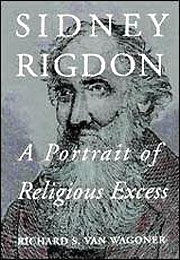
Image

Van Wagoner, Richard S.
Sidney Rigdon: A Portrait of Religious Excess
Salt Lake City, Signature Books, 1994

[pp. 39ff. ]

Section 1: The Baptist Years

Chapter 4: Bainbridge

Sidney and Phebe Rigdon's family, now including children Athalia (b. 1821),
Nancy (b. 1822), Elizabeth or Eliza (b. 1823), and Phebe, Jr. (b. 1824),
moved their meager belongings in December 1825 to Bainbridge, Geauga County,
Ohio, in the Western Reserve. They settled on a landed estate owned by Phebe's
father, Jeremiah Brooks, on the "Chillicothe [Road] just above Taylor Road
and a mile north of Centerville." (Frederick A. Henry, "History of Centerville
Mills and the Old Chillicothe Road.") ----> Note: The Jeremiah Brooks reference
was copied from Whitsitt, and is an error -- he had no such property <-----


Unlike the stilted and staid Redstone Association, Baptist organizations in the
vigorous Western Reserve not only tolerated new biblical interpretations but welcomed
and embraced them. Eastern Ohio settlers had grown weary of hearing they were lost
in a world of sin until God at his pleasure rescued them. This theological uneasiness
helped free-thinking Baptist ministers like Sidney Rigdon introduce fresh points of view.

The Reformed Baptist Movement did not become a separate denomination, the Disciples of
Christ, until 1832 -- two years after Rigdon had left the movement. Even Campbell did
not foresee the founding of a separate sect, initially presuming Christian unity within
the liberal arms of the Mahoning Baptist Association. But he was "firmly convinced,
fully convinced," as he put it, "that the whole head is sick, and the whole heart faint
of modern fashionable Christianity." (The Christian Baptist 1:33.)

Rigdon was in full accord and longed to put a healing hand to the brow of the ailing
churches in the Reserve. This desire was satisfied almost immediately upon his arrival.
His own account said that it was known "he had been a preacher, and had gained considerable
distinction as a public speaker, and the people soliciting him to preach, he complied
with their request." (Times and Seasons 4 (15 May 1843): 193)

The small Bainbridge congregation embraced a Calvinistic creed, which had become unacceptable
to Rigdon, but he was invited to serve without having to endorse their articles of faith.
"From this time forward," he noted, he "devoted himself to the work of the ministry, confining
himself to no creed, but held up the Bible as the rule of faith, and advocating those doctrines
which had been the subject of his, and Mr. Campbell's investigations, viz: Repentence and baptism,
for the remission of sins." (Ibid., 192-93.)

He served the area as a circuit preacher, much like his 1820-21 ministry in Warren. "His
former success attended his labors," he noted of his six-month sojourn in the area. The
largest congregation under his influence was at Mantua Center, Portage County, Ohio, where
he preached once a month. The group consisted of disciples from Nelson, Hiram, and Mantua.
On 24 August 1824 this congregation passed a resolution "to remove the Philadelphia Confession
of Faith and the Church Articles, and to take the Word of God for our Rule of Faith and
Practice." (Amos Sutton Hayden, Early History of the Disciples in the Western Reserve
(Cincinnati: Chase and Hall, 1875), 22-23.)

This action established the assemblage as "the first Church of Christ of the Restoration Movement
in Ohio," according to official Disciple of Christ accounts. (Two years later, in 1826, the
Hiram-Nelson-Garrettsville members coalesced into a separate congregation. Alanson Wilcox,
A History of the Disciples of Christ in Ohio (Cincinnati: The Standard Publishing Co.,
1918), 121.)

Adamson Bentley and a few other reformers also met with considerable success in the Western
Reserve, their work influenced by Campbell's Christian Baptist. In 1825 Campbell wrote
a series of articles entitled "A Restoration of the Ancient Order of Things" in which he
urged abandoning anything not a part of primitive Christianity-creeds and confessions,
unscriptural words and phrases, and theological theories. He also urged adopting everything
sanctioned by the New Testament such as the weekly breaking of the loaf, Christian fellowship,
the simple order of public worship, and the independence of each church under the care of its
bishops and deacons.

Rigdon incorporated these innovations in his own preaching. "Large numbers invariably attended
his meetings," he related in his autobiography, and

[t]he doctrines which he advanced being new, public attention was
awakened, and great excitement pervaded throughout that whole section
of country, and frequently the congregations which he addressed, were
so large that it was impossible to make himself audible to all. The
subjects he proposed were presented in such an impressive manner to
the congregations, that those who were unbiased by bigotry and prejudice,
had to exclaim, "we never heard it in this manner before."

Those by whom he was opposed, well knew that an honorable and public
investigation, would inevitably discover the weakness and fatality of
their doctrines; consequently they shunned it, and endeavored, by
ridiculing the doctrines which he promulgated, to suppress them. But
they were unsuccessful, did not turn him from the path which he felt
to be his duty. He continued to set forth the doctrines of repentance,
and baptism for remission of sins, and the gift of the Holy Ghost,
according to the teachings of Peter, on the day of Pentecost, exhorting
his hearers in the mean time, to throw away their creeds of faith -- to
take the Bible as their standard, and search its sacred pages -- to
learn to live by every word that proceedeth from the mouth of the Lord,
and to rise above every sectarian sentiment, and the traditions of the
age, and explore the wide and glorious fields of truth which the
scriptures holds out to them. (Times and Seasons 4 (15 May 1843): 194.)

In June 1826, Warner Goodall, venerable Baptist preacher at Mentor, thirty miles from Bainbridge, passed
away. Rigdon was invited to deliver Goodall's eulogy. The funeral sermon so impressed the congregation
that in the fall they offered Rigdon Goodall's former pastorship. According to Rigdon's autobiography,
Mentor had been settled by wealthy and enterprising individuals "who had by their industry and good
management made that township one of the most delightful in that country, or probably in the Western
Reserve."


UD
-- the discovery never seems to stop --
_Uncle Dale
_Emeritus
Posts: 3685
Joined: Wed Feb 07, 2007 7:02 am

Re: The Spalding Fable...over at BCC

Post by _Uncle Dale »

Brackite wrote:...
There is also the Theory of Automatic Writing and the Book of Mormon.
http://www.bcmmin.org/auto.html
...


All of which brings us back to Joseph Smith's dictation of the Book of Mormon to Oliver Cowdery in 1829.
If the text was produced by "automatic writing," then it evidently existed as a written
document prior to 1829, and Smith somehow managed to have Oliver reproduce the text
in his (Oliver's) own handwriting.

Can "automatic writing" occur in the form of dictation, from one person to another --
that is from the "medium" to a scribe? I very much doubt it. And I very much doubt
that such an explanation would accord with recent word-print analysis of the Book of Mormon.

That leaves the possibility that Smith had a prepared text, which was either totally
or partially a product of "automatic writing." Again, I have a hard time reconciling
such a text with the recent word-print study results -- which identify Spalding,
Rigdon, Pratt and Cowdery as the likely authors.

However -- there is still a place for "automatic writing" in a Rigdon/Pratt/Cowdery
revision of Spalding's fiction. That possibility of "automatic writing" comes with
Rigdon's (reported) massive contribution to the Book of Mormon text. Some of Rigdon's
post-Nauvoo writings read like "automatic writing" -- and it is possible that he
suffered from a mental condition that caused hypographia (uncontrollable, lengthy
bouts of compulsive writing -- often of a religious nature) in Rigdon's experiences.

THAT is the place I would look first of all -- to try and find evidence of some sort
of "automatic writing" contributing to the Book of Mormon text.

UD
-- the discovery never seems to stop --
_Roger
_Emeritus
Posts: 1905
Joined: Mon Mar 02, 2009 6:29 am

Re: The Spalding Fable...over at BCC

Post by _Roger »

Dale:

For one thing, Vern never published his research into the sources for the 19th century names
he listed. I know that he conducted such investigations in the volumes available in the SLC
Family History Library -- and that he was certain that they all existed before Spalding's death
in 1816. But he failed to document that fact in his booklet.

Because of that, modern LDS critics have asserted that several of Vern's listed place names did
not exist (or were not on the map or gazetteer tabulations) as early as 1816. Some Mormon
critics have even asserted that most of the names did not exist until after 1830.


How much weight do you attach to that criticism? Have you ever broken it down or is it still up in the air?

Another problem is that Vern did not document variations in spelling for his 19th century place names.
Thus, LDS critics can point out that "Kiskiminetas" is really nothing like "Kishkumen," etc. There
were alternative spellings (such as Kishkemenetus) and alternative pronunciations for some of these
place names, but Vernal did not take the trouble to explain that.


Seems to me the dates would be the larger problem. The post 1830 claim is obviously important because then it would be relatively easy to suggest that the names came from the Book of Mormon instead of the Book of Mormon authors getting their names from Spalding. However, I would still see a danger even in that approach since doing so would be an acknowledgment of a positive connection as opposed to coincidence.... and if you could not trace all the names to post 1830 then you have to argue intention mixed with coincidence.

That comprises most of the LDS rebuttal -- but some points are poorly stated there.
For example, it matters not whether Joseph Smith knew (or could know) any of these place names,
because Vernal's thesis was that Spalding made use of them in "Manuscript Found," when Smith
was a mere child.


I agree, once again S/R makes the best sense of the data, but, of course this evidence can also be used by Smith-alone proponents to claim that Smith borrowed the names, hence the need (pro-LDS) to date the names to post 1830.

Smith doing it as opposed to Spalding doesn't make as much sense to me in terms of logic.... Smith I think would be keen on risking exposure by copying place names so blatantly, unless maybe he was intending to argue that the modern names evolved from Nehpite names...? Spalding, on the other hand was not attempting to pass his story off as scripture, but was instead writing a romance featuring his version of the history of the area in which he was writing, so his copying of place names makes more sense to me than Smith doing it.

Another example is that the FAIR people argue that Vernal's placement of names on the map is
not logically consistent with the geography presented in the Book of Mormon -- thus he has placed
names in locations which do not perfectly agree with the Book of Mormon text. This argument presupposes
that the Book of Mormon has an internally consistent geography -- and, if Spalding created that georgraphy
from the Great Lakes area, that no subsequent contributor to the Book of Mormon (Rigdon/Pratt, etc.)
made any changes to that supposed, original and consistent geography. But, of course, the
S-R explanation advances the idea that Rigdon/Pratt/Cowdery (and perhaps Smith) did not fully
understand Spalding's writings and were not fully successful in extending them in a coherent way.


Obviously that is correct... however, in your opinion, ignoring he possibility of later alterations how valid is the criticism? Is there still a relatively consistent geography or as it stands is it seriously out of whack? Also... assuming Spalding did copy place names and no future alterations took place, how consistent & detailed would we expect Spalding to have been in the first place?

All of which leaves his thesis a lot weaker than it could have been, when he published it.


That's a shame, but apparently then you still think a strong case can be made for Spalding borrowing place names...

ps -- And, we still have the problem that FAIR writers have a pre-existing Divine testimony to uphold,
and thus cannot approach writing a rebuttal with open minds. Nevo and mikwut have recently argued
that this fact is irrelevant -- or, that not all modern Mormons claim such a Divine testimony. Be that as
it may, I still do not believe that modern Mormons can maintain their position in the LDS Church, by
stating their openness to a 19th century origin for the book. I simply do not believe that the vast
majority of active, observant Mormons have the freedom of mind which would allow them to advance
in the Church, receive endowments, magnify callings. etc., while refusing to testify that the "Book of
Mormon is true."

Now mikwut says THAT is totally unrelated to discussions between Mormons and non-Mormons on
the probable origin of the book. However -- if I point to something like Vernal Holley's publication,
as providing evidence for the S-R explanation (or even for the Smith-alone explanation), the Mormon
I converse with still operates out of a mental environment in which he/she is not allowed to view
such proffered "evidence" without prejudice. That prejudice might be "My Bishop told me the book is
true" -- or it might be "God told me the book is true;" but either way it exists for the overwhelming
majority of active, observant Mormons. And it stands as an impediment for rebutting critics such
as the FAIR people. They make no effort to add to Vernal's tabulation; nor to admit that some
reasonable people might be able to accept parts of his evidence, etc. Their response is 100%
negative -- just the sort of response designed to uphold and strengthen pre-existing testimonies,
that the "book is true beyond a shadow of a doubt."

I find that intellectual environment frustrating, for the objective exchange of information, such as
the possible validity of some of Vernal's conclusions:
http://sidneyrigdon.com/vern/vernP0.htm


I agree, but that's really to be expected. There's a lot more riding on this for them than merely determining what really happened. Mikwut's own logic on this very thread is a clear indicator that he cannot allow the version he accepts as the true explanation for the Book of Mormon to be held to the same standard of criticism he wants to impose upon any other explanation. That ought to be your first clue that those who hold the same belief and the same method for determining truth are not likely to give Vernal Holly's evidence a fair shake either. I just expect that at this point. But I think the place names stuff is significant... just not sure how much weight it carries at this point.
"...a pious lie, you know, has a great deal more influence with an ignorant people than a profane one."

- Sidney Rigdon, as quoted in the Quincy Whig, June 8, 1839, vol 2 #6.
_Nevo
_Emeritus
Posts: 1500
Joined: Sat Feb 24, 2007 4:05 pm

Re: The Spalding Fable...over at BCC

Post by _Nevo »

Uncle Dale wrote:In fact, Rigdon preached his Mentor sermon on Aug. 24; the "June" date Van Wagoner reported was a mistake.

Apparently so, since Rev. Goodell didn't die until August 15th. It looks like nobody bothered to double-check Hayden's facts (apart from yourself, that is).

Anyway, thanks for the additional information on Rigdon's 1826 activities. I also found Richard McClellan's Winter 2003 Dialogue article quite helpful in brushing up on Rigdon's pre-1830 history.
Post Reply