Intellectual Bankruptcy of Book of Abraham apologetics
Posted: Sat May 09, 2009 6:41 am
Will Schryver cannot be trusted in any sense because he has a documented history of making ridiculously false statements. In most cases, he is so obviously wrong it can only be assumed he is willfully trying to deceive his audience. Here is just one example. About two years ago he made the following statement in reference to the relationship between the KEP characters and the english text:
Here is a microfilm scan of the page Will refers to (Ms1a). It is horrible to be sure, but it serves the purpose of refuting Will’s falsehood.

Will says the last two characters are clearly placed "at random" ??
How does he explain the fact that Ms1b is nearly identical in placing the same Egyptian characters at the exact same corresponding points? What is so "random" about this? Who says a character has to represent the beginning of a new paragraph or sentence anyway? He then told Don Bradly to go study the photos like he has or else he is just blowing smoke! Don never did call him out for this nonsense, but posted this on the two other forums and Will refused to address it. Will continues to preach ignorance uncontested:
Unbelievable! If you take a look at the third circled character from the top (image above), you will notice that this character doesn’t come before a new paragraph, nor does it come before a new sentence, verse or line. In fact, this would be the only example that could possibly be used to support Will’s claim that characters were thrown about at random with no apparent correlation to the English text. This character corresponds to Abraham 1:5, which goes as follows:
“My fathers, having turned from their righteousness, and from the holy commandments which the Lord their God had given unto them, unto the worshiping of the gods of the heathen, utterly refused to hearken to my voice;”
According to this manuscript a new character is placed in mid-sentence. If you look at the style of the writer, the sentences generally continue to the end of the page if they are long enough to do so, but in this manuscript this sentence stops short at the word “heathen,” leaving the rest of the sentence (“utterly refused to hearken to my voice”) for another line. What does this mean? Well, once we consider the Parrish manuscript (Ms1b folder 3) the verdict becomes all the more clearer:

Clearly these two examples are best explained as a transcription process whereby Joseph Smith stopped dictating at “heathen,” before instructing both scribes to insert the next character. So they stopped at heathen wherever they happened to be on that particular line, and then continued on to finish the verse on the next line adjacent with the corresponding character.
Not only does this anecdote serve to refute Will’s pet theory, but it also adds more evidence to the already mounting pile of evidences in favor of the dictated transcription theory. After all, who could imagine someone breaking a sentence in half like that while copying from a source document?
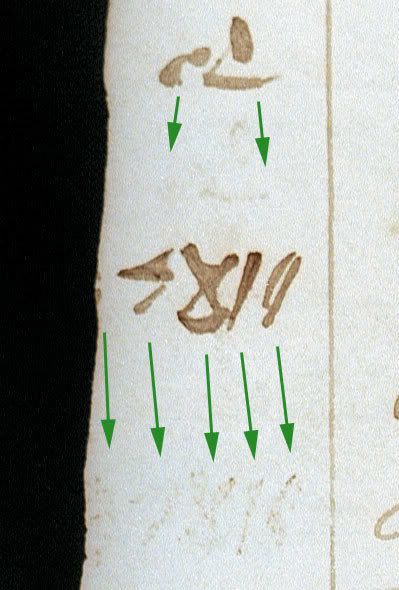
And yet there is further proof that the placement of the Egyptian characters was crucial to this translation project. Below we can see the characters from Ms2 were written, and then erased, and then written in again at different locations, n order to match up to the corresponding text.
Will deals with none of this.
I was walking through memory lane while flipping through the archived discussions I had saved from the FAIR boards years ago. I came across the first discussion where Will tried to engage the KEP issue. After I continued to raise the issue of the KEP it became clear to me Will didn't even know what they were. I mentoned the KEP in several posts and Will fnally realized wasn't going to let him ignore the point, so he responds with:
May 6, 2006 Wll Schryver sad:
Completeness of the KEP? What a stupd comment. Of course Will clearly thought the KEP referred to the Egyptian papyri, which apologsts continue to argue "isn't complete." But I was walking on egg shells at MADB, and didn't want to call him out for being totally stupid. I just impled that he didn't know what the KEP were, to which he responded:
May 10, 2006, Will Schryver said:
I laughed after reading this post because Will was obviously lying about having examined the KEP. If he really knew what the KEP were, he would have known that nobody in the apologetic camp has been able to "examine the contents" at all, let alone "at length," because they are locked up. Even John Gee did not get access to them when he wanted to publish photos in his "Guide to the Joseph Smith Papyri."
The point here is that Will is an established liar and cannot be trusted.
Anyway, I didn't accuse him of lying. Instead, I started a new thread the very next day that explained the KEP situation and I provided photos that I had acquired from Metcalfe. Will quickly realized he was out of his league and tried to distance himself from his previous insinuation that he was in any way familiar with the KEP. So instead of offering criticisms of what I presented, or any arguments based on his "at length examination of the contents," he sat back and watched the discussion play itself out. After a day he took a more humble approach and started asking me questions about the manuscripts, such as:
Are these the kinds of questions you would expect from someone who has "examined the contents of the KEP at length"? The fact that he didn't even know who Smith's scribes were, is reason enough to dismiss him as a know-nothing. This was three years ago exactly. Now Will thinks he has become something of an expert because he has been kissing plenty of BYU arse.
What they are trying to argue is that these are copies of a missing text; what we can only assume is the missing original translation manuscript (manuscript Q). Following this theory, it is assumed that like any original dictation manuscript, there will be all sorts of punctuation errors, scratch outs, misspellings, etc. What they have argued is that what we find in Ms1a and Ms1b are copies of this missing Q document. The reason they contain all the same errors is because (get this!) for whatever reason, Joseph Smith wanted them to make exact copies of the original manuscript. Meaning, he wanted the closest thing to a xerox of the original, with all its scribbles and errors. Not just one, but two copies. And not by just one scribe, but by two. This is how they account for the evidence we have, and it becomes perfectly clear they are bending over backwards in every way they can to distance Joseph Smith from this work.
This scenario doesn't even begin to make sense, and it pretty much undermines their effort to use the Book of Mormon translation process as a parallel model. They shoot down everything we propose because "that ain't how Cowdery and Smith did it." Well, Joseph Smith never asked for two exact copies of the original Book of Mormon manuscript either. He never asked for one. So they appeal to the Book of Mormon translation process only to the extent that it serves their purposes for shooting down anything they don't like coming from our side. There is no consistency in anything Hauglid tries to argue.
But what drives me nuts is how they criticize us for making proposed models whereas they offer none of their own. In all of their rants, they always stop short of providing a hypothetical, let alone plausible, model by which these KEP could have come about. Instead, what we see them doing, constantly, is throwing out all sorts of "maybes" and "could haves", demanding that we answer every ridiculous molehill question they decide to treat as a mountain, and then they stop short of providing any real explanation as they abandon the whole thing and declare it all a mystery. They need it to be as mysterious as possible. Just look at Will's post at MADB. He goes on and on and on attacking the critical model for making "unsupported assumptions," yet when it came time for him to step up to the plate and answer the relevant questions posed by the data, he gave up and said he doesn't have any answers:
No, he doesn't know. He just knows with bombastic certitude, that the critical argument is wrong. Why? Because it has to be. Why? Because he already begins with the assumption that we're wrong. He and Brian both walked into this thing with a planned mission in mind. They came into this thing celebrating Nibley and they feel it is their duty to continue his work, his failed arguments, etc. And this is why Brian responds to Brent's questions with such hostility. He doesn't like being asked to produce something. He knows he can't. All he is left with is rhetoric.
So they admittedly don't "have answers" and they think this is somehow a respectable position to take! Well, at least we do have answers and we base them on the evidences they refuse to address. At least we dare to provide answers and deduce the facts to determine what was the most likely scenario. It isn't mysterious to us. It isn't mysterious to any non-LDS apologist who analyzes the evidence. They can't produce a detailed hypothetical explanation as to who these manuscripts came about, because they realize they would be laughed off the stage if they had to actually back up their claims with a model. So they play this silly game of hide the apologetic. Keep people's hopes up by offering "wait and see" sermons and then two years later, just reiterate the same sermon.
To make matters even more difficult for the "scribes did it" theory, you have to see the overall process in its context. Since we know Ms1a and Ms1b used the Sensen text, how did they manage to get around the huge hole in the papyri at the beginning?

Now Ms1a uses 18 Egyptian characters, and below I provided photos with the characters taken from the 6 pages of the manuscript, in the order they appear:

Notice that in the hole, there are three characters that were invented. Only Joseph Smith would have been able to "reveal" what those characters were. Characters 1-3 appear on the first page, and then on the second page you begin to see the characters from the papyrus show up in order from right to left. Every page has anywhere between 2 or 5 characters, and you can see the last page (p.6) ends where the second line of the papyrus reaches an end (which might explain why they stopped there). And then as they reach the end of the first line, they drop down to the second line and begin where Joseph Smith again tells them what the missing characters were, via revelation. Why does he need to do this? Because he knows that if he is going to convince these guys that he is really "translating" the text as it was originally in Egyptian, then he knows he has to account for the huge hole at the beginning of the document which contained relevant text.
To propose a scenario where all the scribes got together to "try their hand" at revelation, as Nibley suggested ... well, this is really an exercise in desperate thinking.
The above just goes to further the case that Joseph Smith believed, erroneously, that the Sensen text contained writings that had something to do with Abraham. To keep insisting "there is no evidence" to connect him to this, is really just an insult to everyone's intelligence.
And to fully appreciate the schizophrenia that haunts Will, take a look at what he wrote to me in an email just last year:
Will the real Will please stand up?
The characters are not always associated with a discrete paragraph. It is especially evident with Williams' Ms. #2. The final two characters at the bottom of the first page are not clearly associated with the text. They appear to have been placed entirely at random in relationship to the text. They are not aligned with a paragraph break, nor the beginning of a sentence, nor even a specific line.
Here is a microfilm scan of the page Will refers to (Ms1a). It is horrible to be sure, but it serves the purpose of refuting Will’s falsehood.
Will says the last two characters are clearly placed "at random" ??
How does he explain the fact that Ms1b is nearly identical in placing the same Egyptian characters at the exact same corresponding points? What is so "random" about this? Who says a character has to represent the beginning of a new paragraph or sentence anyway? He then told Don Bradly to go study the photos like he has or else he is just blowing smoke! Don never did call him out for this nonsense, but posted this on the two other forums and Will refused to address it. Will continues to preach ignorance uncontested:
In several cases in Williams' Ms. #2, the characters appear to be placed with much uncertainty -- as though the scribe didn't have any idea what their specific relationship was to the English text in the body of the document
Unbelievable! If you take a look at the third circled character from the top (image above), you will notice that this character doesn’t come before a new paragraph, nor does it come before a new sentence, verse or line. In fact, this would be the only example that could possibly be used to support Will’s claim that characters were thrown about at random with no apparent correlation to the English text. This character corresponds to Abraham 1:5, which goes as follows:
“My fathers, having turned from their righteousness, and from the holy commandments which the Lord their God had given unto them, unto the worshiping of the gods of the heathen, utterly refused to hearken to my voice;”
According to this manuscript a new character is placed in mid-sentence. If you look at the style of the writer, the sentences generally continue to the end of the page if they are long enough to do so, but in this manuscript this sentence stops short at the word “heathen,” leaving the rest of the sentence (“utterly refused to hearken to my voice”) for another line. What does this mean? Well, once we consider the Parrish manuscript (Ms1b folder 3) the verdict becomes all the more clearer:
Clearly these two examples are best explained as a transcription process whereby Joseph Smith stopped dictating at “heathen,” before instructing both scribes to insert the next character. So they stopped at heathen wherever they happened to be on that particular line, and then continued on to finish the verse on the next line adjacent with the corresponding character.
Not only does this anecdote serve to refute Will’s pet theory, but it also adds more evidence to the already mounting pile of evidences in favor of the dictated transcription theory. After all, who could imagine someone breaking a sentence in half like that while copying from a source document?
And yet there is further proof that the placement of the Egyptian characters was crucial to this translation project. Below we can see the characters from Ms2 were written, and then erased, and then written in again at different locations, n order to match up to the corresponding text.
Will deals with none of this.
I was walking through memory lane while flipping through the archived discussions I had saved from the FAIR boards years ago. I came across the first discussion where Will tried to engage the KEP issue. After I continued to raise the issue of the KEP it became clear to me Will didn't even know what they were. I mentoned the KEP in several posts and Will fnally realized wasn't going to let him ignore the point, so he responds with:
May 6, 2006 Wll Schryver sad:
Obviously, this debate is going nowhere. Nor did I expect it to do otherwise. I only reiterate for the sake of those who may be following this exchange that your ENTIRE argument rests on the truth of the completeness of the KEP, which is far from a settled question.
Completeness of the KEP? What a stupd comment. Of course Will clearly thought the KEP referred to the Egyptian papyri, which apologsts continue to argue "isn't complete." But I was walking on egg shells at MADB, and didn't want to call him out for being totally stupid. I just impled that he didn't know what the KEP were, to which he responded:
May 10, 2006, Will Schryver said:
I know precisely what the Kirtland Egyptian Papers are (contrary to your previous assertion). It's just that I view them as being utterly irrelevant to the question at hand. I've examined the contents of the KEP at length -- and doing so hasn't persuaded me one iota that the Book of Abraham is anything except what it claims to be.
I laughed after reading this post because Will was obviously lying about having examined the KEP. If he really knew what the KEP were, he would have known that nobody in the apologetic camp has been able to "examine the contents" at all, let alone "at length," because they are locked up. Even John Gee did not get access to them when he wanted to publish photos in his "Guide to the Joseph Smith Papyri."
The point here is that Will is an established liar and cannot be trusted.
Anyway, I didn't accuse him of lying. Instead, I started a new thread the very next day that explained the KEP situation and I provided photos that I had acquired from Metcalfe. Will quickly realized he was out of his league and tried to distance himself from his previous insinuation that he was in any way familiar with the KEP. So instead of offering criticisms of what I presented, or any arguments based on his "at length examination of the contents," he sat back and watched the discussion play itself out. After a day he took a more humble approach and started asking me questions about the manuscripts, such as:
Are there any, or even substantial (in your estimation), differences between the portion of text appearing in the columns of "translated" paragraphs and the final product published in 1842? (Aside from the fact that the KEP refer to only the first 1 1/2 chapters of the Book of Abraham?) Question 1: Why do you say "so another scribe to (sic) take over"? It was my understand from detailed descriptions of the manuscripts that each is of similar content. Perhaps that is my misunderstanding and you could clear that up. But, to elaborate, it is my understanding that there is nothing to indicate that one "scribe" wrote a certain portion, then another "scribe" took up where the previous one left off. Rather, all of the manuscripts appear to be related to the same portion of the Book of Abraham.
Question 2: What other indications lead you to believe that the process "went slowly"? I would not have made that observation based on the photographs I have seen in the past few days. To the contrary, the text in the right hand columns appears to have been written in an extremely fluid fashion, with very few evidences of ink pooling where the scribe would have freshened his pen after a period of pause. Do you not agree?
Question 3: At this period of time (when the KEP were being produced) is there any contemporary evidence that any of the individuals in question had been recently or were currently serviing Joseph Smith in the capacity of "scribe"? To my knowledge, neither Cowdery, Phelphs, nor Parrish had served as scribes to Joseph for a considerable time preceeding this period. Perhaps I am mistaken in this respect and someone will correct me. But I think not.
Are these the kinds of questions you would expect from someone who has "examined the contents of the KEP at length"? The fact that he didn't even know who Smith's scribes were, is reason enough to dismiss him as a know-nothing. This was three years ago exactly. Now Will thinks he has become something of an expert because he has been kissing plenty of BYU arse.
What they are trying to argue is that these are copies of a missing text; what we can only assume is the missing original translation manuscript (manuscript Q). Following this theory, it is assumed that like any original dictation manuscript, there will be all sorts of punctuation errors, scratch outs, misspellings, etc. What they have argued is that what we find in Ms1a and Ms1b are copies of this missing Q document. The reason they contain all the same errors is because (get this!) for whatever reason, Joseph Smith wanted them to make exact copies of the original manuscript. Meaning, he wanted the closest thing to a xerox of the original, with all its scribbles and errors. Not just one, but two copies. And not by just one scribe, but by two. This is how they account for the evidence we have, and it becomes perfectly clear they are bending over backwards in every way they can to distance Joseph Smith from this work.
This scenario doesn't even begin to make sense, and it pretty much undermines their effort to use the Book of Mormon translation process as a parallel model. They shoot down everything we propose because "that ain't how Cowdery and Smith did it." Well, Joseph Smith never asked for two exact copies of the original Book of Mormon manuscript either. He never asked for one. So they appeal to the Book of Mormon translation process only to the extent that it serves their purposes for shooting down anything they don't like coming from our side. There is no consistency in anything Hauglid tries to argue.
But what drives me nuts is how they criticize us for making proposed models whereas they offer none of their own. In all of their rants, they always stop short of providing a hypothetical, let alone plausible, model by which these KEP could have come about. Instead, what we see them doing, constantly, is throwing out all sorts of "maybes" and "could haves", demanding that we answer every ridiculous molehill question they decide to treat as a mountain, and then they stop short of providing any real explanation as they abandon the whole thing and declare it all a mystery. They need it to be as mysterious as possible. Just look at Will's post at MADB. He goes on and on and on attacking the critical model for making "unsupported assumptions," yet when it came time for him to step up to the plate and answer the relevant questions posed by the data, he gave up and said he doesn't have any answers:
"Now, what does this all mean? That is a good question, and I don’t pretend to have a complete answer."
No, he doesn't know. He just knows with bombastic certitude, that the critical argument is wrong. Why? Because it has to be. Why? Because he already begins with the assumption that we're wrong. He and Brian both walked into this thing with a planned mission in mind. They came into this thing celebrating Nibley and they feel it is their duty to continue his work, his failed arguments, etc. And this is why Brian responds to Brent's questions with such hostility. He doesn't like being asked to produce something. He knows he can't. All he is left with is rhetoric.
So they admittedly don't "have answers" and they think this is somehow a respectable position to take! Well, at least we do have answers and we base them on the evidences they refuse to address. At least we dare to provide answers and deduce the facts to determine what was the most likely scenario. It isn't mysterious to us. It isn't mysterious to any non-LDS apologist who analyzes the evidence. They can't produce a detailed hypothetical explanation as to who these manuscripts came about, because they realize they would be laughed off the stage if they had to actually back up their claims with a model. So they play this silly game of hide the apologetic. Keep people's hopes up by offering "wait and see" sermons and then two years later, just reiterate the same sermon.
To make matters even more difficult for the "scribes did it" theory, you have to see the overall process in its context. Since we know Ms1a and Ms1b used the Sensen text, how did they manage to get around the huge hole in the papyri at the beginning?
Now Ms1a uses 18 Egyptian characters, and below I provided photos with the characters taken from the 6 pages of the manuscript, in the order they appear:
Notice that in the hole, there are three characters that were invented. Only Joseph Smith would have been able to "reveal" what those characters were. Characters 1-3 appear on the first page, and then on the second page you begin to see the characters from the papyrus show up in order from right to left. Every page has anywhere between 2 or 5 characters, and you can see the last page (p.6) ends where the second line of the papyrus reaches an end (which might explain why they stopped there). And then as they reach the end of the first line, they drop down to the second line and begin where Joseph Smith again tells them what the missing characters were, via revelation. Why does he need to do this? Because he knows that if he is going to convince these guys that he is really "translating" the text as it was originally in Egyptian, then he knows he has to account for the huge hole at the beginning of the document which contained relevant text.
To propose a scenario where all the scribes got together to "try their hand" at revelation, as Nibley suggested ... well, this is really an exercise in desperate thinking.
The above just goes to further the case that Joseph Smith believed, erroneously, that the Sensen text contained writings that had something to do with Abraham. To keep insisting "there is no evidence" to connect him to this, is really just an insult to everyone's intelligence.
And to fully appreciate the schizophrenia that haunts Will, take a look at what he wrote to me in an email just last year:
…if I were an outsider looking in at all of this, I find it difficult to believe that I could be persuaded that the production of the Book of Abraham was anything other than a clumsy imposture perpetrated by Joseph Smith upon his followers. But, of course, I’m not. I came into the discussion already possessing a conviction that the Book of Abraham was divinely-inspired scripture.
Will the real Will please stand up?


