Page 1 of 1

Theological Origin of Mormonism: 1823

Posted: Fri Aug 28, 2009 5:52 pm
by _Uncle Dale
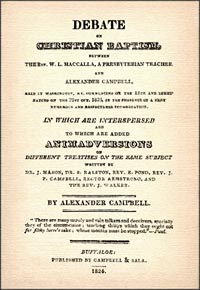
I'm currently working on correcting and formatting this 1824 text:
http://www.sidneyrigdon.com/1824Cam1.htm

"Bishop" Sidney Rigdon was present for the 1823 debate -- took notes --
helped prepare the 1824 text -- certified the contents of that text --
and very likely helped peddle copies of the book to Baptists, first in
the Pittsburgh area, and subsequently in Geauga & Portage counties, Ohio.

Alexander Campbell provides his unique theologizing on the proper mode
and purpose of baptism. And, in doing so, accuses most of Christendom of
having apostatized from the original, apostolic religion and its practices.

Although Campbell spends most of his time defending the antiquity (and
orthodoxy) of adult immersion "for the remission of sins," he also manages
to touch upon several other "restorationist" religious tenets in this text.

Sidney Rigdon did not necessarily adopt ALL that Campbell was then teaching,
but he generally embraced Campbell's theological thinking and made it his
own "restorationist" program, in Pittsburgh in 1824-25 and in Ohio thereafter.

The modern reader, familiar with Mormon-speak, will discover numerous LDS
tenets, concerns and hobbies scattered throughout the 1824 text. There is
even a paragraph on baptism for the dead.
Image

As I go through and clean up the html file, I'll be looking for precursors of
Mormon theology ---- you all are welcome to join in the effort.

Uncle Dale

Re: Theological Origin of Mormonism: 1823

Posted: Fri Aug 28, 2009 10:04 pm
by _Roger
Dale:

Don't have time to read it at the moment, but do you by chance have a rough outline of such tenets to be looking for? I am not nearly as familiar with LDS (or RLDS) doctrine as you are.

Re: Theological Origin of Mormonism: 1823

Posted: Fri Aug 28, 2009 11:04 pm
by _Uncle Dale
Roger wrote:Dale:
Don't have time to read it at the moment, but do you by chance have a rough outline of such tenets
to be looking for? I am not nearly as familiar with LDS (or RLDS) doctrine as you are.


That's pretty much what I want others to do for me -- to make the comparisons and the list.

In the early 182os Alexander Campbell and/or his closest followers would have pretty
much matched the unnamed preacher that Lucy Mack Smith recalled visiting her neighborhood
and advocating a union of all the Christian sects.

Campbell started out by professing much the same philosophy -- but then went
on to demand the abolition of Christian creeds. That led him into arguments with
other theologians, as to what was objectionable in various creeds, confessions,
and articles of faith.

As we see in the 1823 debate with the Presbyterian minister Walmart. L. M'Calla, the
tenet Campbell found most damnable was the doctrine requiring infant baptism
by sprinkling (or pouring). In his 1823 debate he presents his arguments against
this Calvinist and Catholic doctrine, and advocates instead an adult, believer's
baptism, conducted according to biblical practice.

From this initial point of contention, Campbell went on to accuse the infant-baptizers
(along with sprinkle-baptizers such as Methodists), of having long, long ago left
the purity of original, apostolic Christianity, in what was a very early (and nearly
universal) great apostasy.

That left Campbell to fellowship only Baptists, and a few reformers, such as the
1820s followers of Barton Stone (a former Presbyterian).

Then -- beginning in the mid-1820s -- Campbell began to part ways with the
Baptists as well. He derided their requirement of a miraculous conversion
experience, saying that the Holy Ghost in modern times bestows no such
miracle upon sinners -- that the only miracle necessary for conversion to
Christianity was the miracle of scripture conveying the gospel message.

This meant that Campbell was denying the validity/truthfulness of ALL the
Baptists' individual professions of having been "born again." Campbell
taught that a convert was NOT "born again" by any such pre-baptismal miracle,
but only regenerated in the ordinance of baptism, properly administered..

All of this destroyed totally the Calvinist precept of "election." For Campbell,
God did NOT choose who would be converted and who would not -- and God
did NOT send the Holy Ghost to change the hearts of elect sinners prior to
baptism. According to Campbell (in the mid-1820s), practically ALL of
Christendom was following a practically evil, apostate pseudo-religion.

None of this served to make Campbell very popular, among most Christians.

Then, at the end of the 1820s, Sidney Rigdon went one step farther, and
accused the Campbellites of having no Divine authority to baptize.

Thus, even to the extent that Campbell was right, in his condemning
nearly all Christians of a terrible apostasy, he could not correct the
situation by requiring converts to undergo faith, repentance, immersion,
remission, and bestowal of the Holy Ghost, --- because Campbell had
no authority from God to conduct the very ordinance that Campbell
himself was placing overwhelming existential stress upon.

A sinner might indeed have faith; and he might indeed repent; and
God might indeed accept that repentance, and welcome the convert
to be baptized for the remission of sins. But, at that very point, Elder
Rigdon stepped in and asserted that a Campbellite baptism (even
properly conducted, with correct theological precepts) was useless.

It was useless, because God rejected the repentant sinner's choice
of a baptizing elder. If that elder were a Campbellite, he possessed
no God-given authority to baptize. And, if that elder were a Campbellite,
he did not himself possess the Gift of the Holy Ghost, and could not
convey the Holy Ghost through the laying on of hands in confirmation.

Thus, to an external observer, a Mormon baptism conducted by Elder
Sidney Rigdon, and a simultaneous baptism conducted by Elder
Alexander Campbell might appear identical. But --- to God --- only
Sidney's administration of the ordinance was acceptable and valid,
because only Sidney (and fellow Mormon elders) truly held the
latter day priesthood, and only they (Mormons) were speaking
truthfully, during baptismal rites, when they said aloud, for all to
hear: "having authority from God..."

The 1824 "Debate" book provides a foretaste of what was coming, in
the way of "restorationist" theology and practice. When Campbell and
Rigdon sat together, listing to their opponents during that debate,
probably neither one of them realized, that within 7 years, the "latter
day work" would have progressed so far, that even Campbell himself
would be accused of belonging to an apostate sect ----> by Elder Rigdon.

UD

Re: Theological Origin of Mormonism: 1823

Posted: Sat Aug 29, 2009 4:52 am
by _Roger
UD:

Then, at the end of the 1820s, Sidney Rigdon went one step farther, and
accused the Campbellites of having no Divine authority to baptize.


So what was Rigdon's logic? He had obviously been a Campbellite himself... was he admittedly (retrospectively) in an apostate state during that time or did Rigdon allege that Campbell moved away from the truth?

Thus, to an external observer, a Mormon baptism conducted by Elder
Sidney Rigdon, and a simultaneous baptism conducted by Elder
Alexander Campbell might appear identical. But --- to God --- only
Sidney's administration of the ordinance was acceptable and valid,
because only Sidney (and fellow Mormon elders) truly held the
latter day priesthood, and only they (Mormons) were speaking
truthfully, during baptismal rites, when they said aloud, for all to
hear: "having authority from God..."


Do you know when Rigdon first started claiming to receive revelations?

The 1824 "Debate" book provides a foretaste of what was coming, in
the way of "restorationist" theology and practice. When Campbell and
Rigdon sat together, listing to their opponents during that debate,
probably neither one of them realized, that within 7 years, the "latter
day work" would have progressed so far, that even Campbell himself
would be accused of belonging to an apostate sect ----> by Elder Rigdon.


Out of curiosity, do you know what Spalding's views on all this would have been?

Re: Theological Origin of Mormonism: 1823

Posted: Sat Aug 29, 2009 9:44 am
by _Uncle Dale
Roger wrote:...
So what was Rigdon's logic? He had obviously been a Campbellite himself... was he admittedly
(retrospectively) in an apostate state during that time or did Rigdon allege that Campbell moved
away from the truth?


Rigdon was quite content to admit that he had been an apostate as a Campbellite. Of course
hhis being provided with a "revelation" from Joseph Smith, saying that he (Rigdon) had been
preparing the way for Mormonism, must have helped soften the theological blow.

Do you know when Rigdon first started claiming to receive revelations?


>Sidney Rigdon, when quite a boy, living with his father some fifteen miles south of Pittsburgh
>on a farm, was thrown from his horse, his foot entangled in a stirrup and dragged some distance
>before relieved. In this accident he received such a contusion of the brain as ever after seriously
>to affect his character and in some respects, his conduct. In fact, his brother always considered
>Sidney a little deranged in his mind by that accident. His mental powers did hot seem to be impaired,
>but the equlibrium in his intellectual exertions seemed thereby to have been sadly affected. He still
>manifested great mental activity and power, but he was to an equal degree inclined to run into
>wild and visionary views on almost every question. Hence he was a fit
>subject for any new movement in the religious world...

(A. H. Dunlevy, of Lebanon, Ohio -- giving as his authority Dr. Loammi Rigdon (Sidney's older brother)
http://www.sidneyrigdon.com/dbroadhu/PA ... htm#030175


Out of curiosity, do you know what Spalding's views on all this would have been?


As best I can determine Spalding had become a Deist (perhaps even an atheist) in his later
years. He would have understood perfectly the conflict between Calvinism and Universalism
(or Methodism, etc.) -- and would have comprehended Campbell's reasoning on restorationism.

However, Spalding died before Campbell had progressed much past his initial "unite all the
churches -- have no creeds" stage of theology. So the notion of Christian dispensationalism
and a "great apostasy" would have been something beyond Spalding's experience.

If we can rely upon his Roman story, for his personal views on how Christianity should be
managed, he appears to have favored a Congregationalist approach, and would have had
no use for the notion of sectarian exclusivity.

On the other hand, looking at the mound-builder religion in that same story, we might guess
that Spalding would have had no objection to foisting a totally fabricated and dictatorial
religion upon a nation's citizens -- so long as it served to keep them moral and patriotic.

He might not have objected to somebody re-vamping his "Manuscript Found" into the
basis for a new religion -- even an exclusive religion, with a dominating priesthood --
so long as the innovation resulted in a pious and patriotic populace.

UD

Re: Theological Origin of Mormonism: 1823

Posted: Sat Aug 29, 2009 3:32 pm
by _MCB
UD, you got me,

Are you familiar with this related debate?

http://churchofchrist.grigaitis.net/?lo ... index.html

It is not linking right. Go to this The Church of Christ is...
A Debate on the Roman Catholic Religion
Held in the Sycamore-Street Meeting Bouse, Cincinnati
From the 13th to the 21st of January, 1837.
between
Alexander Campbell of Bethany, Virginia
and
The Rt. Rev. John B. Purcell, Bishop of Cincinnati
Taken Down by Reporters, and Revised by the Parties

from the link.

Good to return to conversation with you on a safer forum.

a.k.a. Jerusha, me, and Exile.

Re: Theological Origin of Mormonism: 1823

Posted: Sat Aug 29, 2009 7:08 pm
by _Uncle Dale
MCB wrote:UD, you got me,

Are you familiar with this related debate?

http://churchofchrist.grigaitis.net/?lo ... index.html
...


Yes -- it was a much later occurrence, held after Campbell's theology was
pretty much "set in stone." By 1837 he was the head of the Disciples of Christ,
and had moved far past his old arguments for reforming the Baptists.

There seem to have been subtle adjustments to his Christology and Pneumatology
as well -- with his 1823-1829 stance looking slightly more like Mormon precepts.

By 1837 Campbell's "Millennial Harbinger" was something of a misnomer, and his
followers were no longer expecting an early return of Christ, etc. Campbell had become
a post-millennialist -- which made him even more different from the Mormons.

The 1823 debate includes numerous concepts that soon after ended up in the
Mormon religion. Whether a modern student of Mormon origins opts for the
"Smith-alone" explanation for the Book of Mormon, or for the "Smith-with-others"
explanation, the similarity of early Mormonism and 1820s Campbellism still needs
to be addresed.

If Joseph Smith was the originator of Mormonism, then what did he know of
Campbellism --- and why did he differ from Campbell on some points of religion?

If Sidney Rigdon was the originator of Mormonism, then we already know what he
knew of Campbellism --- but why did he differ from Campbell on some points?

UD

Re: Theological Origin of Mormonism: 1823

Posted: Sun Aug 30, 2009 6:22 pm
by _MCB
Probably because of his own instability, as a result of that head injury. The accusations of heresy against him were pretty serious, when he lost that preaching job. I will definitely read that earlier debate.

Re: Theological Origin of Mormonism: 1823

Posted: Sun Aug 30, 2009 6:50 pm
by _Uncle Dale
MCB wrote:Probably because of his own instability, as a result of that head injury.
The accusations of heresy against him were pretty serious, when he lost that preaching job.
I will definitely read that earlier debate.


Here are the accusations of "heresy" brought against Rigdon by his fellow Baptists in 1823:
http://www.solomonspalding.com/docs/1842Wilm.htm#pg02b

1. that Christians are not under obligation to keep the moral law, it having been
abolished by the Saviour.

2. That the Jewish dispensation was not the best that God might have given to them,
for it had made them threefold more the children of hell, than they were before.

3. That a change of heart consists merely in a change of views and baptism.

4. That there is no such thing as religious experience.

5. That saving faith is a mere crediting of the testimony given by the evangelists,
such as all have, in the truth of any other history.

6. That it is wrong to use the Lord's prayer, inasmuch as the reign of Christ has
already commenced.

Points one and two do not match up well with what we know of Rigdon from his
early days as a Mormon. He obviously placed great emphasis on the Old Testament.

Points three through six sound like pure Campbellism -- the sorts of things Campbell
was saying in his 1823 debate with Rev. M'Calla.

Rigdon was challenged by his congregation on July 11, 1823 -- excluded from an
annual meeting of the Baptists (in his own chapel!) in September of 1823 -- and
formally disfellowshipped from his Baptist congregation on October 11, 1823.

At that time he was on his way to Kentucky with Campbell, to participate in the
debate with Rev. M'Calla -- so he was not present to defend himself at the
hearing set up to consider disfellowshipping him (and his followers). He returned
to Pittsburgh (probably in late October, 1823) to find himself dishonored and out
of a job. It must have been quite a blow to his ego.

In those early days, the Cambellite strategy was to inject "restorationist" ideas
into Baptists churches -- wait for a splintering of the congregation -- and then aid
the "restorationist" faction in taking over the church. Rigdon failed in this strategy
in Pittsburgh in 1823, and he failed again in Bainbridge, Ohio, in 1826.

Perhaps it was about then -- 1825-26 -- that Rigdon began to depart from
Campbell's teachings regarding the Old Testament "dispensation."

Eventually, in promoting the Book of Mormon story of a pre-Christian Nephite
Christian church (an Old Testament church, but with overt Christianity), Rigdon
split entirely with Campbell --- who would have considered such a thing not
only impossible, but utterly ridiculous.

UD]