Wayne Cowdrey, et al.
Who Really Wrote The Book of Mormon? The Spalding Enigma
copyright 2005, Concordia Pub., St. Louis
[p. 229]
Then a second dose of bad news arrived. Oliver's first cousin, Obadiah Fuller, had died, leaving a widow and eight young children on their farm at Carlton, just six miles north of Albion. As it was the beginning of the harvest, and because he really had no other immediate prospects, he volunteered his services to help with the farm work. While he was there, young Joseph Smith, who was also related to Obadiah, stopped by to pay his respects to the widow, and so it was that he and Oliver met again. It was thus that Oliver learned Joseph had once again failed to obtain the ancient Record, even though he had been assisted on this attempt by a reputed Magus named Beaman and a rodsman named Lawrence. Joseph related that he had also been spending a lot of time money-digging with a gang of his friends in hopes of somehow coming up with enough money to save the family farm.
Having nothing better to do, Oliver decided to throw in with the money-diggers and see what developed. Several weeks later, a wealthy farmer named Stowell showed up at the Smiths and hired Joseph and company to go south with him to Bainbridge, to dig for Spanish treasure. The expedition did not bear much fruit, and by November they were back. Joseph then pressed Oliver for more names of potential "clients" in the Newport area, and the group was soon off digging for kettles of gold 'In the hills of Orleans County.
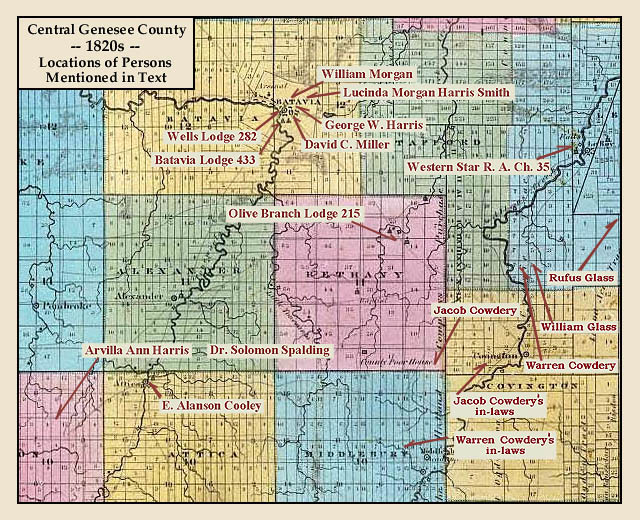
Oliver soon tired of this lifestyle because outdoor physical labor in cold weather did not agree with him, and sought out the shelter of his brother Warren's place at South Leroy. Warren, who had just returned from helping set Dyar up in medical practice in Farmersville, said that he had space for Oliver and that he might find work with David C. Miller, who kept the print shop in nearby Batavia. It was New Year's, 1826.
Miller, who had known Oliver slightly when he was with Franklin at Newport, said he could use him on a part-time basis, and that he might stay in the loft above the shop with his other young employees. It was during this time that Oliver was introduced to William Morgan, a semi-disreputable type who was then living above the local Jewelry shop with his attractive young wife. Both Miller and Morgan were Freemasons, as were Oliver, his father, his brothers Warren, Stephen, and Lyman, and many other members of his extended family. Morgan, it seems, was looking for a part-time scribe to assist him and Miller in the clandestine preparation of a book that, when published, would undertake to expose the innermost secrets of Freemasonry. Oliver discovered that a great deal of money was expected from this scheme, but that it must be kept very secret until everything was ready, for if other Masons discovered what Morgan and Miller were up to, their very lives Would be in danger. Other conspirators were involved as well, and secret meetings and discussions were held. Although Oliver was not one of the conspirators, they trusted him, often employing his services as scribe during their meetings, and occasionally to take dictation of the actual manuscript.
[p. 230]
It was through Oliver that William Morgan was soon introduced to Joseph Smith, who took an immediate interest in him and began to teach him how to see visions and interpret dreams. But things did not go exactly as planned. Morgan, given to liquor, had boasted openly about their plans in a local tavern. The Masons, having been alerted to traitors in their midst, were fomenting counterplots, and trouble was brewing. Eventually threats were exchanged. Soon warnings against Morgan began to appear in area newspapers, followed closely by harassment from the law (which was but a tool of the Masons). Finally, an attempt was made to torch Miller's printing establishment -- an effort thwarted by luck alone. By this time, Oliver had been warned it was better to stay away from Morgan and that it wasn't healthy to continue working for Miller.
[p. 265]
...If Oliver and Joseph were responsible for the Orleans County "gold rush" of 1825, it must have failed to produce a mother load, because Joseph soon went back to Stowell's with his father, while Oliver -- if our hypothesis is correct -- went to visit his brother Warren at South LeRoy, just a few miles from Batavia.
Dr. Warren A. Cowdery's presence in Genesee County at the beginning of 1826 is particularly interesting in that it placed him right in the middle of a powder keg soon to be ignited by a reckless and enigmatic associate of Joseph Smith, Captain William Morgan. A brief overview of events is found in W. F. Peck's 1895 Landmarks of Monroe County:
Early in 1817 Wells Lodge of Free Masons was instituted in the little settlement [of Rochester, New York]; on March 23, 1819, Hamilton Royal Arch chapter was installed here, and in June, 1826, Monroe encampment
[p. 266]
of Knights Templars was organised, these events indicating the rapid growth of the order in numbers and influence. Among its members was William Morgan, at first a resident of Rochester, though he had removed to Batavia before he became prominent by the announcement that he was writing a book to reveal the secrets of Freemasonry. Intense excitement was roused by this, and Morgan was subjected to all kinds of treatment calculated to make him forego his purpose; all failed, and an attempt to burn the printing-office in which the book was being put in type was equally abortive. Finally he was arrested for petty larceny and taken to Canandaigua, where the offense was alleged to have been committed; once there the charge was dismissed but he was immediately re-arrested and imprisoned for a debt of two dollars, which he admitted; the next night four men came to the place and paid the debt, with the costs, after which they seized Morgan as he was leaving the jail and threw him into a carriage, which drove rapidly away; he was never seen in public again. [130]
Warren Cowdery's medical ledger shows that he moved from Moscow to LeRoy in 1819 at virtually the same time as his cousin Franklin moved from Moscow to Olean Point -- this further reinforcing the probability that Franklin had lived with Warren and his family for several months during this period. [131] Among his patients at LeRoy between 1819-24 was James Hulbert (or Halbert), who would later serve three months in jail for having been in the wagon when Morgan's printer, David C. Miller, was forcibly abducted and beaten on the night of September 12, 1826. And among his neighbors was William H. Morgan, MD, a prominent member of the Genesee County Medical Society (not to be confused with the antimasonic martyr). [132]
In the spring of 1819 Warren moved from Groveland to South Leroy, where he perhaps assumed his granduncle Jacob's small medical practice. His son Martius Dyar (Marty) was born there on October 29, and the following year finds the doctor and his family listed in the U.S. census for that place. [133] Although he spent much of his time in Cattaraugus County during 1823-25, he nonetheless maintained a continuous association with South LeRoy up until the spring of 1828, and even served as its postmaster from April 11, 1826 to March 3, 1828, during the height of the Morgan Affair. [134]
While there is no question that Warren lived in the Batavia-South LeRoy area at this time, establishing Oliver's presence there is considerably more difficult -- especially because he may have had excellent reasons for not wanting anyone to know about it.
[p. 267]
William Morgan, for his part, was born in Culpepper County, Virginia on August 7, 1774. He is said to have been a soldier in the War of 1812, where he served under Andrew Jackson at New Orleans and earned the rank of Captain. In 1819, when he was in his mid-forties, he married 16-year-old Lucinda Pendleton, a Methodist clergyman's daughter said to have been very beautiful. Shortly thereafter he set himself up as a trader in Richmond, where "shady dealings" resulted in his sudden departure for York (now Toronto), Canada. There, in 1821, he operated a brewery until it was destroyed by fire; after which he became a farm laborer on Yonge Street. The next year he moved to Tower's Corners (about a dozen miles northwest of Lockport), where he worked as a clerk for Peter Tower. This places him not far from Lockport during the winter of 1822-23 at the same time Oliver was with his cousin Franklin at Orsamus Turner's print shop. (As Morgan was certainly literate, perhaps he was even among Turner's subscribers.) [135]
In 1823 Morgan moved to Rochester and began working as a stonemason. In the spring of the following year, he moved to LeRoy for a short while, and then to Batavia. During this time, he seems to have plied his trade at various locations around western New York while his wife remained in Rochester, where she gave birth to their second daughter, Lucinda Wesley, on August 25, 1824. According to a letter from Morgan to his wife, "Luccinda," dated Batavia, September 4, 1824, the couple had at least one other child, Harriett, who was near death at the time the letter was written and apparently died soon after. That autumn, Morgan moved his family to Batavia, lodging them first in rooms above the silversmith shop of George W. Harris (of whom, more later), then afterward at Stewart's Tavern. While in Batavia on July 4, 1826, Lucinda gave birth to her third child and first son, Thomas Jefferson Morgan. Lucinda Pendleton Morgan (born September 27, 1801) died in obscurity sometime after 1860, apparently in Tennessee. [136]
Morgan's September 1824 letter to his wife stands in stark contrast to Masonic assertions that Morgan was a drunkard, ruffian, and ne'er-do-well, for in it he comes across as a truly tender and caring husband, and even (perhaps) a bit of a poet. [137] Samuel D. Green(e), who claims Morgan was his friend and neighbor in Batavia, states: "I myself have seen him when he had been drinking more than what was good for him; but he was not what, in the general acceptation of the word at that time, or at any time, would be called a drunkard." [138]
According to historian Clarence O. Lewis, William Morgan made his New York Masonic debut at Wells Lodge #282 in Rochester, possibly by having
[p. 268]
presented a forged certificate from Canada. Subsequently, during 1824-25, he is said to have frequented Olive Branch Lodge, which then met at East Bethany within walking distance of Warren Cowdery's home. [139] On May 31, 1825, he joined the Western Star Chapter in LeRoy, taking only the advanced Royal Arch Degree by allegedly declaring that he had already taken all the preceding degrees. [140] Later, he signed a petition seeking to have a Royal Arch Chapter established at Batavia, but someone drew two horizontal lines through his name eliminating him from it. At about this same time, Masonic relief (essentially a welfare program) was cut off from his family. [141] It was in the early months of 1826 that Morgan began to talk openly about publishing an expose of secret Masonic rites and rituals. He was encouraged in this endeavor by David Cady Miller, publisher of the Batavia Republican, who would edit and print the book; and by two other men, John Davids and Russell Dyer, the latter of whom Morgan had known since at least 1824. [142]
On March 13, 1826, Morgan, Miller, Dyer, and Marks signed a secret Agreement, with the latter two apparently undertaking to finance the scheme. Clandestine meetings were held behind closed doors, and Morgan began to compose his manuscript. Soon public announcements were circulated that, though intended to stir up interest in the forthcoming book, unfortunately served as a rallying point for loyal Freemasons whose anger quickly rose to a crescendo of opposition, thus setting the stage for the tragedies to follow. [143]
Suffice it to say that many subscriptions to Miller's newspaper were withdrawn, verbal and written threats were made, numerous lawsuits and petty criminal actions were initiated, advertisements against Morgan appeared in various newspapers seeking to discredit him, and finally Miller was dragged out and beaten by a masked mob not long after an abortive effort had been made to burn down his print shop. Indeed, the Masons at Rochester even went so far as to introduce a spy, Daniel Johns, into Miller's establishment. [144]
Before all this trouble began, Morgan had made arrangements for himself and his family to board at the lodgings of Batavia tavern keeper John Stewart. Later, when things began to heat up, Morgan started secreting himself away to write in an upper room of the home of his partner John Davids, located across Tonawanda Creek about a mile outside of town. It was there, on August 19, that a local constable (Daniel H. Dana) and several other Masons conducted a raid that resulted in Morgan's arrest and the seizure of as much of his manuscript as could be found. Within hours, Morgan's room at Stewart's Tavern was also searched and more of the manuscript was confiscated, though the greater part of it lay hidden in a straw mattress at Davids' home and was
[p. 269]
not discovered. It is asserted that a considerable portion of the remainder fell into the hands of Johns, the spy, during the series of events that took place between September 8 and 10, culminating in the attempt to burn Miller's print shop. [145]
Only hours after the fire had been extinguished, on the morning of September 11, 1826, Morgan was arrested on a petty charge and carted off to jail in Canandaigua. It was from the steps of that jail, at about 9:00 p.m. on the moonlit evening of September 12, that he was forcefully abducted into a carriage to start his journey into oblivion.
Masonic writers, wishing to emphasize his darker side, usually portray William Morgan as a scheming, unstable, and unreliable scoundrel and a confirmed drunkard of bad reputation. Anti-masonic writers, on the other hand, often treat him as if he were a martyred saint. The truth no doubt lies somewhere in the middle and may never be known with certainty, just as it may never be known what his ultimate fate was. [146]
Although the story of William Morgan's efforts to make a fortune by exposing the secrets of Freemasonry is unquestionably intriguing, there are only two small facets of it that bear directly upon the Spalding Enigma. These are its fundamental similarity to The Book of Mormon enterprise that followed almost directly on its heels, and the extremely intriguing question of precisely what roles Joseph Smith and Oliver Cowdery may have played in the whole affair.
As to the former, all sources agree that the principal goal of Morgan and his co-conspirators was nothing short of making huge sums of money by creating and publishing a very controversial and revealing book. The Illustrations of Free Masonry, intended to expose all of the Lodge's darkest secrets and rituals. In the words of Henry Brown:
It was, no doubt, Morgan's intention at first to have remained unknown... and had his intention in that particular met the approbation of his more cunning and avaricious partners, his book would probably have remained as much of a secret to this day, as its author himself. They however, it seems, reasoned more correctly. They considered a stir among the masons "necessary to secure its sale," and by their exertions, and the folly and depravity of masons, finally succeeded [in calling attention to themselves]. [147]
This, of course, is similar to the strategy later employed to promote The Book of Mormon, and it produced similar results. In the end, Morgan was arrested, jailed, and presumably murdered because his efforts to promote a book challenged an existing power structure. Joseph Smith was killed for
[p. 270]
exactly the same reason. And in both cases, the material used to create the resulting book was obtained under fraudulent circumstances with the intent of making large sums of money.
The question of the many curious parallels between Mormonism and the rites, symbols, history, and legends of Freemasonry is best pursued elsewhere. [148] Suffice it to say that even Fawn Brodie, Joseph Smith's best-known biographer, had just such parallels in mind when she concluded that portions of The Book of Mormon gave every appearance of having been inspired by the antimasonic spasms that rocked western New York following the Morgan Affair. [149]
At least a partial explanation of the parallels between Mormonism and Freemasonry may be found in the fact that both Joseph Smith and Oliver Cowdery came from families with strong Masonic backgrounds. However, the real connection may lie at a much deeper level, for there is evidence that William Morgan had actually befriended Smith, and that he may have employed Cowdery as his personal scribe in the months prior to his disappearance!
As to the Masonic connections of Smith and Cowdery, it is important to note that under the rules then in effect, both would have been eligible to join lodges as "Lewis members" at the age of 18 if sponsored by other family members who were already Freemasons in good standing. Whether either had taken advantage of this rule by the time of the Morgan Affair is uncertain because many Masonic records were lost in the confusion that followed. Both, however, had a number of close family members who were active in the craft. In Joseph's case, these were his brother Hyrum, his father (probably), and at least three uncles and two first cousins. Representing the Cowderys were Oliver's father, at least three of his brothers (Warren, Stephen, and Lyman), his cousin Franklin, and perhaps his uncle Ansel. [150] If Oliver and Joseph weren't already Masons by 1826, they certainly would become so later, when it was politically expedient, and after it had become fashionable once again. The events surrounding the admission of Joseph Smith to the newly-formed Nauvoo lodge in 1842, for example, are widely reported. [151]
With respect to Oliver Cowdery, it appears that his connections to Freemasonry have remained unknown, or at least unreported, until the publication of this volume. Given that Oliver was old enough to have become a Lewis Mason on October 3, 1824, it seems likely he was already a lodge member when the Morgan Affair began. Whatever the circumstances, however, according to Proceedings of a Grand Annual Communication of the grand Lodge of Wisconsin
[p. 271]
Begun and Held at Madison, W[isconsin] T[erritory], On the Second Wednesday, being the 12th day of January, A. L. 5848, A. D. 1848 (Madison: Beriah Brown, Printer, 1848), 87, among the founding members of Harmony Lodge #12 at Elkhorn, Wisconsin the previous year were Lyman Cowdery, Secretary, and Oliver Cowdery, Senior Deacon. Also listed in attendance was "Edwin" A[lanson] Cooley, Oliver's soon-to-be editorial partner on the Walworth County Democrat. Cooley (1806-1883) is particularly interesting because he was a journeyman printer in Orsamus Turner's shop at Lockport at least as early as 1827 (Hamilton, Country Printer, 265), which could be where Oliver first met him.
Given the above, there can be no doubt that Lyman and Oliver Cowdery were Master Masons prior to Wisconsin. Lyman moved to Elkhorn in 1846 (History of Walworth Co., 591), perhaps Lyman stopped along the way to visit Oliver at Tiffin, Ohio.
The only Lodge in Tiffin during the time Oliver lived there was Sandusky #77, Free and Accepted Masons, chartered on October 19, 1842, and it remains uncertain whether he was a member. According to the Tiffin Advertiser of February 19, 1847, Oliver moved to Elkhorn that same month, after which he immediately began to practice law with Lyman. As Harmony #12 had only been granted dispensation to organize in January 1847 and probably held its organizational meeting on Thursday, March 4, it would appear that one of the very first things Oliver did after his arrival was to get involved with the local Masons -- indicating he had either been previously initiated somewhere else or he was prevaricating just as Morgan had allegedly done.
While the full extent of Joseph Smith's involvement in the Morgan Affair may never be known, a remarkable piece of evidence has come to light that clearly demonstrates that there was at least some connection between the two, and that Morgan's interest in Smith, at least in part, had to do with his alleged abilities as an occult mystic and seer.
By all appearance, Smith was first introduced to William Morgan by a shadowy character named John Whitney. Morgan and Whitney seem to have befriended each other in 1823 while working together in Rochester as stone-cutters. Three years later, Whitney would play a major role in the abduction and disappearance of his erstwhile friend, and would come to serve 15 months in jail because of it. He got off easy, for he was undoubtedly one of the masterminds of the conspiracy. [152]
It is generally recognized that Nicholas Chesebro (often Cheesebro, Cheeseborough or Cheseboro) and John Whitney were the two principal
[p. 272]
engineers behind the plot to abduct Morgan, and that only five others were in their confidence concerning the matter. These were Col. Eli Bruce, Sheriff of Niagara County, Col. William King, Burrage Smith, Loton Lawson, and Orsamus Turner.
Turner was a prominent member of both the Lockport Lodge and the Ames Royal Arch Chapter. On September 9, 1826, the day prior to Morgan's transportation to the jail at Canandaigua on petty charges, Turner and Jared Darrow had crossed over to Canada to arrange for Canadian Masons to receive Morgan and place him on a small farm near the present city of Hamilton. On this same day, they are said to have persuaded Col. Ezekiel Jewett, custodian of the largely abandoned Fort Niagara, to let them use a powder magazine as a temporary cell for Morgan in the event the Canadians were not ready to accept him.
In May 1827, Turner, Darrow, Sheriff Ell Bruce, and David Haigh were indicted at Canandaigua for conspiracy to kidnap and carry away Morgan. Haigh died before he could be brought to trial. The remaining three were tried by the Ontario County General Sessions on August 20, 1828, with the result that Bruce was convicted, while Turner and Darrow were found not guilty. Nearly two years later, during the five-day trial of Col. Jewett in Lockport that began on June 15, 1830, Turner was called to the stand as the "one man who knew, or was believed to know, all about the guilt or innocence of the accused." [153] In the words of Lewis' well-researched account, gleaned from the original records:
Four prominent lawyers defen[d]ed [Jewett]. The Masons who had been called for witnesses also had a lawyer.... Judge [William L.] Marcy of the [New York] Supreme Court was sent by the Governor to preside at this Circuit Court. Orsamus Turner... was the first witness. Some indirect evidence was given and then he was asked a question he refused to answer. The Judge sustained his objections to answering. The next question was in regards to the defendant's connection with removing Morgan. Turner refused to answer and a lengthy argument between lawyers and the judge ensued, but finally the judge decided the question must be answered. Turner refused and then Judge Marcy fined him $250 and 30 days in jail. Similar questions being asked him three times, he refused to answer, and each refusal brought him a punishment of 30 days.... Eli Bruce and John Whitney had been brought [to Lockport] from the Canandaigua jail to testify, but they both refused even to be sworn. They were sentenced to 30 days for the refusal. Col. Jewett was found "not guilty," but Orsamus
[p. 273]
Turner was sent to jail for 30 days, the other 90 days being remitted. While there his friends deluged him with delicacies and at the end of his sentence escorted him to his home with a "coach and four." While in jail, he wrote to Bruce... in the Canandaigua jail... "I am well and in jail and hope that these lines find you enjoying the same blessing." [154]
Further illumination is provided by Vanderhoof:
[I]t may well be imagined that... tongues and pens were not silent over the refusal of Turner to reply to a vital interrogatory, though commanded by the law, and its minister, Judge Marcy, to do so. It was vehemently and logically asserted that a truthful answer to... [the prosecutor's] question must have revealed the secret of Morgan's murder and convicted Jewett of guilty participation in it. Turner had only to open his lips falsely, and the accused would have walked out of court free and exonerated. But he was a man of too much honor to violate the oath he had taken by telling a falsehood, and of too much loyalty to his friend to utter the words that would have brought upon him a felon's fate; he therefore maintained an absolute and inflexible silence and accepted its consequences. [155]
Turner's experiences during the Morgan Affair must have wounded him to the very soul, yet he maintained a profound silence on the subject for the rest of his life. Indeed, he scrupulously avoided all mention of the Morgan Affair in both of his extensive volumes on western New York history, and spoke of David C. Miller only once, in connection with his having been a vestryman at the Batavia Episcopal church.
As for John Whitney, many years later, in September 1859, he traveled to Chicago in company with three other conspirators, Nicholas G. Chesebro, Elihu Mather, and Samuel Wilson, to relate their personal knowledge of the Morgan Affair to Masonic historian Robert Morris. Morris, who was recording their testimony for posterity, had been collecting information on the subject since 1846 and had already interviewed more than 100 persons in connection with it. [156] In the case of Whitney, his testimony had been elicited upon the promise that it would not be revealed until after his death. [157] In his lengthy statement, Whitney asserted that he had gone directly to New York Governor DeWitt Clinton in August 1826, to seek "his advice as to the best course to be pursued." After a lengthy conference "extended far into the night Whitney returned home to Rochester with a plan which he always declared was the "workmanship of Clinton." An autograph letter was placed in his possession by
[p. 274]
Clinton, in which he was warned that "no steps must be taken that would conflict with a citizen's duty to the law." Clinton counseled the purchase of Morgan's manuscripts, and his removal, by his own consent, to some foreign country where he might be separated from Miller and his other partners. Whitney was assured a supply of money to the amount of one thousand dollars if needed, and that he might depend upon being sustained in all lawful proceedings by the Masonic authorities of the State. With this pledge he undertook the work of deportation. [158]
Around September 5 Whitney went from Rochester to Batavia and met with Morgan over dinner at Danold's Tavern. There he outlined the plan to Morgan, who agreed to it. Morgan was then paid $50 and promised $500 more "in good money" once he had turned over his manuscript and was safely out of the country. Part of this conversation, as reported by Whitney, went as follows:
Morgan: "I've thought sometimes of committing suicide. What have I got to live for? Wife would do better as a widow. When I sold myself to that rascal, Dave Miller, I thought, at least, he would support me and my family. Why, they promised me half a million dollars! Who wouldn't sell himself for half a million dollars! I'd go to hell and eternal damnation, if I could get that much, and ten years to spend it in! How much have they paid me? Why I have never got over a shilling [12.5 cents] at a time, and that only with abuse that made me want to knock the damned scoundrel's teeth down his throat...." [159]
According to co-conspirator Nicholas Chesebro's testimony, "[T]he best plan conceivable to Whitney and himself, under the circumstances, for getting Morgan quietly away from Batavia, was to have him arrested upon a criminal charge and brought to Canandaigua." [160]
Once Morgan had been taken to the Canandaigua jail, and the minor charges against him disposed of, he was snatched from the jailhouse steps and whisked off Fort Niagara, near Lewiston, where he was kept in the old powder arsenal, awaiting arrangements to transport him quietly to Canada. Once there, he was to remain at a secret location while further arrangements were made to get his wife and children to him. Meanwhile, at Ft. Niagara, Col. Eli Bruce had been charged with his safekeeping. While Morgan was in Bruce's care, according to Whitney:
During the day [Thursday, September 14, 1826] it was reported to us at Lewiston that "Morgan had gone into the theatricals" and was shouting
[p. 275]
and alarming people in the vicinity. It was a common thing with the fellow, as the people of Batavia used to testify. He had had delirium tremens. He couldn't endure to be left alone. His eyes hurt him terribly. He saw snakes in the apartment. He had been a half-way convert of Joe Smith, the Mormon, and had learned from him to see visions and dream dreams. So we sent a man down to him, and before night two or three more, before he could be quieted, and nothing less than heavy doses of rum did it at last. [161]
This same scenario, without the mention of Joseph Smith, is essentially corroborated in testimony given by Lawton Lawson, Edward Giddings (the local ferryboat operator), and his brother-in-law, John Jackson, a member of the Lockport Lodge. [162] The business about seeing visions and dreaming dreams is particularly interesting, and lends an additional measure of credence to this scene because both Smith and Cowdery are known to have believed that visions and dreams were often essentially the same thing. [163] Oliver, for his part, even went so far as to call his dreams "night visions" in a letter to his brother Warren. "May the Lord bless you and your family -- I often see them in night visions -- if they are faithful they will be blessed," he wrote. [164]
The question of how Morgan came to know Joseph Smith may never be adequately answered. One possibility is that they happened to meet by chance at Canandaigua while Morgan was staying there in May 1826. This would have been shortly after Joseph's money-digging activities led to in his being tried and convicted of "glass looking" (i.e., con-artistry) and being "a disorderly person" in Bainbridge, following a complaint filed against him in the latter part of March by one of Josiah Stowell's relatives. Smith, who was still under legal age at the time, seems to have been granted "leg bail," which means he was probably permitted to escape in exchange for his promise to get out of town. [165]
What is important here is that by May 1826 Joseph Smith had returned to Manchester from Bainbridge, and thus could have been lounging around nearby Canandaigua looking for opportunities at the same time as Morgan. Morgan's presence in that town is documented by this unusual "Notice and Caution" which appeared in the Canandaigua Ontario Messenger on August 9, 1826:
NOTICE AND CAUTION. If any man, calling himself William Morgan, should intrude himself on the community, they should be on their guard, particularly the MASONIC FRATERNITY. Morgan was in this village May last, and his conduct while here and elsewhere calls forth this notice. Any information in relation to Morgan can be obtained by calling at the Masonic Hall in this village.
[p. 276]
Morgan is Considered a swindler and a dangerous man.
There are people in this village who would be happy to see this Captain Morgan. CANANDAIGUA, August 9, 1826. [166]
This notice was subsequently carried by other newspapers in the area. Whether Joseph Smith was in Canandaigua at this time is not known, but he certainly visited the place on occasion because his neighbor Joshua Stafford told Hurlbut in November 1833 that:
Joseph once showed me a piece of wood which he said he took from a box of money, and the reason he gave for not obtaining the box, was, that it moved. At another time, he, (Joseph Jr.) at a husking, called on me to become security for a horse, and said he would reward me handsomely, for he had found a box of watches, and they were as large as his fist, and he put one of them to his ear, and he could hear it "tick forty rods." Since he could not dispose of them profitably at Canandaigua or Palmyra, he wished to go east with them. [167]
How or why Joseph Smith might have been familiar with the market for "found" watches in Canandaigua are open questions, as is the more important ethical point (for a future Prophet) of why, if he did find a box of watches, he seems to have made no effort to locate their rightful owner.
There is one other thing that seems to suggest that a more-than-passing connection existed between Joseph Smith and William Morgan. On November 23, 1830, Lucinda Morgan married Batavia silversmith George Washington Harris, who, like Morgan before him, was many years her senior. Afterward, George and his new family moved to Terre Haute, Indiana, where, in the fall of 1834, they encountered Orson Pratt and became Mormons. Later they moved to Missouri. [168]
If William Morgan was predisposed to beliefs in visions and was already a "half way convert of Joseph Smith" when he disappeared, then it is not surprising that his wife and his close friend Harris (who had boarded the Morgans in rooms over his shop when they first came to Batavia) would have thrown their lot in with others associated with this same Joseph Smith. Naturally the implications here are obvious, but there is more. For a time in 1838, Smith and his family actually lived with the Harrises in Missouri, after which Harris (already High Priest and member of the Far West Council) would
[p. 277]
quickly ascend to additional offices in the Mormon hierarchy and finally, at Joseph's invitation, moved across the street from the Smiths at Nauvoo. [169] Harris's good fortune undoubtedly had a great deal to do with the fact that his wife Lucinda, Morgan's widow, had been, by her own admission, Joseph Smith's mistress from at least the time the two families had lived together in 1838, [170] and is generally regarded as his second plural or polygamous wife. [171] Moreover, Harris must have known this, for when Lucinda was sealed to Smith "for eternity" in the Nauvoo Temple on January 22, 1846, it was none other than Harris himself who stood proxy for the Prophet. [172]
In June 1844, during the public funeral following Smith's assassination, B. W. Richmond, a "stranger and guest" who happened to be staying at the Mansion House at Nauvoo, "noticed a lady standing at the head of Joseph Smith's body, her face covered, and her whole frame convulsed with weeping. She was the widow of William Morgan, of Masonic memory...." He described her as short, "with light hair... very bright blue eyes, and a pleasant countenance." [173]
By all appearances, Morgan became associated with Smith between the time he lived near Lockport in 1822, and his disappearance in September 1826. John Whitney, who had first befriended Morgan in Rochester in 1823, knew of this, and his description is most revealing. Morgan, he said, was "a half way convert of Joe Smith, the Mormon, and had learned from him to see visions and dream dreams." Of course, Smith could not have been styled a Mormon in 1826 because his church did not yet exist; but by 1859, when Whitney gave his statement, the term was widely used to identify him. The part about visions and dreams having already been dealt with, the phrase "half way convert" which now comes to the forefront. Why, for example, half way? Why not simply a convert? Does this mean that the process was not yet complete -- that at the time of his kidnapping, Morgan was still under Smith's instruction? If so, it must have been a secret relationship, or surely someone else would have remembered it and remarked accordingly. In order to have known this, Whitney must have been among Morgan's closest friends -- a relationship that lasted until Morgan (perhaps at Smith's suggestion?) hatched some scheme that Whitney did not agree with and could not participate in; at which point Whitney turned on Morgan and became one of the key organizers of the conspiracy against him and one of the central figures in the abduction that followed. Whitney, who had first tried to buy off Morgan and later stayed with him in the carriage the entire 80-mile journey from Canandaigua to Wright's Corners just north of Lockport, was the only person ever to admit he had been one of Morgan's kidnappers. [174]
[p. 278]
According to Whitney's own testimony, he turned against Morgan when he discovered, "about March 1826 that Morgan had never been a Mason," that he was, in fact, an imposter and poseur whose purpose was to gain access to Masonic secrets, then convert them into a great deal of money by exposing them to the world. [175] The fact that Whitney's lengthy statement makes essentially nothing more than a passing reference to Smith must be seen as weighing heavily in favor of its accuracy. If Whitney's motive had been to vilify Smith, or to try to further discredit Morgan's reputation by associating him with Smith, then this would seem a truly feeble effort in pursuit of such a goal. Granted, the evidence is slim, but this does not detract from its significance.
As to Oliver Cowdery's role in all of this, if our hypothesis is correct, then his part in the Morgan Affair was brief and relatively insignificant. Moreover, as soon as things got hot, he fled. Actually, all that exists are a few shards of history that seem to take on added significance when it is considered whether these might apply to Oliver. Oliver was only 19 during the Morgan Affair, and unlike Joseph Smith, he was essentially a follower and not a leader. If he was involved, it is unfortunate that no one seems to have recorded it. But then, perhaps his participation was so low-key that no one paid much attention to him. [176]