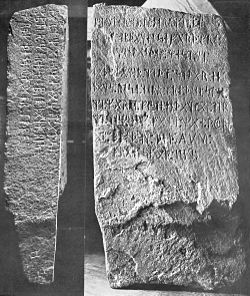
One day several years ago, I discovered an obscure book dealing (Explorations in America Before Columbus Hjalmar Holland) with the discovery and context of what may be the most interesting piece of material culture in American history, the Kensington Runestone.
(This book started me on the path that has defined my adult life. This book revealed the amazing world of the Vikings to my eyes, and helped me learn to love medieval and later modern Scandinavia. I eventually studied the subjects and earned a BA and finally an MA. Scandinavia has been my hobby and my profession for a long time and I am blessed to live there now. This chain of events has been long and rich but traces its genesis to that one book.)
In my following analysis I will rely a little bit on wikipedia, but I will supplement it with my own memory and 'expertise'.
In 1898, a Swedish settler, Olof Ohman, uncovered a Nordic artifact while grubbing a birch tree from his property. The roots of the tree clasped a flat stone that turned out to bear Runic script on the covered side. Several members of his family witnessed the discovery and later swore affidavits to the effect. Neighbors also reported that the roots of said tree were indeed flat, as though grasping the stone.
The runes have been translated by several experts to be something like: Eight Goths and twenty two Norwegians on a voyage of discovery coming from Vinland to the far west. We have made traps around two shelters one day's travel northward from this stone. We fished and when we returned (to our shelter) we found ten men bloody and dead. AVM.
We left ten men to guard our ship fourteen days travel from this place, in the year of our lord, 1362.
(Translations vary, this one is my own from years ago.)
Although the stone became an artifact of local interest and was reported in some local papers, Ohman seemed uninterested in his find and eventually stored the stone in his barn (or in his mill, reports conflict) and forgot about it. A decade later, an unemployed scholar, Hjalmar Holand, stayed in the neighborhood while attempting to secure a position and heard the stories while investigating local folklore for his thesis. He investigated, then allegedly purchased the stone from Ohman for ten dollars. (Ohman later denied this, asserting he had only consented to having the stone examined by experts)
In the decades that followed Holand promoted the stone even as experts questioned its authenticity. Holand produced dozens of books, articles, and promotional events about the stone. Holand died a firm believer, intellectually mourned by several amateur scholars that had found his arguments convincing. Even today, many people in the region and many others are believers. Even I was among their number as Holand swept me along in his enthusiasm.
But the stone is almost certainly a hoax. Here's how we know.
First, of course is the problematic location. Kensington, Minnesota is nearly 2000 miles from any ocean, and far from any major waterways. What were Nordic explorers doing in that neck of the woods? They had no reason to travel so far for products they could have procured much closer to home, like timber and slaves. Additionally, the Norse of the period were not known for ranging widely, the Viking Age had ended centuries prior. Even the unfortunate Greenlandic Norse, the only Europeans of the hemisphere, had slipped so deep into poverty they could not boast any sea going vessels of their own, relying entirely on the Norwegian crown for supplies. Within a century they would be extinct. The timing all wrong. Nordic loggers in Labrador would also be anachronistic, let alone in Minnesota. though stone is out of place.
Second, the use of runes and the language are highly anachronistic. Writing is a technology, not merely a method of capturing meaning. Its use varies with how it is produced, with its intended use, and place it occupies in a culture. Thus it is not strictly accurate to compare writing without also understanding its context. Runes are not equivalent to writing on a piece of paper. Where our letters represent a phoneme or concept, runes also represented something deeper. Each rune was believed to also have an essence, a character. (What some in the modern Pagan movements call magic)
There were many runic alphabets that varied from region to region, but also from person to person in order to preserve a personal essence. Runestones are common is Scandinavia as late as the 12th cetury, later in some districts. They were erected as an assertion of power, of memory, or of penance. For example a rich king would pay a runic 'shaman' to carve a stone that would proclaim 'King Eiric built this bridge in honor of his wife'. The runes seal or magnify the power of the king, in other words they give the power. Thus, the runestone is not a mere sign telling who made the bridge, but a capturing of the power.
Runes were not used as signs, generally speaking, and an improperly carved rune could illness or accident. Eventually the Norse learned to write in regular Roman script as Christianity became more widespread and runes became a curiosity and finally abandoned. By 1362, runic writing was almost totally forgotten and runestones were long since rejected as of the devil. To sum up, using a runestone to commemorate this expedition is anachronistic.
There are other, bigger problems, too. The word opþagelsefarþ (voyage of discovery) is not Old Norse, but a 19th century invention. Several runes are also out of place. The runic alphabet used on the stone seemed to be a mixture of different regional alphabets. To put it another way, the Norse of the 14th century, if carving a memorial, would have used the Roman alphabet, and knowledge of runes at this time would have been limited to monks and such like that.
Finally ,there is the problem of context. The upper Midwest, especially western Minnesota, is densely settled by Scandinavians who in this period were torn between a developing American pride and an emergent Scandinavian nationalism. Ohman and a million farmers like him were seeking a new voice and a new legitimacy. The stone makes perfect sense as a cultural artifact. As wiki puts it:
When Öhman discovered the stone, the journey of Leif Ericson to Vinland (North America) was being widely discussed and there was renewed interest in the Vikings throughout Scandinavia, stirred by the National Romanticism movement. Five years earlier Norway had participated in the World's Columbian Exposition by sending the Viking, a replica of the Gokstad ship to Chicago.... the runestone took root in a community that was proud of its Scandinavian heritage.
The runestone makes more sense in this context.
By now, to those interested in the discovery of the Book of Mormon the parallels should be clear. I could write a great deal more about the stone's likely creator, the equivalent to Spaulding, and much more about the controversy and actors. The continuing saga of the Kensington Runestone mirrors the Book of Mormon, and especially Mormon apologetics. Perhaps if enough here are interested, I can tell that story.