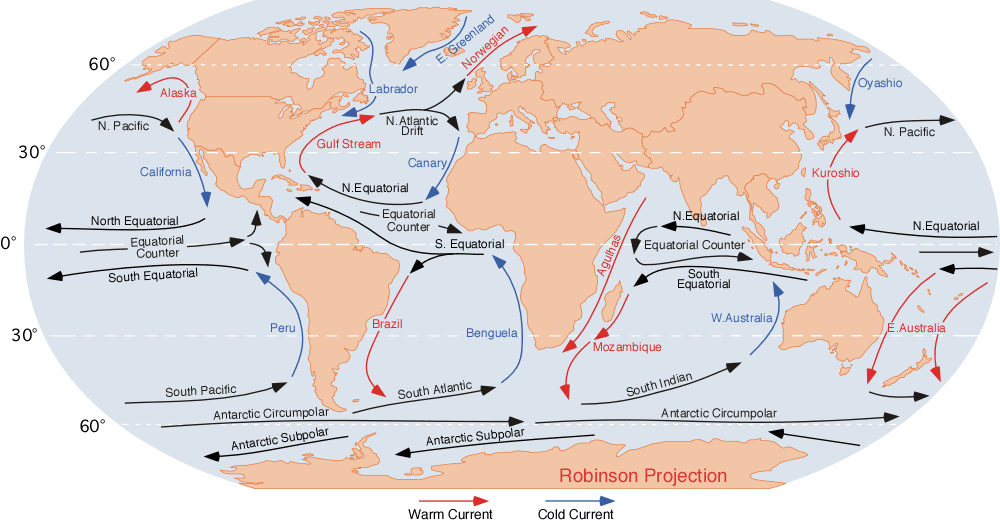
Easterly Transit Highly Unlikely: As is evident from the graphic showing major ocean currents, launching from anywhere on the southern Arabian Peninsula would have made it very unlikely that the Jaredites could have headed in an easterly direction. They would have had to catch the southern portion of the Equatorial countercurrent flowing east. As shown from the current data, this Equatorial lies well off shore and they would have had to cross the local south flowing current in order to reach it. Even if they had done so, the chances of them eventually reaching and then “drifting” through complex of narrow passages and channels between Australia and Southeast Asia into the Pacific Ocean are essentially zero. (Please note from the map that the currents in this area of the ocean are running east to west). And if they had, by some miracle, made it to the Pacific Basin, they would have been carried north by relatively strong currents with first landfall in the Western Hemisphere somewhere in Alaska or the Pacific Northwest.
Considerations Regarding a Westerly Transit: As is postulated for the voyage of Nephi, the most “logical” point for a Jaredite departure would have been from the south end of the Arabian Peninsula. The Mediterranean is a generally devoid of the surface currents necessary for a direct Middle East to Western Hemisphere crossing of the Med and Atlantic. Even if they had launched into the Med and made it into the Atlantic (which is highly unlikely without power), or launched into the Atlantic directly, as they approached the eastern seaboard of North America, the strong north flowing Gulf Stream current (2-4 knots) would have picked them up and kept them at least 5-10 miles offshore until they were well into the North Atlantic, where the North Atlantic Drift current would have most likely brought them back to Europe.
Problems with transit from current to current without power: Launching from somewhere in the eastern part of present day Oman would have put them in the Agulhas current, which would have carried them down to the tip of Africa. Had they been able to transit to the Benguella current (highly unlikely without power) , they would have had to next transit to the Northern branch of the Equatorial current (again unlikely without power) which would have eventually sent them into the Caribbean South of Haiti. This is a journey on the order of some 13,000 to 14,000 miles. Note that this route passes through a meteorological zone known as the “doldrums” between the northern and southern trade wind zones. In the doldrums winds are normally calm. It would have taken a major modification of world climatic patterns for the winds to “blow without ceasing” in region where the winds seldom blow at all.
Not Enough Time to Make the Trip: If the journey took 344 days as described in the Book of Ether, this means that that the Jaredites would have had to travel at an average speed of a little over 2 miles per hour, or approximately 50 miles per day. Except for the Gulf Stream, all other currents they could have possibly encountered in the Atlantic on this routing move at a rate of less than 9 km or about 5.4 miles per day. At these average speeds, the journey would have required at least six years, wind or no wind.
Dangerous Waters in Route: It is of interest that, even in moderate winds along the East Coast of Africa, the Aguhla current gives rise to sea conditions so severe that many large modern commercial vessels have been lost along this route, even in otherwise clear weather. In fact, mile per mile, this stretch of water accounts for more lost ships than any other commercial sea lane, and is slowly being abandoned because of this problem. The chances of wooden vessels surviving this part of the passage in moderate to strong winds would be slim indeed (yet we read the winds "did never cease to blow towards the promised land").
Problems of a “Driftwood Flotilla”: The likelihood that a flotilla of eight drifting vessels could stay together in a group at sea for 344 days is vanishingly small. Try this thought experiment. Imagine you went to southern Oman and launched eight large pieces of wood into the ocean. Let’s assume that these were 50 foot wooden poles on which you had carved your name and an identifying serial number. What are the chances you would find that all of your poles had washed ashore, at about the same place, and at about the same time, anywhere in the western hemisphere within one year (or ever)?
From experience in trying to maintain a group of sail powered vessels in visual contact with one another at sea, especially at night, even with the help of lights and radios, I can assure you that the chances of a group of eight drifting vessels staying together at sea for 344 days would be zero, especially in the face of continuous winds.
Directly Relevant Data on Drifting Objects: “In 1929 a crew of German scientists set out to track the journey of one particular bottle. It was set to sea in the South Indian Ocean with a note inside asking the finder to record the location where it washed up and to throw it back into the sea. By 1935 it had rounded the world and traveled approximately sixteen thousand miles, the longest distance officially recorded.”
This bottle was released near, or directly into, the relatively fast moving Antarctic Circumpolar current to give it the best chance of circling the globe, which it eventually did. Dynamic ocean current simulation models that I have looked at indicated that the most likely outcome for objects drifting in the Indian Ocean Agulhas current is that they would transit to the Antarctic Circumpolar current (as was the case with the German bottle), not to the Benguella current. Also note that the Benguella current and the Northern Equatorial current that would have taken a drifting object from west coast of the southern tip of Africa to the Caribbean are much slower (with a maximum speeds of 9 km/day) than the Antarctic Circumpolar current.
Provision Estimates for the Jaredites: Calculations for the provisions that such a trip would require show that approximately 40,000 kg (40 metric tons or approximately 100,000 pounds) of food and water would be needed for the 22 members of the Jaredite band for a 344 day journey. These calculations are made based on modern sail boat passage making weekly provision recommendations. (I assumed that the vessels had an length of between 40 and 50 feet and a beam of between 13 feet and 15 feet. The displacement of such a vessel would be something on the order of 20 - 30 tons, depending on construction and loading.)
As for the animals; if they took “flocks of every kind,” we could easily multiply the provision requirements by several fold. However, since we have little information as to the exact types and numbers of animal taken aboard, we will ignore this factor. Considering animals only exacerbates the food and water problem which, as shown below, is already insurmountable.
Water Contamination and Food Spoilage in Route, Especially in the Tropics: With eight vessels, (And depending on the number of humans and animals in each) the main problem with provisions is not the weight or volume of the food and water required. Although one can be assured that so laden, these vessels would not have been “light upon the water” as described in the Book of Ether.
The main problem with provisioning is keeping the drinking water from going bad and the food from spoiling without refrigeration during a one year voyage. This is an especially important problem considering that most of the trip (regardless of direction) would have been in the tropics. Much of the food could have been in the form of dried figs and dates. These are high in calories and keep fairly well. Grains, meat and most other fruits or other foodstuffs would have been a real problem (just consider the problems of the British Royal Navy in this regard several centuries later).
There is also the problem of what containers would be used to store the water. We know that in the ancient world, wine was shipped in amphora. Wood barrel making (cooper technology) had not yet been developed. The problem is that these clay vessels are heavy and could be easily broken, especially if the ship were to pitch and roll in rough seas. We are told the Jeredites "built vessels" to contain the water. Whatever they were made of they would have needed to be capable of holding more than 30 metric tons of water, and keeping it potable in the tropics for many months. It is highly unlikely that this could have been done in 2500 BC.
No Fires, No Cooked Food: Another problem is that there were to be no fires aboard the Jaredite barges, making it impossible to boil water or cook food. This would mean that the occupants had to live on dried or otherwise preserved foods with no means of making them safer by cooking before eating. In the heat and humidity of the tropics, in a closed vessel without sunlight and little ventilation, most of the food, dried or not, would have spoiled within a matter of weeks.
Mesopotamian Ship Building 2000-3000 BC: According to Makela (2002) shipbuilding in Mesopotamia in this era was surprisingly advanced. The region used the inland seas and waterways, and even some canals, for transport of goods (food, leather, textiles and timber) by ship. The shipbuilding industry required several types of imported woods, including cedar. Cedar would have been especially valuable for keels because of its single piece length and it resistance to rot and decay.
More interestingly, in terms of making the Jaredite barges “tight like unto a dish” was the use of two types of bitumen. The first was a “soft” bitumen and the second a harder, more asphalt-like material perhaps on the order of a roofing tar. In Mesopotamian ship building, these bitumen were the only means of sealing wooden ships to make them watertight. Bitumen, along with certain clays, were used both on the exterior and the interior surfaces of the hull. There is little doubt that bitumen would have been necessary for the Jaredite barges because it was the only watertight sealing material available at that time (and indeed for more than 2000 years hence. Anyone living in a bitumen-lined hull with only air holes for ventilation in temperatures above about 85 degrees F (temperatures in Oman can reach 130 degrees F, no problem), would be fortunate indeed to live for a year. The fumes given off by bitumen are toxic, and can be dangerous in closed, poorly ventilated spaces, especially in warm weather.
No Sealed Barges: In reviewing Makela’s well researched and comprehensive work on ancient Mesopotamian shipbuilding, which includes descriptions of the known ship types and uses, there is no reference whatsoever to closed hull craft or "barges" as described in the Book of Ether. So the question arises as to where the Jaredites got their “experience” in building such barges, as mentioned in the Book of Ether.
No Fire, No Hull Re-Sealing in Route: Makela (2002) explains that it was also necessary to periodically replace the bitumen sealing the spaces between the wooden planks of the hull. This was done by scraping off the old bitumen, adding new bitumen, and heating the mixture in a pot with a fire to soften it so it could be re-applied. The problem is that the Book of Ether specifically states “no fire” was to be on the barges. Therefore there could be no hull seal repair in route. Using the best technology available in that time frame, the inability to re-seal the hull underway would have lead to massive seawater ingress (leakage) which would have eventually lead to loss of the vessels.
Air Holes, Through Hull Plugs, and Hatches in Wooden Vessels: Having a hole or opening below the waterline in the hull of an oceangoing vessel made of wood presents special problems. Designing such boats with a workable watertight seal around any ports or hatches is also a problem. Shipbuilders of the time used wooden planks for the outer hull and any spaces between these planks were caulked and sealed with tar. These structures had withstand tremendous forces in rough seas and would flex and, of course, leak.
Bilge Water: If built as described described in the Book of Ether, it would not have been possible to remove the bilge water from these vessels at sea. Removal of water that leaks into a vessel requires that people with baling buckets carry the water out onto the deck and throw it overboard. If the passengers could not leave the vessel because the hatch was sealed tight and the breathing holes did not allow access to the upper deck, the boat would have eventually swamped. If the hatches were large enough to allow access to the deck they could not have been re-sealed to sufficiently withstand being "buried in the depths of the sea" once opened at sea because no fire was permitted to heat the sealing tar.
"For behold, ye shall be as a whale in the midst of the sea; for the mountain waves shall dash upon you. Nevertheless, I will bring you up again out of the depths of the sea; ...." (Ether 2:25)
Urine and Feces: The problem of bilge water removal would have been eclipsed by greater problem of removal of urine and feces of the human crew and the animals. If not removed soon after every urination of defecation, these materials would have severely contaminated the interior of the vessels, especially in heavy seas. Having experienced the failure of a head in a 50 foot sailboat and been unable to fix it for two days because of heavy seas, I would say that the interior of the barges would have been uninhabitable because of urine and feces contamination within a few weeks.
Breathing Air: Simple breathing holes would have been inadequate for ventilation. Some type of forced ventilation system with forward (windward) facing ducts or scoops to bring fresh air into the craft and rear (leeward) facing scoops aft to help expel the denser air aft would have been required. On a 50 foot vessel with a 14 foot beam, for example, these holes could not have been closed for much more than an hour or so with animals on board. In heavy seas with winds continually blowing for 344 days, it is hard to see how adequate ventilation of the barges could have been maintained, especially in the tropics.
No Stops Along the Way: The Book of Ether tells us that the winds “did never cease to blow towards the promised land”, suggesting that the trip was made without stopping for re-supply. It is highly unlikely that a wooden craft that was the length of a tree (say 50 feet) having several tons of cargo aboard and no power, could be safely beached and re-launched. With a total group of 22 people, the average crew on the eight vessels would have been three people, and some would have only had two. Imagine three people trying to beach, secure, land or launch an 20 ton vessel that had no power or steering in unfamiliar waters with no maps or charts.
In Florida we have a name for 50 foot vessels that end up on the shore with no power. They are called “shipwrecks”. And in a manner of speaking, that is exactly what this story is in terms of any claims that it is a record of actual events.
Atlantic Transit: Anyone who suggests that there were stops along the way for an Atlantic crossing would need to point out where such stops could be made. (A quick glance at a map of the South Atlantic basin shows the problem here - there is only one island group in the South Atlantic that is even close to the drift current route and it is so small it is not even on the map.)
Pacific Transit: Anyone suggesting a Pacific crossing must explain how the barges reached the North Equatorial countercurrent from the Arabian Peninsula (or any other launching place in the Middle East or Mesopotamia) and then how they traveled against the South Equatorial current (which would have taken them west instead of east) and thereafter managed to avoid wrecking their wooden craft on the reefs and shoals surrounding most Pacific Islands, or running aground on the rocks of the islands proper, as they negotiated these waters without power or the ability to steer. (I use "negotiated" instead of "navigated" because navigation implies steering control and these vessels had none. In fact being sealed in a boat that was like unto a dish, with no portals, the crew could not even see where they were going or where they had been, thus making any kind of navigation impossible.) Again, a glance at the map of currents shows that an unpowered transit from the Indian Ocean to the Pacific Ocean without experiencing an uncontrolled encounter with land would not be possible, even if the ocean currents were running in the right general direction, which they are not.
The Nibley Hypothesis: It has been pointed out that Hugh Nibley claimed that the Jaredites were not "Hebrew" (did he mean Semitic?), but "Asiatic". According to the Nibley hypothesis, "Asiatic" Jaredites, who were threatened with language problems by the Lord, crossed Asia to the Pacific and then crossed the Pacific in barges to the New World. (This just gets better all the time.)
Turns out that the ocean current in question this time would have been the very fast (and quite wide) Kuroshio current. This current would have delivered them to the American West Coast (probably Washington State or perhaps Oregon) in about 70 to 90 days, depending on where they launched. If this journey would have only taken 70 to 90 days without any fierce winds, then why did the Lord cause winds to blow (obviously in the wrong direction) and hold them at sea for 344 days? A glance at the map shows that stops along this route are also not feasible. In fact, a 344 day crossing along this route would have included at least one north Pacific winter and without fire for warmth it is unlikely that anyone would have survived.
Conclusion: The Book of Ether is Bad Fiction. This analysis shows that because of many factors, and beyond any reasonable doubt, based on hard sciences including oceanography, geography, meteorology, physics and chemistry, the ocean crossing of the Jaredites described in the Book of Ether must be judged as fiction, and bad fiction at that.