Petersen claims First Vision known about in 1827.

The catch-all forum for general topics and debates. Minimal moderation. Rated PG to PG-13.
_I have a question
_Emeritus
Posts: 9749
Joined: Fri Feb 13, 2015 8:01 am

Petersen claims First Vision known about in 1827.

Post by _I have a question »

Some critics of Mormonism deny that any reference to Joseph Smith’s First Vision existed prior to 1832. This claim is false: Hostile witnesses had demonstrably heard elements of the First Vision by 1827, and newspaper reports strongly suggest that Latter-day Saint missionaries were alluding to it by early 1831 (i.e., within a year of the founding of The Church of Jesus Christ of Latter-day Saints).

http://www.deseretnews.com/article/8656 ... ision.html

Inexplicably, Peterson fails to support his assertions with any references...
“When we are confronted with evidence that challenges our deeply held beliefs we are more likely to reframe the evidence than we are to alter our beliefs. We simply invent new reasons, new justifications, new explanations. Sometimes we ignore the evidence altogether.” (Mathew Syed 'Black Box Thinking')
_Dr Exiled
_Emeritus
Posts: 3616
Joined: Wed Sep 30, 2015 3:48 am

Re: Petersen claims First Vision known about in 1827.

Post by _Dr Exiled »

He doesn't have any sources except his imagination. That's why no references. Also, one would think that Joseph Smith would have discussed his 1820 vision prior to 1827, if it had happened that is. He didn't have any qualms at the time against telling about moroni/nephi and the plates that no one else could supposedly see. Surely seeing Jesus alone or god and Jesus together, a more grandiose vision, would have been spoken of by Joseph if he so freely spoke about the plates story?
"Religion is about providing human community in the guise of solving problems that don’t exist or failing to solve problems that do and seeking to reconcile these contradictions and conceal the failures in bogus explanations otherwise known as theology." - Kishkumen 
_Philo Sofee
_Emeritus
Posts: 6660
Joined: Wed Jul 04, 2012 9:04 am

Re: Petersen claims First Vision known about in 1827.

Post by _Philo Sofee »

It's the same with so many claims in his article "News from Antiquity" about the real good proof of the Book of Abraham. He said there was evidence, but of course. But he deposited none in his article. Just keep em believin with those faithful words of support and righteousness and they shall stay. Er, at least some of em.
Dr CamNC4Me
"Dr. Peterson and his Callithumpian cabal of BYU idiots have been marginalized by their own inevitable irrelevancy defending a fraud."
_Bret Ripley
_Emeritus
Posts: 1542
Joined: Thu Dec 16, 2010 3:53 am

Re: Petersen claims First Vision known about in 1827.

Post by _Bret Ripley »

I have a question wrote:Inexplicably, Peterson fails to support his assertions with any references...
I think he may be referring to stories published in Rochester in 1829 that allude to an 1827 vision: http://www.sidneyrigdon.com/dbroadhu/ny/miscNYSf.htm (for probably the umpteenth time, link shared with maximum gratitude to Dale Broadhurst for collecting and organizing this stuff).
_grindael
_Emeritus
Posts: 6791
Joined: Mon Aug 08, 2011 8:15 am

Re: Petersen claims First Vision known about in 1827.

Post by _grindael »

I destroy that argument here. https://mormonitemusings.com/2015/10/27 ... gm/#Think2

Here are my concluding remarks, (the actual evidence is discussed before this)

But there is one piece of evidence that apparently all the Mormon experts have missed. In the February 1, 1831 edition of the Palmyra Reflector, (The issue preceding the Feb. 14 issue), Abner Cole published this blurb:

We have received a long letter from a gentleman of respectability from Painesville, Ohio, respecting the conduct of the “Mormonites” in that state. We shall publish a synopsis of it in our next… We have an article in type, copied from the Painesville Telegraph, which from want of room has been excluded from this day’s paper detailing some account of the Mormonites in the state of Ohio, it will appear in our next.


Cole himself admits that he was only going to publish a “synopsis” of the letter. This is the material that he attributes to the “Painesville Correspondent”.

It is obvious from the above, that Abner Cole had simply taken the accounts from several of the back issues of the Telegraph, and supplemented them with material from some letter he had received which turned into the Painesville “correspondent” material. It might have even been the same person who submitted material to the Telegraph. Certainly there are too many similarities to assume all of those claims came from one letter. (Though it might be possible) It seems more likely that Cole was simply taking a little artistic license here.

This begs the question though, if we are to accept the anonymous claim that Smith had seen and spoken to God frequently as “clear evidence”; does this contradict the claim that Jeremy made which was: “There is absolutely no record of a First Vision prior to 1832?” It is ludicrous to even suggest that it does. We have no idea what was actually written in the letter that Cole received.

What Cole did was common practice in Nineteenth Century America:

News gathering procedures grew from four practices that were routine by 1800: taking items from other papers, culling excerpts from letters, assembling word of mouth reports and taking notes on congressional sessions. … Despite increased pursuit of news, a great amount of newspaper content still came from other newspapers—through the system of editors’ exchanges—until the Civil War brought the first organized, systematic news gathering in the field. (Hazel Dicken-Garcia, Reporters and Reporting in the Nineteenth Century, History of Mass Media in the United States, Margaret A. Blanchard, ed., 1998, p. 585, 586)


Cole did not publish excerpts though, but a synopsis, or brief summary of the letter he put into his own words. That means what we see in print was authored by Cole, who was not in Ohio, but in New York. We have no way at all of determining what was in the original letter. What is interesting is that in all of the comparisons above from the Telegraph, we see none that claim that Smith had actually seen God (Jesus) frequently or at all, for that matter. The Telegraph articles claimed this of Oliver Cowdery, not Joseph Smith.

This claim (about Smith seeing God frequently) only appears in Cole’s synopsis. We can confirm the information about Cowdery, but not Smith in the Telegraph articles. In other words we have no idea what additions or elaborations Cole may have made since it was not a verbatim quote of the letter. One also has to ask, if Cole actually had a long letter, why not publish at least parts of it verbatim? He certainly printed up a lot of other material on the Mormons (and Joanna Southcott) in that issue.

Christensen also astoundingly characterizes the above synopsis by Abner Cole as a “discussion of Joseph’s vision as early as November 1830″. Who is he trying to kid here? A discussion of Joseph’s claimed 1820 vision? Really? What was being discussed, apparently, were the “revelations” that Joseph had received signed by Jesus Christ, the Book of Mormon, and the New Jerusalem, along with the authority to preach.

This is his clear evidence for the claimed 1820 vision? And what about the rest of the claims that were made by Abner Cole? Is Christensen ready to admit that they too, are clear evidence of the doctrines being taught at that time? For example, that the Mormons were receiving signed “revelations” by Jesus? What is deceptive about FAIRMORMON is that they do not quote the entire article (or explain it) and let people judge for themselves if this is an actual quote, or the generalizations of an Editor.

Christensen writes,

What he does not do is cancel out or explain the reason for the existence of the distinctive themes in the February 1831 Reflector. He writes as though reticence and variations in personal knowledge in other reports about such experiences could never be a factor in who said, or reported, what when.


Distinctive “themes”? Gleaned from the synopsis of an anonymous letter? How can we take anything that Christensen says seriously? And it was one anonymous report, not “other reports” that Christensen was whining about. Perhaps we should understand this statement from the Palmyra Reflector made a week later as having distinctive themes also, that should be taken as seriously as the February 14th synopsis:

It is well known that Jo Smith never pretended to have any communion with angels, until a long period after the pretended finding of his book, and that the juggling of himself or father, went no further than the pretended faculty of seeing wonders in a “peep stone,” and the occasional interview with the spirit, supposed to have the custody of hidden treasures; and it is also equally well known, that a vagabond fortune-teller by the name of Walters, who then resided in the town of Sodus, and was once committed to the jail of this country for juggling, was the constant companion and bosom friend of these money digging impostors. (Palmyra Reflector, February 28, 1831).


Peterson and FAIRMORMON have never really analyzed the evidence for this claim. They simply take what Cole wrote completely out of context, (what was actually being reported in Ohio), and run with their own made up evidence. Peterson is a hack. He will only ever spout the Mormon "faithful" narrative, never doing any real research of his own, but keep regurgitating FAIRMORMON BS.
Riding on a speeding train; trapped inside a revolving door;
Lost in the riddle of a quatrain; Stuck in an elevator between floors.
One focal point in a random world can change your direction:
One step where events converge may alter your perception.
_Bret Ripley
_Emeritus
Posts: 1542
Joined: Thu Dec 16, 2010 3:53 am

Re: Petersen claims First Vision known about in 1827.

Post by _Bret Ripley »

grindael wrote:I destroy that argument here.
Thanks for that, grindael.

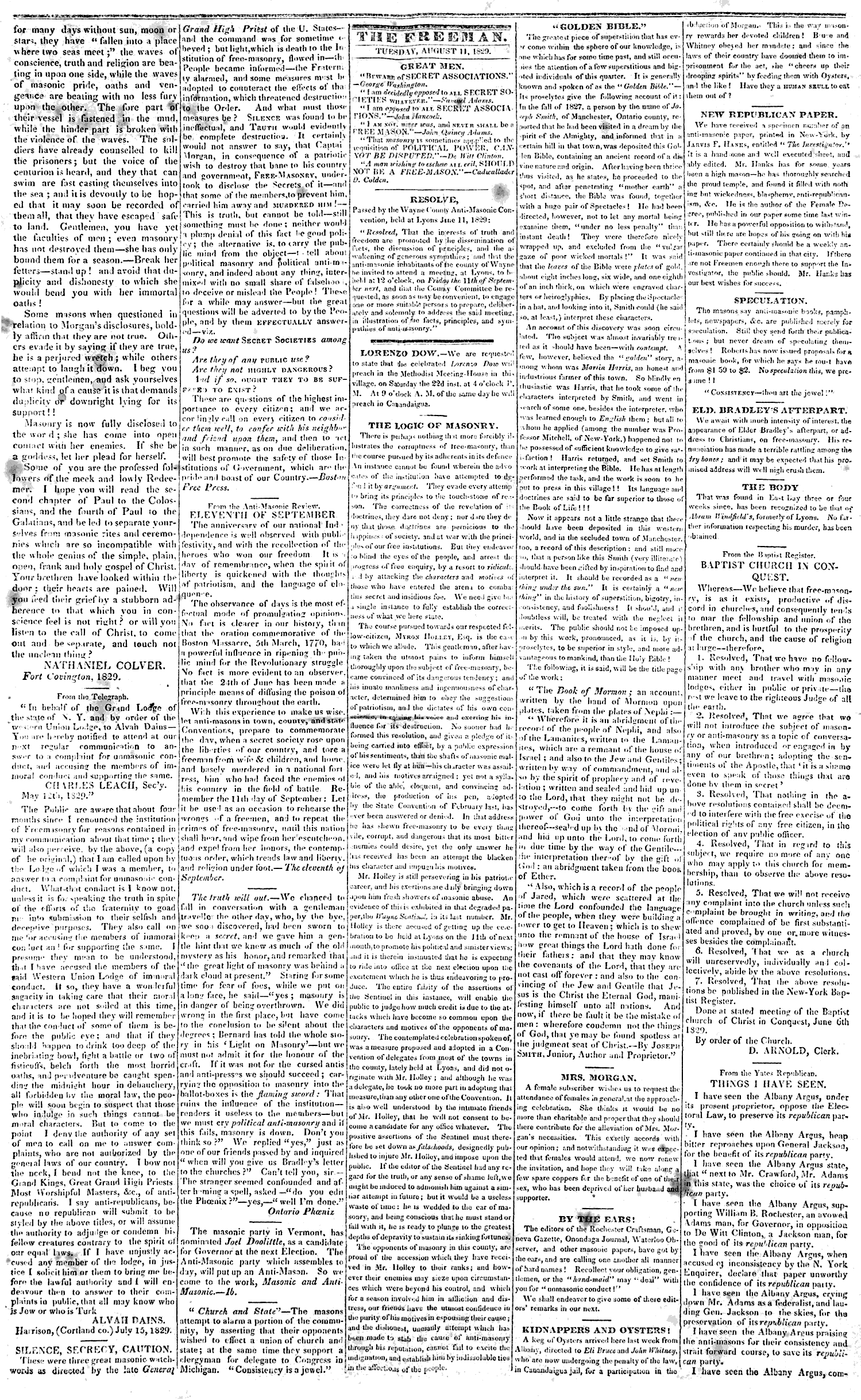
I know this really only takes us back to 1829, but I'd be interested to hear any comments you may have on this: http://www.olivercowdery.com/smithhome/Phelps/1829_0811PF-pg2.gif

(From Palmyra's The Freeman, August 11, 1829): "The greatest piece of superstition that has ever come within our knowledge, now occupies the attention of a few individuals of this quarter. It is generally known and spoken of as the "Golden Bible." Its proselytes give the following account of it: -- In the fall of 1827, a person by the name of Joseph Smith, of Manchester, Ontario county, reported that he had been visited in a dream by the spirit of the Almighty, and informed that in a certain hill in that town, was deposited this Golden Bible ..."

This account seems incompatible with Smith's later versions of his various visitations, and perhaps combines what would later become known as his 'First Vision' and and visits from Moroni. Is it any sort of stretch to regard this account as a reference to a version of the story that marks an early evolutionary step in Smith's 'First Vision' and 'Angel Moroni' tales?
_grindael
_Emeritus
Posts: 6791
Joined: Mon Aug 08, 2011 8:15 am

Re: Petersen claims First Vision known about in 1827.

Post by _grindael »

Bret Ripley wrote:
grindael wrote:I destroy that argument here.
Thanks for that, grindael.

I know this really only takes us back to 1829, but I'd be interested to hear any comments you may have on this: http://www.olivercowdery.com/smithhome/Phelps/1829_0811PF-pg2.gif

(From Palmyra's The Freeman, August 11, 1829): "The greatest piece of superstition that has ever come within our knowledge, now occupies the attention of a few individuals of this quarter. It is generally known and spoken of as the "Golden Bible." Its proselytes give the following account of it: -- In the fall of 1827, a person by the name of Joseph Smith, of Manchester, Ontario county, reported that he had been visited in a dream by the spirit of the Almighty, and informed that in a certain hill in that town, was deposited this Golden Bible ..."

This account seems incompatible with Smith's later versions of his various visitations, and perhaps combines what would later become known as his 'First Vision' and and visits from Moroni. Is it any sort of stretch to regard this account as a reference to a version of the story that marks an early evolutionary step in Smith's 'First Vision' and 'Angel Moroni' tales?


This is claiming it is in a dream. Not a vision. And it is obviously a garbled account of the angel story. From the Rochester Gem:

“In the autumn of 1827 a man named Joseph Smith of Manchester, in Ontario County, said that he had been visited by the spirit of the Almighty in a dream, and informed that in a certain hill in that town was deposited a Golden Bible, containing an ancient record of divine origin. He states that after the third visit from the same spirit in a dream he proceeded to the spot, removed earth, and there found the Bible, together with a large pair of spectacles. He had also been directed to let no mortal see them under the penalty of immediate death, which injunction he steadfastly adheres to. The treasure consisted of a number of gold plates, about 8 inches long, 6 wide, and one eighth of an inch thick, on which were engraved hieroglyphics. By placing the spectacles in a hat and looking into it, Smith interprets the characters into the English language."


This was from Martin Harris and he was telling the angel story. It was being paraphrased by the editor of the Gem. Anyone who thinks this is somehow an allusion to the claimed 1820 vision is being extremely disingenuous.
Riding on a speeding train; trapped inside a revolving door;
Lost in the riddle of a quatrain; Stuck in an elevator between floors.
One focal point in a random world can change your direction:
One step where events converge may alter your perception.
_grindael
_Emeritus
Posts: 6791
Joined: Mon Aug 08, 2011 8:15 am

Re: Petersen claims First Vision known about in 1827.

Post by _grindael »

Here is the FAIRMORMON page that Peterson pretty much plagiarized:

Question: How early was the story of the First Vision known among the members of the Church?

Claims made by critics regarding early knowledge of the First Vision

It is claimed that "there is absolutely no record of a First Vision prior to 1832." [1]
It is claimed that there is "no reference to the 1838 canonical First Vision story in any published material from the 1830s."
It is claimed that "Not a single piece of published literature (Mormon, non-Mormon, or anti-Mormon) from the 1830s mentions Smith having a vision of the Father and Son."
If Joseph Smith's First Vision actually occurred, then why wouldn't it have been mentioned in the local newspapers at the time? Since no such record exists, is this evidence that the vision must not have actually occurred?
There is evidence that Church members were aware of elements of the First Vision story as early as 1827

Several LDS commentators - including one member of the Quorum of the Twelve Apostles - agree that D&C 20:5 (part of the Articles and Covenants of the Church) is the earliest published reference to the First Vision story. [2] The Articles and Covenants of the Church were presented to the Church membership and then published in the following order.

The Articles and Covenants of the Church are first verbally presented by Joseph Smith for approval at a Church conference held in Fayette, New York on 9 June 1830 (see Cannon and Cook, Far West Record, 1). The following sequence is found in the Articles and Covenants: (1) forgiveness of sin, (2) entanglement in vanities of the world, (3) visit of an angel with regard to the Book of Mormon plates. This is the exact same sequence presented in the Prophet's unpublished 1832 history and the forgiveness of sins comes during the First Vision event in that document.
The Articles and Covenants of the Church were read out loud by Oliver Cowdery during a Church conference on 26 September 1830 (see Cannon and Cook, Far West Record, 3).
The Articles and Covenants of the Church were published in a non-LDS newspaper in Painesville, Ohio (Telegraph, 19 April 1831).
The Articles and Covenants of the Church were published in an LDS newspaper in Independence, Missouri (Evening and Morning Star, vol. 1, no. 1, June 1832).
The Articles and Covenants of the Church were published in an LDS newspaper in Independence, Missouri (Evening and Morning Star, vol. 2, no. 13, June 1833).
The Book of Commandments—which contained the Articles and Covenants—was published in July 1833 in Independence, Missouri (chapter 24, verses 6-7, page 48).
January 1835 Kirtland, Ohio reprint of an Evening and Morning Star article containing the “Articles and Covenants” (reprint of Evening and Morning Star, vol. 1, no. 1, June 1832, 2; reprinted by Frederick G. Williams).
The first edition of the Doctrine and Covenants - which contained the Articles and Covenants - was published in September 1835 in Kirtland, Ohio (part 2, section 2, verse 2, pages 77-78).
June 1836 Kirtland, Ohio reprint of an Evening and Morning Star article containing the “Articles and Covenants” of the Church (reprint of Evening and Morning Star, vol. 2, no. 1, June 1833, 1; reprinted by Oliver Cowdery).
Notes

Jump up ↑ Jeremy Runnells, Letter to a CES Director. http://www.cesletter.com
Jump up ↑ See Hyrum M. Smith, Doctrine and Covenants Commentary (Liverpool: George F. Richards, 1919), 139; Robert L. Millet and Kent P. Jackson, eds., Studies in Scripture, Volume 1: The Doctrine and Covenants (Salt Lake City: Deseret Book, 1989), 110–11; Grant Underwood, “First Vision,” in Daniel H. Ludlow, ed., Encyclopedia of Mormonism (New York: Macmillan, 1992), 2:410; Stephen E. Robinson and H. Dean Garrett, A Commentary on the Doctrine and Covenants (Salt Lake City: Deseret Book, 2000), 1:130.
Categories: First VisionLetter to a CES DirectorMormonThink https://www.fairmormon.org/answers/Ques ... _Church%3F
Riding on a speeding train; trapped inside a revolving door;
Lost in the riddle of a quatrain; Stuck in an elevator between floors.
One focal point in a random world can change your direction:
One step where events converge may alter your perception.
_grindael
_Emeritus
Posts: 6791
Joined: Mon Aug 08, 2011 8:15 am

Re: Petersen claims First Vision known about in 1827.

Post by _grindael »

I've posted this elsewhere.

As for D&C 20, I have a different take on that. The verses in question read,

6. For, after that it truly was manifested unto the first elder [Joseph Smith] that he had received remission of his sins,[1823 by the angel] he was entangled again in the vanities of the world, 7. but after truly repenting, [In 1827 after his Examination for Glass Looking] God visited him by an holy angel, whose countenance was as lightning, and whose garments were pure and white above all whiteness, and gave unto him commandments which inspired him from on high, and gave unto him power, by the means which was before prepared that he should translate a book;


The Articles and Covenants say that “after it was truly manifested that he [Joseph] had received a remission of his sins”, then he “was entangled again in the vanities of the world,” then “after truly repenting” an angel visited him who gave him commandments and “power” to translate a book “by the means which was before prepared.”

What does this mean? Mormon Apologists would have you believe that Joseph is referring to a vision that he claimed he had when he was fourteen years old, in the spring of 1820, and that after this vision (between 1820 and 1823) Joseph was “entangled again in the vanities of the world” and that he repented and then God sent Joseph an angel who gave him the means to translate a set of gold plates that this angel had buried when he was a mortal man.

There are many problems with this explanation for the verses in D&C Section 20. For example, in their 1834-5 History of the Church published in The Latter-Day Saints’ Messenger And Advocate , Cowdery writes that Joseph was 17 when he experienced the religious excitement that led him to first “call upon the Lord in secret for a full manifestation of divine approbation, and for, to him, the all important information, if a Supreme being did exist, to have an assurance that he was accepted of him.”

Cowdery then relates that in answer to this prayer by Joseph, who was a “penitent sinner”, an angel appeared to Joseph and told him that he was “sent by commandment of the Lord, to deliver a special message, and to witness to him that his sins were forgiven, and that his prayers were heard.”

This then, would be the first instance of Joseph receiving any kind of heavenly manifestation, and also having it confirmed that his sins were forgiven. At this time (1823) Joseph did not get any “power”, nor the “means which was before prepared” to translate the gold plates. In fact, in 1832 the Fredonia Censor published that,

Joseph Smith, then an inhabitant of the state of New-York, county of Ontario, and town of Manchester. Having repented of his sins, but not attached himself to any party of Christians, owing to the numerous divisions among them, and being in doubt what his duty was, he had recourse prayer. After retiring to bed one night, he was visited by an Angel and directed to proceed to a hill in the neighborhood where he would find a stone box containing a quantity of Gold plates. “Mormonism,” Fredonia Censor, March 7, 1832.


But they leave something out. The FOUR YEARS between 1823 and 1827 when Smith was involved with the moneydiggers. THEN, after this, he was again visited by the angel and got the plates. This is exactly what Joseph and Oliver describe happened in their 1834-35 History. The Articles and Covenants of the church describes the period between 1823 and 1827, when Joseph became involved with a band of money diggers, which included his own father, which ultimately led to his arrest for “glass looking” in 1826. The reason that it could not be describing the period from 1820 to 1823 is simply because Joseph supposedly did not receive any “power” from the angel until the fall of 1827, after he had “truly” repented. It was then he supposedly took possession of the plates and got the powerful "spectacles" in which he could see anything. He told his mother he was more excited about those, than the plates. According to the history published by Joseph Smith himself, [1834-35] his “recourse prayer” took place in 1823.
Riding on a speeding train; trapped inside a revolving door;
Lost in the riddle of a quatrain; Stuck in an elevator between floors.
One focal point in a random world can change your direction:
One step where events converge may alter your perception.
_Bret Ripley
_Emeritus
Posts: 1542
Joined: Thu Dec 16, 2010 3:53 am

Re: Petersen claims First Vision known about in 1827.

Post by _Bret Ripley »

Thanks again, grindael.

For my part, I hesitate to refer to a coherent 'first vision' narrative before 1832. Even after that, it's a tale that continued to grow in the telling. One of the characteristics of a prophet seems to be difficulty in keeping a story straight.

As for the distinction between a vision and a dream -- if we were talking about a real event, then yeah. But I was speculating (and nothing more) that the 1829 may refer to story elements that were later re-purposed in the form of two distinct narratives -- an 'earlier' vision and an angelic visitation. Anyway, it was just a passing fancy and I think your interpretation (i.e. it's simply a mangled version of the angel story) is by far the more reasonable/probable.
Post Reply