Exmo’ Influencers Mount a TikTok War Against the Mormon Church
When Madeline Woodward discovered ex-Mormon influencers on social media, it was her first glimpse of people finding joy after leaving the Church of Jesus Christ of Latter-day Saints.
Woodward, a descendant of church pioneers, had struggled for years to reconcile her faith with church policies she viewed as antigay, discriminatory and troubling, like the polygamy of Mormon founder Joseph Smith.
After watching posts on TikTok and Instagram known as #exmo content, she realized she wasn’t alone. In April, she requested that her records be removed from church member rolls. Woodward, whose intense dedication to her faith previously led classmates to call her “Mormon Maddie,” had officially severed ties with the church.
Once among the world’s fastest-growing religions, Mormonism is facing a 21st-century reckoning, driven by social-media influencers—and the church is racing to counter them.
In video after video, an army of #exmo creators emphasize controversial aspects of LDS history, such as “death oaths” to protect temple secrets or a regulatory fine the church paid in 2023 for hiding the scale of its wealth. They question some of the Book of Mormon’s claims, pointing to a lack of archaeological evidence, dissect leaders’ efforts to modernize, and share snapshots of the happier lives they find outside the church.
“Creators gave me the final boost to take my name off the list,” Woodward said.
Younger generations have long questioned their parents’ faith, whatever the religion—and lately, many have aired their grievances online. Some religious officials have worked to harness the internet in their favor. In late July, the Vatican hosted more than 1,000 content creators for a two-day Jubilee for Digital Missionaries and Catholic Influencers, with an appearance from Pope Leo XIV.
Mormonism is particularly vulnerable to social-media backlash. Organized in 1830, it’s a relatively new religion—with documents detailing the peccadilloes of its early leaders that skeptics scrutinize. Mormon leaders manage their flock with a hierarchical and centralized style, rooted in conservative practices that have repelled some younger members. And former members who leave the church say they face judgment from others in their tightknit communities for their decision.
“Ex-Mormons used to be their own secret society,” said Alyssa Grenfell in Texas, who started questioning her faith about nine years ago and now has more than 1 million followers across her social-media accounts. “To become public about this—it’s like ‘Oh, my God, she went there.’”
The church declined to comment.
The church’s fight for relevance on social media comes as it battles a broader membership crisis. After decades of expanding its American base by 4% a year, official church rolls are now growing less than 1% annually in the U.S. Globally, church growth is bolstered by converts abroad, especially in Africa.
The portion of people in the U.S. who identify as Mormon has almost halved from the 1.8% they represented in 2012, according to the Cooperative Election Study, a survey of more than 50,000 Americans. Justin Turman, a former member who conducts church attendance surveys, has found that approximately 21% of the 17.5 million official members worldwide are actively involved in the church.
“Retention is the easiest way for a religion to stay robust,” said Ryan Burge, a professor of political science at Washington University in St. Louis who studies religion. “Mormonism has a retention problem,” even more so than many Christian denominations, he added.
To counter the #exmo narratives, teams of employees, pastoral officials at its Utah headquarters and even a paid ad agency are organizing a slate of pro-church influencers. They highlight positive perspectives on the Book of Mormon and encourage viewers to meet with missionaries.
Cultural trends like the hit reality show “The Secret Lives of Mormon Wives” and the #Tradwives movement, which has raised the profile of some Mormon families, have driven curiosity about the church. Some insiders are calling it a “Mormon Moment,” with a chance to draw new members, and the church’s reputation management department has tracked the interest.
Yet negative videos about the church vastly outnumber positive ones on social media, according to people familiar with the institution’s tallies of the content. Recent polling data of nonmembers studied by the church found that “cult” was the most common word people associated with the church, they said.
Going viral
The church and the internet coexisted for decades before #exmo stormed TikTok and Instagram. Former Mormons could find community on online discussion site Reddit and in private groups on Facebook—but they had to intentionally seek out those online communities.
Now, TikTok and Instagram’s Reels serve #exmo content to people who never intended to search for it. Those apps’ algorithms can inundate viewers in “rabbit holes” of content when they determine those users are lingering on videos about a particular topic.
The flood of videos from #exmo influencers question church rules banning same-sex marriage, previous policies that barred Black men from the priesthood until 1978 and current restrictions on leadership positions for women.
“When your content is all about problems with the church, it’s kind of hard to dismiss it,” said Benson Lawson, 20, who left the church last summer after finding #exmo content on social media.
Lex Ivarsson, who goes by ExmoLex on social media, said she had been posting to YouTube for a year about her decision to leave the church, with videos garnering thousands of views. When she posted on TikTok, her third video received more than a million views. “TikTok shocked me,” Ivarsson said.
Short-form videos challenging church doctrine and culture have supercharged the speed with which many young people are deciding to leave the church, according to former member John Dehlin, a longtime church critic who hosts a prominent podcast about Mormon controversies.
Several ex-Mormons said their social-media videos went viral when they started posting them in 2020. That year, creators noticed the hashtag #exmormon had received a total of more than 200 million views on TikTok, and was increasing by about 1 million views a day. TikTok no longer displays the number of views a hashtag has received.
Crisis of faith
Mormons used to leave the tightknit LDS community quietly. Now they are finding a large—and loud—audience online.
Grenfell’s posts, such as “The Day I Realized I Was in a Cult” and “That Time I Believed in Polygamy in Heaven,” are controversial among Mormons. The 32-year-old posts about topics members of the faith prefer not to discuss publicly, such as the events that occur during baptisms, initiations and other ceremonies in the temples they consider sacred. Some Mormons describe her content as “cult porn” that they believe ridicules their religion in an attempt to attract followers.
Grenfell said she is trying to help others navigate their own decisions to leave the faith.
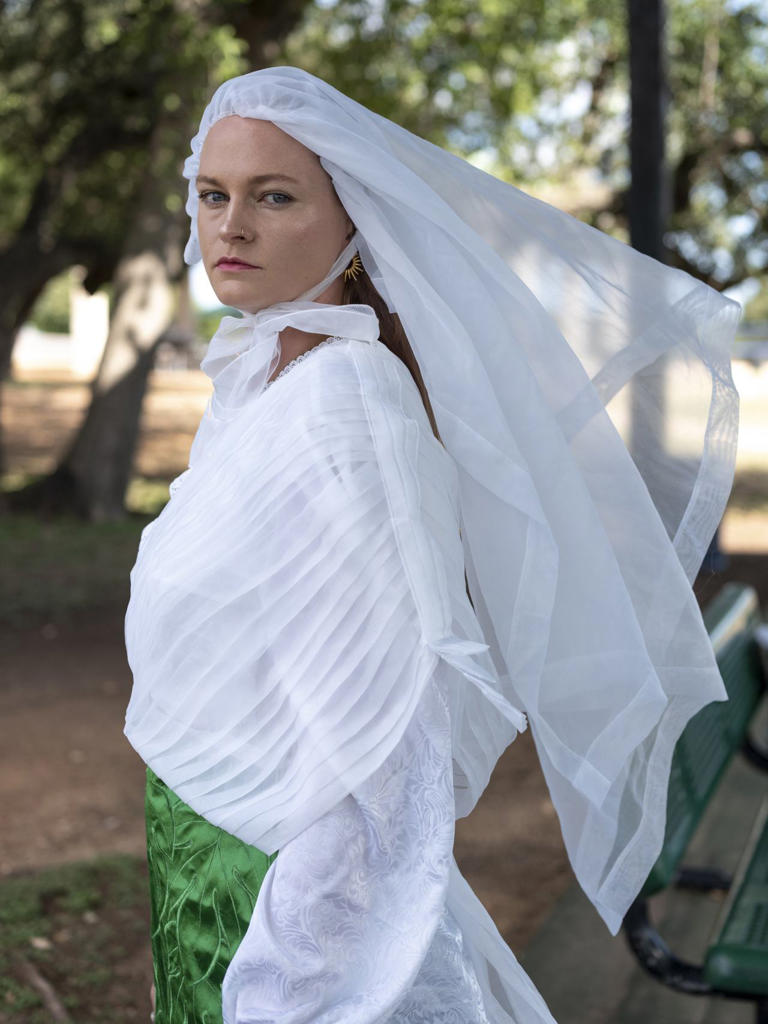
Grenfell wearing sacred temple clothing. She has featured such garments in her videos—a move some practicing Mormons consider sacrilegious.
© Ilana Panich-Linsman for WSJ
Part of Grenfell’s appeal to many questioning members are her LDS bona fides: She attended Brigham Young University, served a mission and married in a temple at 23. She started questioning her faith in 2016, and decided to leave the church a year later.
Abigail Hancock from Utah said she had been in a crisis of faith for years after facing judgment at church for having a baby without being married. It wasn’t until she saw Grenfell’s videos about Mormon founder Joseph Smith that she decided to leave.
Grenfell said in one video that Smith married multiple women without disclosing some of the relationships to his first wife. Hancock was shocked. “Everything fell on its head,” she said.
Grenfell knows firsthand how hard it can be to leave. Religious leaders promote the idea of an afterlife in which members are reunited with loved ones, but it doesn’t apply to people who resign. Friends and family of those leaving the church often grieve the loss of that opportunity and try to convince them to stay. Community members sometimes cut ties entirely with people who leave the church, intensifying the feelings of loneliness for those who want out.
Growing up in an intensely Mormon community in Utah, Cecily Hughes said she long tried to stick with church-approved sources of information, largely avoiding social media. For years, Hughes said, she didn’t realize gay people existed and fell into a depression while grappling with her sexuality.
“Doubt your doubts before you doubt your faith,” church members often repeated to her. By 18, Hughes discovered Grenfell’s videos online and months later decided to leave the church.
The Book of Mormon
The church has pressured a number of prominent influencers in recent years to stop producing content critical of the church, stripping some of their membership and prompting others to resign before they could be excommunicated.
Leaders increasingly post short-form video content on the church’s social-media accounts, featuring a variety of members and faith stories and Mormon apostles. It has also encouraged its tens of thousands of missionaries to post pro-church content.
“There are so many things that are being blasted into your feed the minute the algorithm detects you’re a Latter-day Saint, and it’s all negative,” said Jasmin Rappleye, who until recently worked for an organization with funding from the church, in one video.
Rappleye belongs to a group of LDS content creators trying to promote their faith and connect with other members on social media. For many, their motivation is to try to counter the rise in the number of #exmo voices, who they say outnumber them.
Creators like 24-year-old Tautai Fano, in Utah, focus on the culture of the church. Fano, who has about 300,000 followers, goes by ElderTikTok on social media.
“I’m looking for the people who have been lost, and remind them that you can be Mormon and be yourself at the same time,” he said.
David Snell, 33, tries to address controversial questions about church history and provide what he sees as a faithful perspective on what the #exmo community is saying. Based in Utah, he hosts a prominent podcast, called Keystone, sponsored by an LDS nonprofit.
“If the only place you are getting information about the faith is from people who have left it, chances are you are probably not seeing a lot of reasons people choose to join and stay in the church,” Snell said.
Write to Georgia Wells at
georgia.wells@wsj.com