Page 1 of 1
Interesting downward trends within Mormon polling data
Posted: Sat Sep 06, 2025 1:22 am
by drumdude
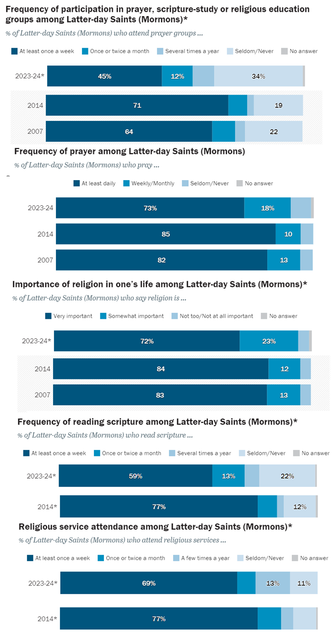 https://www.pewresearch.org/religious-l ... int-Mormon
Here's what DCP and the Deseret News cherry picked out:
But what does the data say?
For a long time, it was difficult to find a survey with sufficient data on current and former Latter-day Saints to answer these questions. However, the latest Pew Religious Landscape Survey (2023-2024) includes responses from 313 former members, 414 lifelong members, and 147 converts. (The highly reputable Pew survey also has the advantage of being independent and not specifically about active Latter-day Saints or former members. This avoids sample and selection biases, and there is less risk of desirability bias, or people answering according to what they think the surveyors want to hear.)
According to the Pew numbers, about 35% of lifelong Latter-day Saints are “very happy” and 50% “pretty happy” — totaling 85% of current members. On the same questions, about 20% of former Latter-day Saints say they are “very happy” and 55% “pretty happy” - totaling about 75%.
When asked in this national survey, then, majorities of members and former members say they are happy. In the other direction, while about 10% of converts and 15% of lifelong members surveyed say they are “not too happy,” about a quarter of ex-members say the same.
When asked about their family life, 31% of converts and lifelong members said “excellent” (with another 38% saying “very good,” 19% “good”, 11% “fair” and 1% “poor”).
On the same question, 20% of former members described their family life as “excellent” (with another 39% saying “very good,” 28% “good,” 8% “fair,” and 6% “poor”).
These differences above are not dramatic, but they are enough to rebut an increasingly popular narrative. The idea that leaving The Church of Jesus Christ of Latter-day Saints leads people toward more happiness — as implied by the influencers highlighted by The Wall Street Journal — is not borne out by data.
https://www.deseret.com/opinion/2025/09 ... -pew-data/
Re: Interesting downward trends within Mormon polling data
Posted: Sat Sep 06, 2025 2:27 pm
by Physics Guy
Statistics about how things are don't say why they are so. If ex-Mormons were happier than Mormons, it could be because Mormonism attracted unhappy people because it strengthened and comforted them in their sorrow. If more Mormons report being happy, it could be because Mormonism makes people feel that they should say they are happy while ex-Mormons are free to admit things aren't great.
I've just been thinking again about some statistics that are, if not completely unambiguous, more straightforward than measures of happiness, namely the trends of LDS church membership numbers over time. For a long time I was puzzled by the fact that although membership growth had been exponential initially, for the past few decades it has been much closer to linear, and lately has even been levelling off. Linear growth continuing at a steady rate, for long enough that the membership doubles, seemed like a miraculous balancing of exponential factors. I was suspecting that the numbers were fake.
I shouldn't have been puzzled by the linear era. The LDS church membership numbers over time turned out to fit nicely to a so-called logistic function, which is a simple and common pattern of growth. Logistic growth starts out exponential, but then it always does have a long nearly-linear phase, before eventually levelling off. You get logistic growth, rather than exponential, whenever growth is proportional to the existing population (as with reproduction and proselytising), plus a negative feedback proportional to the square of the existing population. One easy way to get such population-squared negative growth correction is for the population growth to come from a limited pool of potential converts, since then the number of potential converts goes down whenever more have already been converted. Whatever the mechanism, that population-squared feedback automatically makes the growth close to linear throughout the middle phase between initial takeoff and the final plateau.
It doesn't take any miracles. And this is exactly the kind of thing that I ought to have understood better, professionally. So, d'oh. There's always something to learn.
It may be interesting to fit the LDS church statistics to a logistic curve and then try to deduce exactly what it is that makes that negative feedback. It may be worth considering a generalised kind of logistic growth that takes into account the simultaneous growth of the world population (which also seems to be logistic rather than exponential). The idea that occurred to me today, though, was in a different direction.
The fifteen men who run the LDS church have surely seen all kinds of analysis like that. What conclusions can they have drawn from the clear and dramatic falling off from exponential growth? Are they daunted and humbled?
The thought that occurred today was: probably not. All they need to assume is that only a certain fraction of humanity is destined to join the LDS church—only the most valiant souls. The fact that membership numbers are plateauing just means that the church has grown big enough, and its continuing missionary efforts are effective enough, that church membership is now bumping the ceiling of the number of valiant ones.
Faltering growth means they're winning. The end of the race is in sight. Hold the course. All is well.
Re: Interesting downward trends within Mormon polling data
Posted: Sat Sep 06, 2025 3:56 pm
by malkie
Physics Guy wrote: ↑Sat Sep 06, 2025 2:27 pm
Statistics about how things are don't say why they are so. If ex-Mormons were happier than Mormons, it could be because Mormonism attracted unhappy people because it strengthened and comforted them in their sorrow. If more Mormons report being happy, it could be because Mormonism makes people feel that they should say they are happy while ex-Mormons are free to admit things aren't great.
I've just been thinking again about some statistics that are, if not completely unambiguous, more straightforward than measures of happiness, namely the trends of LDS church membership numbers over time. For a long time I was puzzled by the fact that although membership growth had been exponential initially, for the past few decades it has been much closer to linear, and lately has even been levelling off. Linear growth continuing at a steady rate, for long enough that the membership doubles, seemed like a miraculous balancing of exponential factors. I was suspecting that the numbers were fake.
I shouldn't have been puzzled by the linear era. The LDS church membership numbers over time turned out to fit nicely to a so-called logistic function, which is a simple and common pattern of growth. Logistic growth starts out exponential, but then it always does have a long nearly-linear phase, before eventually levelling off. You get logistic growth, rather than exponential, whenever growth is proportional to the existing population (as with reproduction and proselytising), plus a negative feedback proportional to the square of the existing population. One easy way to get such population-squared negative growth correction is for the population growth to come from a limited pool of potential converts, since then the number of potential converts goes down whenever more have already been converted. Whatever the mechanism, that population-squared feedback automatically makes the growth close to linear throughout the middle phase between initial takeoff and the final plateau.
It doesn't take any miracles. And this is exactly the kind of thing that I ought to have understood better, professionally. So, d'oh. There's always something to learn.
It may be interesting to fit the LDS church statistics to a logistic curve and then try to deduce exactly what it is that makes that negative feedback. It may be worth considering a generalised kind of logistic growth that takes into account the simultaneous growth of the world population (which also seems to be logistic rather than exponential). The idea that occurred to me today, though, was in a different direction.
The fifteen men who run the LDS church have surely seen all kinds of analysis like that. What conclusions can they have drawn from the clear and dramatic falling off from exponential growth? Are they daunted and humbled?
The thought that occurred today was: probably not. All they need to assume is that only a certain fraction of humanity is destined to join the LDS church—only the most valiant souls. The fact that membership numbers are plateauing just means that the church has grown big enough, and its continuing missionary efforts are effective enough, that church membership is now bumping the ceiling of the number of valiant ones.
Faltering growth means they're winning. The end of the race is in sight. Hold the course. All is well.
Perhaps Marcus will tackle the curve-fitting exercise.
If your speculation is valid - church membership is now bumping the ceiling of the number of valiant one - I wonder if the Mormon god always had such low expectations, such that only a tiny fraction of his potential offspring would be able to follow him into godhood.
When I became responsible for administering and instructing a class for adults who had dropped out of school, but now wanted to obtain their HS certificate, I was very optimistic about how many of my students would complete the required courses and go on to great things.
It didn't take long for realism to settle in, along with the realization that, for the great majority of my students, HS graduation or its equivalent would remain forever out of reach. For some, the life choices that caused them to drop out in their youth were still affecting their lives; for others, it was the challenge of fitting in the required studying with the responsibilities of an adult life that was already taking all of their time and energy; only a pitifully small number reached their goal, and I suspected that, even without my efforts, these ones would eventually have got there.
Perhaps this is how the Mormon god felt/feels.
At least I can console myself with the thought that I never reached the point at which I drowned almost all of my students.
Re: Interesting downward trends within Mormon polling data
Posted: Sun Sep 07, 2025 2:48 pm
by Physics Guy
malkie wrote: ↑Sat Sep 06, 2025 3:56 pm
When I became responsible for administering and instructing a class for adults who had dropped out of school, but now wanted to obtain their HS certificate, I was very optimistic about how many of my students would complete the required courses and go on to great things.
It didn't take long for realism to settle in, along with the realization that, for the great majority of my students, HS graduation or its equivalent would remain forever out of reach. For some, the life choices that caused them to drop out in their youth were still affecting their lives; for others, it was the challenge of fitting in the required studying with the responsibilities of an adult life that was already taking all of their time and energy; only a pitifully small number reached their goal, and I suspected that, even without my efforts, these ones would eventually have got there.
A couple of younger members of my extended family haven't yet made it through high school or its equivalent. We're all worried for them because they're not getting jobs or other training, and I think that means there's a bigger problem, a general stalling in life of which crashing out of high school was just the first big effect. We'd be thrilled if they even just tried to go back and get a certificate.
But maybe we'd be badly wrong to be thrilled about that, if it's actually as hard as you say. Doing it and succeeding would be great, but trying and failing yet again might just make everything worse.
Early in my own teaching career an older professor told me that one third of students couldn't be helped, a third didn't need help, and so I should focus all my effort on the middle third. It was kind of cynical but I think it was good advice, because teaching can absorb unlimited time and effort, and the only way to avoid burnout is to recognize the limits of what you can do.
On the other hand every single student is a whole human being who's going to live a whole life. A teacher who makes just a bit of a difference for someone isn't just making a little bit of a difference. Teachers can do an absurd amount of good—and probably never know it.
Maybe when Saint Peter goes over your account with you, to see how much treasure you stored up in heaven for your eternal retirement, he'll point to some forgotten little conversation with one student and tell you, "This was a BitCoin. It's worth sixteen billion dollars."