Page 1 of 2
Combat Photography...old school
Posted: Sat Nov 02, 2013 1:34 am
by _The Erotic Apologist
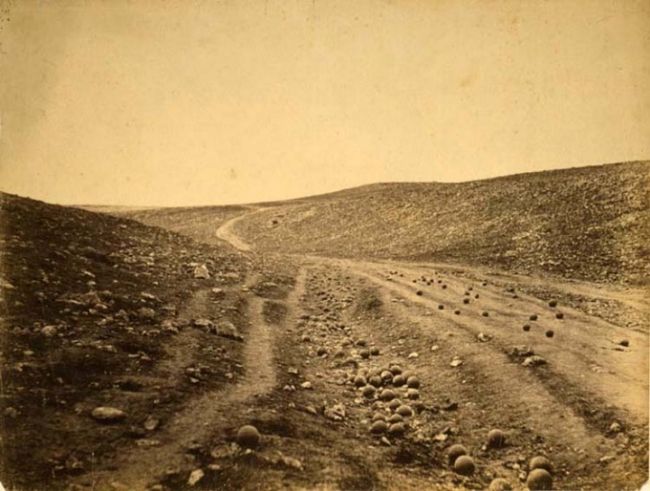 The Valley of the Shadow of Death
 by Roger Fenton, 1855.
This is the same "Valley of Death" spoken of in
The Charge of the Light Brigade by Alfred Tennyson.
Re: Combat Photography...old school
Posted: Sat Nov 02, 2013 1:37 am
by _The Erotic Apologist
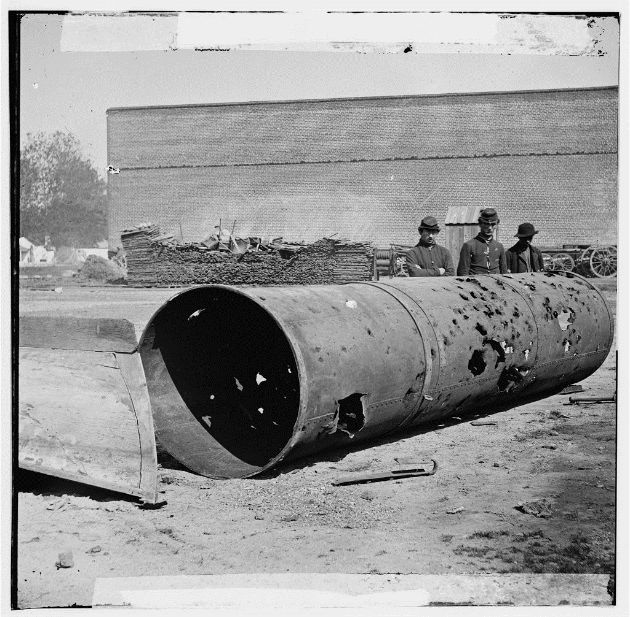
The smokestack of the
CSS Virginia 2, a Confederate ironclad that participated in the battle of Trent's Reach, 1865.
Re: Combat Photography...old school
Posted: Sat Nov 02, 2013 1:43 am
by _Quasimodo
The image of the cannon balls at Balaclava may be my favorite very old photo. Some survived that charge. God knows how.
Re: Combat Photography...old school
Posted: Sat Nov 02, 2013 1:53 am
by _The Erotic Apologist
Re: Combat Photography...old school
Posted: Sat Nov 02, 2013 2:25 am
by _Quasimodo
It's an interesting analysis. Did the cannon balls get repositioned on the road to make a more dramatic photo?
It's both good and bad that Fenton's image was not taken a few days before it was. Showing the carnage from that charge. I wouldn't like to look at those poor boys dead in battle photos, but it is historically important.
It seems logical that the cannon balls would end up in the ditch beside the road. No doubt that there was some rearranging of things in that photo. I don't think it really matters much. A tremendous amount of cannon balls were shot at these poor guys.
Before I had seen this photo I imagined that the Light Brigade was charging up a wide valley and spread out in a wide line. It's now obvious that they were charging up a road in a narrow ravine. All bunched up and easy targets for artillery.
Re: Combat Photography...old school
Posted: Sat Nov 02, 2013 5:31 pm
by _Quasimodo
I revisited this thread this morning and did a little Google search for Crimean War photos.
I imagine that you have seen this, already, but just in case:
http://www.allworldwars.com/Crimean-War-Photographs-by-Roger-Fenton-1855.htmlAbsolutely fascinating! These images were taken in the 1850's. It's a little haunting to look into the faces of people that died well over a hundred years ago.
I also noticed that there is very little motion blur in these images. Even the horses. The exposure times must have been fairly short, which surprised me.
I think there may be another explanation for the cannon balls on the road in the "Light Brigade" photo. It depends on which shot was taken first (we will never know). Those cannon balls would need to be pushed over to the side of the road to make it possible for wagons, etc. to use the road. Maybe the image of the road showing no cannon balls on it was taken after the road was cleared. Just a thought.
Re: Combat Photography...old school
Posted: Sat Nov 02, 2013 5:57 pm
by _Quasimodo
Erotic, this should be hanging on a wall in your home, somewhere.
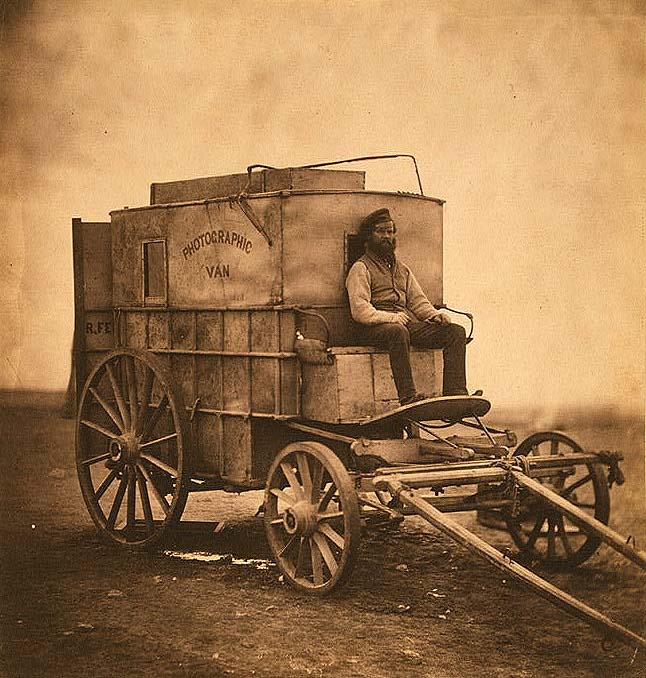
The artist's van. Marcus Sparling, seated on Roger Fenton's photographic van.
Re: Combat Photography...old school
Posted: Sun Nov 03, 2013 6:10 pm
by _The Erotic Apologist
Thanks for the link! I have a coffee table book with most of those photos in it, but it's nice to know they're all in one place on the web. I also have a portable dark room that stands on tripod legs, but it doesn't have wheels...maybe I should add wheels to it...hmmm.
One of Roger Fenton's competitors would have been a man named Felice Beato. Beato has a Wikipedia page with some nice, high resolution scans of his pix:
http://en.wikipedia.org/wiki/Felice_BeatoAs for the exposure times, I would guess most them were between three and five seconds. Most of them look like they were done in direct sunlight, with the sun near its highest point in the sky. It also looks like he's using the widest aperture in his lens, because a wide aperture tends to exaggerate the effect of a spherical field of focus, which you have with a Petzval lens. The fact that he's shooting negatives (as opposed to direct positives, i.e. tintypes & ambrotypes) would normally require much longer exposures, but it's probably so bright and sunny out there that he's able to get away with fewer than five seconds. Of course there's no way to be sure without knowing what kind of lens he's using, but even then it would still be difficult to tell because each of those hand-made lenses were slightly different from each other.
The longest exposure I ever used with a human subject was two minutes. It was at a Civil War re-enactment with an overcast sky, and it was very late in the day. The sun must have been very close to the horizon, but I couldn't tell because of the overcast. I told the subject to lean against a tree and to breathe as shallowly as possible...and the resulting image wasn't half bad.
Re: Combat Photography...old school
Posted: Wed Nov 06, 2013 6:24 pm
by _The Erotic Apologist
The first military photographer was an unknown individual who followed the US Army into Mexico in 1847. His name has been forgotten, but a few of his images still survive...
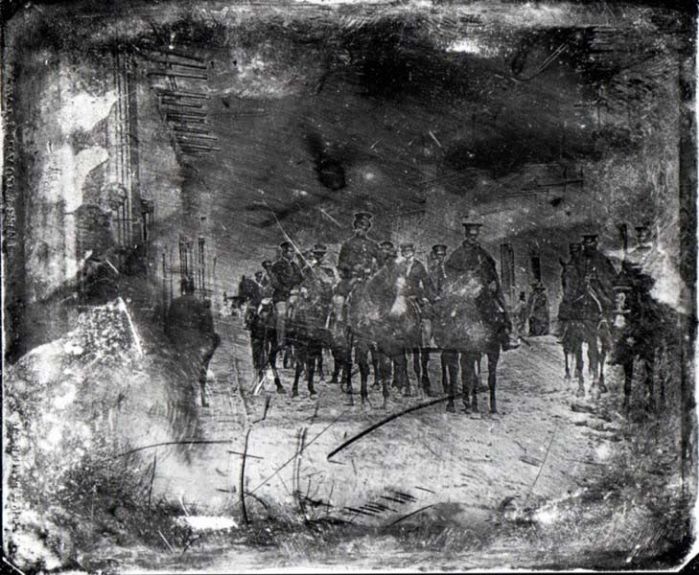
General John E. Wool and his staff after the capture of the city of Saltillo in early 1847.
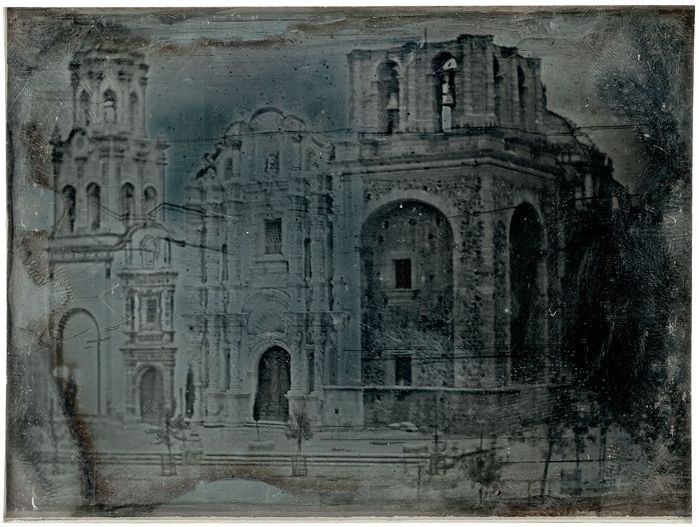
The Parroquia de Santiago in Saltillo, Mexico.
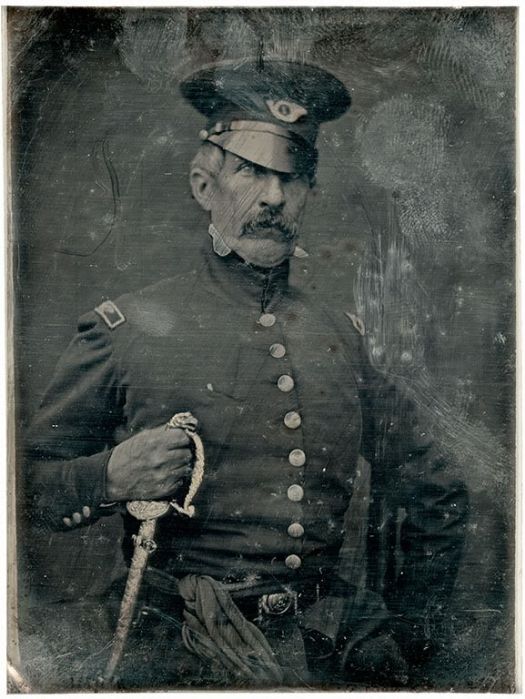
Colonel Hamtramck, Virginia Volunteers, 1847
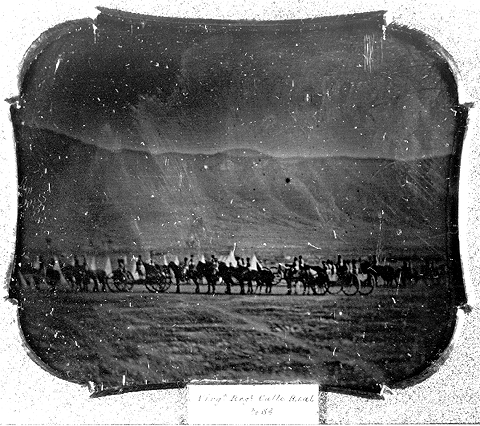
Major Lucien B. Webster's battery of artillery after the battle of Buena Vista, Feb. 22-23, 1847.
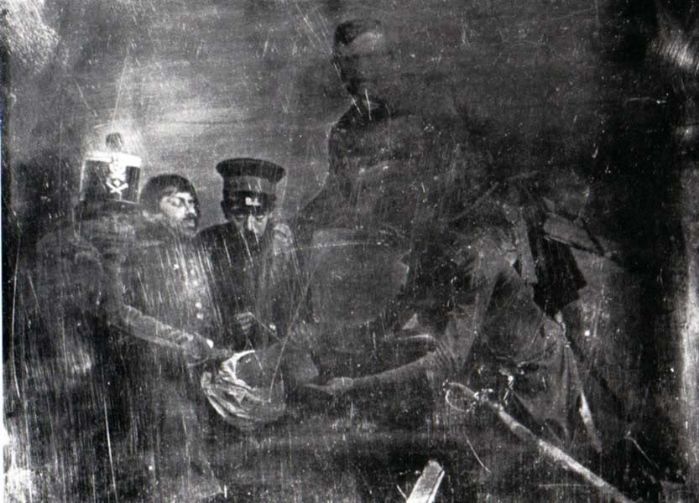
A leg amputation in a military hospital after the Battle of Cerro Gordo, April 18, 1847.
Re: Combat Photography...old school
Posted: Wed Nov 06, 2013 6:50 pm
by _ludwigm
The Erotic Apologist wrote:A leg amputation in a military hospital after the Battle of Cerro Gordo, April 18, 1847.
Facsimile No. 1 ...