Cahokia

The catch-all forum for general topics and debates. Minimal moderation. Rated PG to PG-13.
_Gazelam
_Emeritus
Posts: 5659
Joined: Thu Oct 26, 2006 2:06 am

Cahokia

Post by _Gazelam »

For your consideration:

Image

It’s hard to believe there was a city in the U.S. that outnumbered any other in population, that was larger than even London at one point, that served as the biggest urban center north of Mexico – and that lots of us have never even heard of.

It’s Cahokia, Illinois, about 15 minutes away from St. Louis, Missouri. It was inhabited for about 700 years and was home to up to 20,000 people when it peaked from 1050-1200. More than 120 “mounds” were built for ceremonial purposes and to provide a prestigious spot for temples and the homes of chiefs.

Lots of interesting things have been discovered in excavations at Cahokia over the years. It even had its own Stonehenge – in fact, maybe up to five of them. Dubbed “Woodhenge,” archaeologists think the early residents of Cahokia used red cedar posts stuck in deep pits to mark days and events. One of them has been reconstructed for tourists to the Cahokia area.

Other advancements found include a copper workshop and watchtowers.

A slightly more disturbing discovery was hundreds of skeletons, including a mass grave of more than 50 women who were about the same age. Another mass grave was found containing both men and women, some of whom where apparently buried alive. It’s believed that they were sacrificial victims.

All of these signs of thriving civilization have to make you wonder: what the heck happened? How does a city go from being one of the largest in the world to being practically nonexistent in less than 200 years? Well… we don’t really know. There are plenty of theories, from widespread disease to political collapse. But since the people who lived there left absolutely no written record, we have no idea what actually happened. We also don’t know who these early people were – although we know all about the French missionaries who settled in the area in 1699 and the monks who made the mounds their home in 1809, it’s still not known what Native American tribes might be descendants of those early people.
We can easily forgive a child who is afraid of the dark; the real tragedy of life is when men are afraid of the light. - Plato
_Ray A

Re: Cahokia

Post by _Ray A »

For more consideration:

Fantastic Archaeology: The Wild Side of North American Prehistory.

Williams uncovers the fraud and fantasy interspersed throughout the American popular view of North American archaeology and the continent's connections with distant civilizations. Williams asserts in this volume, as in his Harvard University course of the same name, that when an American site is uncovered or artifact discovered, conclusions are often too easily drawn where not enough evidence has been revealed to hypothesize. Wild, amateurish declarations historically have been quickly and easily published, whereas counterarguments seldom reach the same massive audience. With the competition for public attention from the plethora of fantastic claims, the documented discoveries and amazing achievements of the past become hidden from public understanding. This is an important guide for the student or layperson interested in sifting through the myth to find the verified facts of America's fascinating past.


"This is a book to cherish and enjoy. The book demonstrates once again how many ways there are for people to mislead other people, particularly in areas where emotions become involved in objective assessments of scientific evidence."—Anthro Notes
(Emphasis added)

"What a bundle of wishes, folly, and fraud is here unpacked."—Scientific American.


And for more consideration:

All That Glitters :Uncovering Fool's Gold in Book of Mormon Archaeology.
Last edited by _Ray A on Thu Feb 25, 2010 3:49 am, edited 1 time in total.
_moksha
_Emeritus
Posts: 22508
Joined: Fri Oct 27, 2006 8:42 pm

Re: Cahokia

Post by _moksha »

Did Williams discuss this Cahokia site?
Cry Heaven and let loose the Penguins of Peace
_KimberlyAnn
_Emeritus
Posts: 3171
Joined: Thu Mar 22, 2007 2:03 pm

Re: Cahokia

Post by _KimberlyAnn »

I've been there, Gaz. Cahokia is neat, but I prefer Anasazi ruins, myself. They're even neater. I've been to two Anasazi settlements. Chaco Canyon in New Mexico is amazing. I hiked around that canyon for a solid day in the wrong shoes, but it was worth it.

There's no connection between Cahokia and Mormonism, Gaz. There's just not. But it has an intriguing history of its own, which you can enjoy entirely apart from Mormonism.

KA
_Uncle Dale
_Emeritus
Posts: 3685
Joined: Wed Feb 07, 2007 7:02 am

Re: Cahokia

Post by _Uncle Dale »

Gazelam wrote:For your consideration...


I've been there also -- twice, in fact. I was more impressed with Palenque,
but Cahokia, in its heyday, was probably almost equally magnificant.

Its ceremonial center (which was really not a city) was not as ornate and
complex as were the stone-building sites of Central America and Mexico, but
the platform mounds must have been grand stuff.

Still, a settled life -- subsistence farming of maize -- was not a healthy
thing. The common folk probably would have done better, had they deserted
the social congregation and taken up a hunter-gatherer existence, And I
suppose that's what they eventually did.

Below is a description published in Pittsburgh, while Solomon Spalding was
living there. I suppose that similar descriptions were also available in
later years to Sidney Rigdon, Joseph Smith, Oliver Cowdery, etc.

UD


The subject of Indian antiquities, is more philosophically discussed by Mr. B. than we have seen it any where else. He gives us at the same time the description of several mounds. which seem to have escaped the attention of former travellers, and which, in point of magnitude and of regularity of plan surpass any thing that has come hitherto to our knowledge, concerning Indian workmanship. They are situated in the American bottom, which is perhaps the richest alluvial land in North America. It extends on the Mississippi from the Kaskaskia to the Cahokia river, about thirty miles in length, and above five in breadth.

"If any vestige of ancient population were to be found," says Mr. B. "this would be the place to search for it -- accordingly, this tract, as also the bank of the river on the western side, exhibits proofs of an immense population. If the city of Philadelphia and its environs, were deserted, there would not be more numerous traces of human existence. The great number of mounds, and the astonishing quantity of human bones, every where dug up, or found on the surface of the ground, with a thousand other appearances, announce that this valley was at one period filled with habitations and villages. The whole face of the bluff, or hill which bounds it to the east, appears to have been a continued burial ground.

But the most remarkable appearances, are two groups of mounds or pyramids, the one about ten miles above Cahokia, the other nearly the same distance below it, which in all, exceed one hundred and fifty, of various sizes. The western side, also, contains a considerable number.

A more minute description of those above Cahokia, which I visited in the fall of 1811, will give a tolerable idea of them all.

I crossed the Mississippi at St. Louis, and after passing through the wood which borders the river, about half a mile in width, entered an extensive open plain. In fifteen minutes, I found myself in the midst of a group of mounds, mostly of a circular shape, and at a distance, resembling enormous haystacks scattered through a meadow. -- One of the largest which I ascended, was about two hundred paces in circumference at the bottom, the form nearly square, though it had entirely undergone considerable alteration from the washing of the rains. The top was level, with an area sufficient to contain several hundred men.

The prospect from this mound is very beautiful, looking towards the bluffs, which are dimly seen at the distance of six or eight miles, the bottom at this place being very wide, I had a level plain before me, varied by islets of wood, and a few solitary trees; to the right, the prairie is bounded by the horizon, to the left, the course of the Cahokia may be distinguished by the margin of wood upon its banks, and crossing the valley diagonally, S. S. W. Around me, I counted forty-five mounds, or pyramids, besides a great number of small artificial elevations; these mounds form something more than a semicircle, about a mile in extent, the open space on the river.

Pursuing my walk along the bank of the Cahokia, I passed eight others in the distance of three miles, before I arrived at the largest assemblage. When I reached the foot of the principal mound, I was struck with a degree of astonishment, not unlike that which is experienced in contemplating the Egyptian pyramids. What a stupendous pile of earth! To heap up such a mass must have required years, and the labors of thousands. It stands immediately on the bank of the Cahokia, and on the side next it, is covered with lofty trees. Were it not for the regularity and design which it manifests, the circumstances of its being on alluvial ground, and the other mounds scattered around it, we could scarcely believe it the work of human hands. The shape is that of a parallelogram, standing from north to south; on the south side there is a broad apron or step, about half way down, and from this, another projection into the plain about fifteen feet wide, which was probably intended as an ascent to the mound. By stepping round the base, I computed the circumference to be at least eight hundred yards, and the height of the mound about ninty feet. The step, or apron, has been used as a kitchen garden, by the monks of La Trappe, settled near this, and the top is sowed with wheat. Nearly west there is another of a smaller size, and forty others scattered through the plain. Two are also seen on the bluff, at the distance of three miles. Several of these mounds are almost conical. As the sward had been burnt, the earth was perfectly naked, and I could trace with ease, any unevenness of surface, so as to discover whether it was artificial or accidental. I every where observed a great number of small elevations of earth, to the heighth of a few feet, at regular distances from each other, and which appeared to observe some order; near them I also observed pieces of flint, and fragments of earthen vessels. I concluded, that a very populous town had once existed here, similar to those of Mexico, described by the first conquerors. The mounds were sites of temples, or monuments erected to the memory of great men. It is evident, this could never have been the work of thinly scattered tribes. If the human species had at any time been permitted in this country to have increased freely, and there is every probability of the fact, it must, as in Mexico, have become astonishingly numerous."

http://www.sidneyrigdon.com/dbroadhu/PA ... htm#G1-064
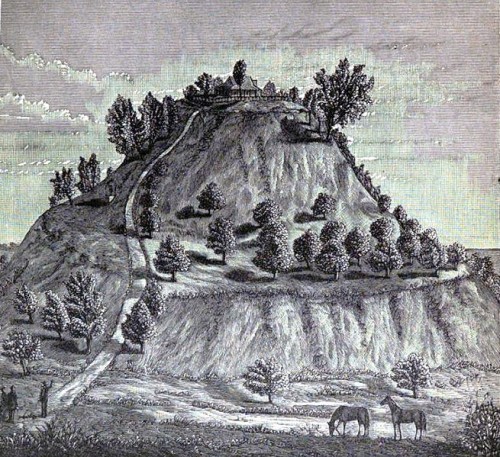
-- the discovery never seems to stop --
_Uncle Dale
_Emeritus
Posts: 3685
Joined: Wed Feb 07, 2007 7:02 am

Re: Cahokia

Post by _Uncle Dale »

Uncle Dale wrote:...Cahokia... Its ceremonial center...


There may be some residual Woodland Indian recollection of the ancient Mississippian
"mound builder" culture in this Tuscarora tradition:

Perhaps about two thousand two hundred years before the Columbus discovered the America, and northern nations appointed a prince, and immediately repaired to the south and visited the great Emperor who resided at the Golden City, a capital of the vast empire After a time the Emperor built many forts throughout his dominions and almost penetrated the lake Erie; this produced an excitement, the people of the north felt that they would soon be deprived of the country on the south side of the Great Lakes they determined to defend their country against any infringement of foreign people: long bloody war ensued which perhaps lasted about one hundred years; the people of the north were too skillful in the use of bows and arrows and could endure hardships which proved fatal to a foreign people; at last the northern nations gained the conquest and all the towns and forts were totally destroyed and left them in the heap of ruins.

http://olivercowdery.com/texts/1827cusk.htm#pg10a


See also Heckewelder's accounts the great "Allegewi" nation of preColumbian times --
mentioned here:

"The Allegewi, the Nephilim, and the Nephites"
http://solomonspalding.com/SRP/saga2/sagawt0a.htm

UD
-- the discovery never seems to stop --
_why me
_Emeritus
Posts: 9589
Joined: Fri Feb 02, 2007 8:19 pm

Re: Cahokia

Post by _why me »

Uncle Dale wrote:
Below is a description published in Pittsburgh, while Solomon Spalding was
living there. I suppose that similar descriptions were also available in
later years to Sidney Rigdon, Joseph Smith, Oliver Cowdery, etc.

UD


And of course, you assume that Spaulding read this account in the paper. I think uncle dale that no one is claiming that some information was not available at the time of Joseph Smith or Soloman. But I have to say that the description does sound like a lamanite civilization. But what came first the chicken or the egg is the question. Cahokia does give support that great civilizations existed in North America. And this is something that many antimormons do not consider or know.

However I see no proof that Joseph Smith was into book reading as a young man. His own personal library was very small as a young adult person.
I intend to lay a foundation that will revolutionize the whole world.
Joseph Smith


We are “to feed the hungry, to clothe the naked, to provide for the widow, to dry up the tear of the orphan, to comfort the afflicted, whether in this church, or in any other, or in no church at all…”
Joseph Smith
_harmony
_Emeritus
Posts: 18195
Joined: Fri Oct 27, 2006 1:35 am

Re: Cahokia

Post by _harmony »

why me wrote:
And of course, you assume that Spalding read this account in the paper.


Newspapers were the primary form of written news, Whyme. It's not like they got soundbites via their cell phones or tuned into the 6 oclock news on tv every night. Of course he read the newspaper. Everyone who could afford to buy a paper read the newspaper.

I think uncle dale that no one is claiming that some information was not available at the time of Joseph Smith or Soloman. But I have to say that the description does sound like a lamanite civilization.


It's more likely it was the other way around... Lamanite civilizations sound like Cahokia, since Cahokia actually has been dated to further back than the 1800's, which seems to be the date the 19th century creation Book of Mormon can be validated to.

But what came first the chicken or the egg is the question. Cahokia does give support that great civilizations existed in North America. And this is something that many antimormons do not consider or know.


Many of the civilizations in the Old Testament can be validated. That doesn't mean the stories in the Bible happened as the book says they did.

However I see no proof that Joseph Smith was into book reading as a young man. His own personal library was very small as a young adult person.


A newspaper is not a book. He would not need a personal library at all in order to read the newspapers.
(Nevo, Jan 23) And the Melchizedek Priesthood may not have been restored until the summer of 1830, several months after the organization of the Church.
_Uncle Dale
_Emeritus
Posts: 3685
Joined: Wed Feb 07, 2007 7:02 am

Re: Cahokia

Post by _Uncle Dale »

why me wrote:...Cahokia does give support that great civilizations existed in North America.
...


The Mississippian Culture was NOT a "civilization." Its members did not live in cities.
Cahokia was NOT Teotihuacan nor Pekin nor Rome -- it was a ceremonial center
surrounded by farmers' huts and connected by waterways to other, smaller villages.

We should not think of its residents as engaging in city life, with artisans, shops,
government workers, city planning, etc.

If you want to look at a culture on the verge of becoming a civilization, look at
the Valley of Mexico at the time Cortez arrived.

No reputable paleo-anthropologist will resort to exotic, transoceanic dispersions
to account for the technology, social structure, language, etc., of American Indians
associated with the Adena, Hopewell, or Mississippian cultures.

Take a minute to address letters of inquiry to the topmost cultural anthropologists
at Brigham Young University, asking them what aspects of the Mississippian Culture
necessarily depended upon importation from elsewhere -- in other words, what
parts of their society could not have been "home-grown" from the ground up.

The answer you will get back is: maize agriculture.
That, and perhaps some external "hints" on how to make better pottery,
or weave better baskets, or better shape native copper into ornaments.

Image

There is absolutely NOTHING in "mound-builder" culture dependent upon any
external, trans-oceanic contact. Their corn farming was an import from Mexico,
and not from Jerusalem.

Sorry about that.

UD
-- the discovery never seems to stop --
_Dr. Shades
_Emeritus
Posts: 14117
Joined: Mon Oct 23, 2006 9:07 pm

Re: Cahokia

Post by _Dr. Shades »

Your picture was this:

Gazelam wrote:Image

But your comment was this:

Gazelam wrote:It’s Cahokia, Illinois, about 15 minutes away from St. Louis, Missouri. It was inhabited for about 700 years and was home to up to 20,000 people when it peaked from 1050-1200.

What does the picture have to do with the post? That picture sure doesn't depict a place inhabited by up to 20,000.

why me wrote:Cahokia does give support that great civilizations existed in North America. And this is something that many antimormons do not consider or know.

It is also something that many FARMS and FAIR mopologists do not consider or know, either. Just ask Meldrum.
"Finally, for your rather strange idea that miracles are somehow linked to the amount of gay sexual gratification that is taking place would require that primitive Christianity was launched by gay sex, would it not?"

--Louis Midgley
Post Reply