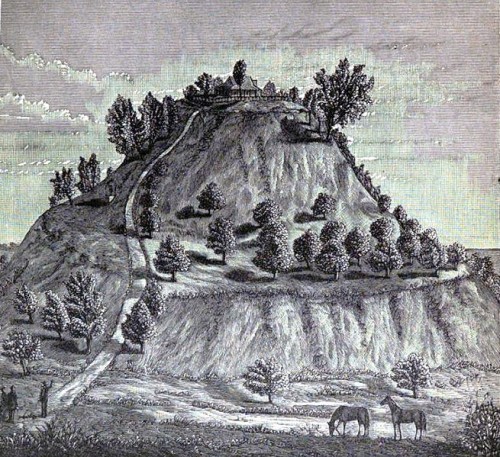
The subject of Indian antiquities, is more philosophically discussed by Mr. B. than we have seen it any where else. He gives us at the same time the description of several mounds. which seem to have escaped the attention of former travellers, and which, in point of magnitude and of regularity of plan surpass any thing that has come hitherto to our knowledge, concerning Indian workmanship. They are situated in the American bottom, which is perhaps the richest alluvial land in North America. It extends on the Mississippi from the Kaskaskia to the Cahokia river, about thirty miles in length, and above five in breadth.
"If any vestige of ancient population were to be found," says Mr. B. "this would be the place to search for it -- accordingly, this tract, as also the bank of the river on the western side, exhibits proofs of an immense population. If the city of Philadelphia and its environs, were deserted, there would not be more numerous traces of human existence. The great number of mounds, and the astonishing quantity of human bones, every where dug up, or found on the surface of the ground, with a thousand other appearances, announce that this valley was at one period filled with habitations and villages. The whole face of the bluff, or hill which bounds it to the east, appears to have been a continued burial ground.
But the most remarkable appearances, are two groups of mounds or pyramids, the one about ten miles above Cahokia, the other nearly the same distance below it, which in all, exceed one hundred and fifty, of various sizes. The western side, also, contains a considerable number.
A more minute description of those above Cahokia, which I visited in the fall of 1811, will give a tolerable idea of them all.
I crossed the Mississippi at St. Louis, and after passing through the wood which borders the river, about half a mile in width, entered an extensive open plain. In fifteen minutes, I found myself in the midst of a group of mounds, mostly of a circular shape, and at a distance, resembling enormous haystacks scattered through a meadow. -- One of the largest which I ascended, was about two hundred paces in circumference at the bottom, the form nearly square, though it had entirely undergone considerable alteration from the washing of the rains. The top was level, with an area sufficient to contain several hundred men.
The prospect from this mound is very beautiful, looking towards the bluffs, which are dimly seen at the distance of six or eight miles, the bottom at this place being very wide, I had a level plain before me, varied by islets of wood, and a few solitary trees; to the right, the prairie is bounded by the horizon, to the left, the course of the Cahokia may be distinguished by the margin of wood upon its banks, and crossing the valley diagonally, S. S. W. Around me, I counted forty-five mounds, or pyramids, besides a great number of small artificial elevations; these mounds form something more than a semicircle, about a mile in extent, the open space on the river.
Pursuing my walk along the bank of the Cahokia, I passed eight others in the distance of three miles, before I arrived at the largest assemblage. When I reached the foot of the principal mound, I was struck with a degree of astonishment, not unlike that which is experienced in contemplating the Egyptian pyramids. What a stupendous pile of earth! To heap up such a mass must have required years, and the labors of thousands. It stands immediately on the bank of the Cahokia, and on the side next it, is covered with lofty trees. Were it not for the regularity and design which it manifests, the circumstances of its being on alluvial ground, and the other mounds scattered around it, we could scarcely believe it the work of human hands. The shape is that of a parallelogram, standing from north to south; on the south side there is a broad apron or step, about half way down, and from this, another projection into the plain about fifteen feet wide, which was probably intended as an ascent to the mound. By stepping round the base, I computed the circumference to be at least eight hundred yards, and the height of the mound about ninty feet. The step, or apron, has been used as a kitchen garden, by the monks of La Trappe, settled near this, and the top is sowed with wheat. Nearly west there is another of a smaller size, and forty others scattered through the plain. Two are also seen on the bluff, at the distance of three miles. Several of these mounds are almost conical. As the sward had been burnt, the earth was perfectly naked, and I could trace with ease, any unevenness of surface, so as to discover whether it was artificial or accidental. I every where observed a great number of small elevations of earth, to the heighth of a few feet, at regular distances from each other, and which appeared to observe some order; near them I also observed pieces of flint, and fragments of earthen vessels. I concluded, that a very populous town had once existed here, similar to those of Mexico, described by the first conquerors. The mounds were sites of temples, or monuments erected to the memory of great men. It is evident, this could never have been the work of thinly scattered tribes. If the human species had at any time been permitted in this country to have increased freely, and there is every probability of the fact, it must, as in Mexico, have become astonishingly numerous."
http://www.sidneyrigdon.com/dbroadhu/PA ... htm#G1-064