Page 1 of 1

The heavenly priesthood are not idle spectators

Posted: Fri Jul 25, 2025 9:01 pm
by drumdude
“Interpreter’s latest article” wrote: As noted, of the four hundred or so verses of Isaiah quoted in the Book of Mormon, about half have differences in wording from their counterparts in the King James translation. In those verses that are not identical to the KJV, most of the differences are in only a few words, but the rest of the words are the same. Thus, clearly Isaiah in the Book of Mormon comes from the King James Bible. It does not just look like the King James Bible, and it does not just use King James English. It comes from the King James Bible, with some modifications.

Because the evidence shows that the English words of the Book of Mormon were made visible to Joseph Smith, there must necessarily have been a translation process beforehand. My assumption (shared by some others) is that someone in the world of spirits, a faithful but imperfect human like the rest of us, was tasked with translating the words of the ancient Nephites into English. Perhaps it was a group of people. As Joseph Smith taught about the Restoration,
All things whether in heaven or on earth will be in one, even in Christ. The heavenly priesthood will unite with the earthly, to bring about those great purposes; and whilst we are thus united in the one common cause to roll forth the kingdom of God, the heavenly priesthood are not idle spectators.
Whatever the process of translation was, one thing is made clear by the Isaiah passages: the translator or translators who prepared the English text of the Book of Mormon prior to Joseph Smith used the words of the King James Bible.

Why would God want the Isaiah passages to follow the King James translation? We can speculate that because it was the common Bible in the English language in Joseph Smith’s generation and was used by almost all English-speaking Christians, having the Book of Mormon’s Isaiah passages match the words of the King James translation would make sense. If the translation had been different, it might have drawn attention to unimportant wording matters, rather than to the text’s message.

https://journal.interpreterfoundation.o ... of-Mormon/

DCP’s latest blog entry about Occam’s razor comes careening into mind.

I love how the article points out that the quoted passages are full of minor errors, while speculating that the reason for the KJV being used was to avoid a text full of minor errors.

Re: The heavenly priesthood are not idle spectators

Posted: Fri Jul 25, 2025 9:24 pm
by Rivendale
Minor errors. If ghost writers can introduce minor errors how can the bulk of the translation be considered accurate?

Re: The heavenly priesthood are not idle spectators

Posted: Fri Jul 25, 2025 9:34 pm
by drumdude
Rivendale wrote:
Fri Jul 25, 2025 9:24 pm
Minor errors. If ghost writers can introduce minor errors how can the bulk of the translation be considered accurate?
Maybe they were missing their ghost glasses.

Re: The heavenly priesthood are not idle spectators

Posted: Fri Jul 25, 2025 10:27 pm
by I Have Questions
So when Kent P Jackson (the author) acknowledges that the Book of Mormon contains KJV Bible content, verbatim for the most part, his conclusion isn’t that Joseph utilised a KJV Bible, with which he was extremely familiar. His conclusion isn’t that someone in between when the KJV Bible was produced, and when Joseph Smith started producing the Book of Mormon, must have taken that content and inserted into the record prior to it being “transmitted” onto the rock in the hat.

I mean, if it looks like a duck, quacks like a duck, waddles like a duck, and has a duck’s bill, it’s more than likely a rhinoceros, according to Kent P Jackson.

I know that by now I shouldn’t be surprised that Interpreter shoves this nonsense out on a weekly basis, but I am. This is junk. Not scholarship.

Re: The heavenly priesthood are not idle spectators

Posted: Sat Jul 26, 2025 12:27 am
by malkie
To me, this looks like an attempt to get past the concern that the documented process - a "caractor" appears in Reformed Egyptian, along with its English translation - is extremely unlikely to yield a coherent translation, as languages, in general, cannot be translated one "word" at a time. In this modified process, the pre-translated text is shown to Joseph with (presumably) the words in the correct KJV order.

But it still blows up the description in Elder Nelson's July 1993 article in the Ensign:
Russell M. Nelson wrote:The details of this miraculous method of translation are still not fully known. Yet we do have a few precious insights. David Whitmer wrote:

“Joseph Smith would put the seer stone into a hat, and put his face in the hat, drawing it closely around his face to exclude the light; and in the darkness the spiritual light would shine. A piece of something resembling parchment would appear, and on that appeared the writing. One character at a time would appear, and under it was the interpretation in English. Brother Joseph would read off the English to Oliver Cowdery, who was his principal scribe, and when it was written down and repeated to Brother Joseph to see if it was correct, then it would disappear, and another character with the interpretation would appear. Thus the Book of Mormon was translated by the gift and power of God, and not by any power of man.” (David Whitmer, An Address to All Believers in Christ, Richmond, Mo.: n.p., 1887, p. 12.)

Later in the article we read:
Sister Nelson and I have a close friend and former neighbor, Sami Hanna, who was born in Egypt. He is a scholar with special expertise in Semitic languages. As a linguistic exercise, he translated the Book of Mormon from English into Arabic.
What Elder Nelson does not tell us is whether the translation was done with only one English word available to the translator at a time, and no going back allowed. I wonder if an expert in Arabic could answer this question for us. Perhaps such a person might read the board?

From my own experience - poor though it is - there is a strong likelihood that the documented process would result in gibberish - perhaps, in some cases, even yielding the complete opposite of the intended meaning at intermediate points, requiring a recasting of what had already been translated.

Re: The heavenly priesthood are not idle spectators

Posted: Sat Jul 26, 2025 1:55 am
by Doctor Scratch
With all due respect, drumdude, I think you are seriously under-selling the importance of this article. I would argue that this article is the most important thing that Interpreter has published this year—and possibly even this decade.

For one thing, this is obviously a smear effort aimed at discrediting Colby Townsend. Townsend, of course, has been one of the Mopologists’ principal enemies for a number of years. But it would seem that he has delivered a huge, devastating blow against them. Just look at this—the first endnote from the piece:
Colby Townsend, “Early Nineteenth-Century Biblical Scholarship and the Production of The Book of Mormon,” Journal of the Bible and its Reception 12, no. 1 (2025): 57–84, doi.org/10.1515/jbr-2024-0001. Townsend notes that he prefers to italicize the title of the Book of Mormon (p. 58n2). In academic and nonacademic writing, the titles of sacred religious books are not italicized. The choice to use italics for the Book of Mormon shows that he chooses not to afford the Book of Mormon the respect traditionally given to a religious text like the Bible, a title he does not italicize.
It is worth noting that the link to the article does not work. Could it be that Interpreter is afraid of allowing their readers to see Townsend’s actual scholarship?

Setting that issue aside: lol!!! Wow! Townsend has delivered a double-whammy: a peer-reviewed piece of actual scholarship that deals with Joseph Smith’s plagiarism, plus, *he doesn’t italicize the Book of Mormon*! It’s as if the Book of Mormon is a work of fiction! Could it be that the mainstream, academic view is shifting in such a way that the Book of Mormon is viewed as “fiction” rather than scripture? Is Townsend single-handedly leading a revolution that will unravel decades of fruitless Mopologetic effort?

It is very interesting to note that this attack-piece was authored by Kent Jackson, who is infamous for having been “called on the carpet” for not following Mopologetic orthodoxy. And now he’s being deployed to go after Townsend, who, if I’m not mistaken, is a grad student?

Well, kudos to Townsend for getting a scholarly article accepted in a legitimate academic journal. If Jackson or any of the other Interpreter apologists can get their response to Townsend published in a non-Mormon venue, then I will take it seriously.

But that will never happen. Instead, what we’ve got here is an apparently historic “Hail Mary” tossed up in attempt to fight off a truly crushing blow to the credibility of traditional Church claims.

Re: The heavenly priesthood are not idle spectators

Posted: Sat Jul 26, 2025 11:03 am
by Chap
malkie wrote:
Sat Jul 26, 2025 12:27 am
To me, this looks like an attempt to get past the concern that the documented process - a "caractor" appears in Reformed Egyptian, along with its English translation - is extremely unlikely to yield a coherent translation, as languages, in general, cannot be translated one "word" at a time. In this modified process, the pre-translated text is shown to Joseph with (presumably) the words in the correct KJV order.

But it still blows up the description in Elder Nelson's July 1993 article in the Ensign:
Russell M. Nelson wrote:The details of this miraculous method of translation are still not fully known. Yet we do have a few precious insights. David Whitmer wrote:

“Joseph Smith would put the seer stone into a hat, and put his face in the hat, drawing it closely around his face to exclude the light; and in the darkness the spiritual light would shine. A piece of something resembling parchment would appear, and on that appeared the writing. One character at a time would appear, and under it was the interpretation in English. Brother Joseph would read off the English to Oliver Cowdery, who was his principal scribe, and when it was written down and repeated to Brother Joseph to see if it was correct, then it would disappear, and another character with the interpretation would appear. Thus the Book of Mormon was translated by the gift and power of God, and not by any power of man.” (David Whitmer, An Address to All Believers in Christ, Richmond, Mo.: n.p., 1887, p. 12.)

Later in the article we read:
Sister Nelson and I have a close friend and former neighbor, Sami Hanna, who was born in Egypt. He is a scholar with special expertise in Semitic languages. As a linguistic exercise, he translated the Book of Mormon from English into Arabic.
What Elder Nelson does not tell us is whether the translation was done with only one English word available to the translator at a time, and no going back allowed. I wonder if an expert in Arabic could answer this question for us. Perhaps such a person might read the board?

From my own experience - poor though it is - there is a strong likelihood that the documented process would result in gibberish - perhaps, in some cases, even yielding the complete opposite of the intended meaning at intermediate points, requiring a recasting of what had already been translated.
I must admit that I had never before paid proper attention to the fact that descriptions of the translation process say that the seer stone provided English renderings of the characters in the Book of Mormon one character at a time, and that Joseph's scribe wrote them down in the same sequence to produce the English text of the Book of Mormon.

Such a claim could only be credible to a person who had no knowledge of languages other than the one they had been brought up to speak, in this case English. In general, there is often no one-to-one correspondence between the words in an English sentence and those in the equivalent sentence in another language, and the order of the words may often be different.

For example, take the English sentence "I do not like that book." One of several ways of translating that sentence into Japanese might be "Sono hon w a* suki de w a* nai". If you tried to turn that sentence into English word for word you would get something like "That book <topic marker> liked being <topic marker> isn't".

The words marked in < > are added by me to try to convey what the particle represented by the letters w a* is doing in the sentence. Notice that Japanese tends to assume that you know who is doing what - so in this case the English word "I" is not represented in the Japanese sentence. Obviously, if the Book of Mormon had been written in Japanese, any attempt to do the translation into English 'caractor by caractor' would have produced mere gibberish. And the same is true of a lot of sentences in a lot of other languages. But Joseph Smith knew nothing of that when he told his translation story.

* the particle represented here by the letters w and a would normally be written in romanised Japanese by those two letters forming a single syllable. But if I try to do that, the system produces "Washington" ...

Re: The heavenly priesthood are not idle spectators

Posted: Sat Jul 26, 2025 5:31 pm
by malkie
Chap wrote:
Sat Jul 26, 2025 11:03 am
malkie wrote:
Sat Jul 26, 2025 12:27 am
To me, this looks like an attempt to get past the concern that the documented process - a "caractor" appears in Reformed Egyptian, along with its English translation - is extremely unlikely to yield a coherent translation, as languages, in general, cannot be translated one "word" at a time. In this modified process, the pre-translated text is shown to Joseph with (presumably) the words in the correct KJV order.

But it still blows up the description in Elder Nelson's July 1993 article in the Ensign:


Later in the article we read:

What Elder Nelson does not tell us is whether the translation was done with only one English word available to the translator at a time, and no going back allowed. I wonder if an expert in Arabic could answer this question for us. Perhaps such a person might read the board?

From my own experience - poor though it is - there is a strong likelihood that the documented process would result in gibberish - perhaps, in some cases, even yielding the complete opposite of the intended meaning at intermediate points, requiring a recasting of what had already been translated.
I must admit that I had never before paid proper attention to the fact that descriptions of the translation process say that the seer stone provided English renderings of the characters in the Book of Mormon one character at a time, and that Joseph's scribe wrote them down in the same sequence to produce the English text of the Book of Mormon.

Such a claim could only be credible to a person who had no knowledge of languages other than the one they had been brought up to speak, in this case English. In general, there is often no one-to-one correspondence between the words in an English sentence and those in the equivalent sentence in another language, and the order of the words may often be different.

For example, take the English sentence "I do not like that book." One of several ways of translating that sentence into Japanese might be "Sono hon w a* suki de w a* nai". If you tried to turn that sentence into English word for word you would get something like "That book <topic marker> liked being <topic marker> isn't".

The words marked in < > are added by me to try to convey what the particle represented by the letters w a* is doing in the sentence. Notice that Japanese tends to assume that you know who is doing what - so in this case the English word "I" is not represented in the Japanese sentence. Obviously, if the Book of Mormon had been written in Japanese, any attempt to do the translation into English 'caractor by caractor' would have produced mere gibberish. And the same is true of a lot of sentences in a lot of other languages. But Joseph Smith knew nothing of that when he told his translation story.

* the particle represented here by the letters w and a would normally be written in romanised Japanese by those two letters forming a single syllable. But if I try to do that, the system produces "Washington" ...
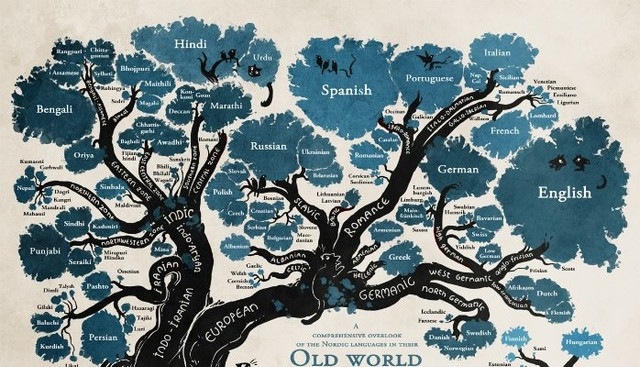
I expect that, roughly speaking, the closer two languages are on a language tree like this:
Image,
for example, considering Spanish and Portuguese to be very close, the more likely it is that there could be substantial passages in one that could possibly be translated one word at a time to the other. But I suspect that even then a full idiomatic translation would show substantial differences.

Here's an example within my own scope of knowledge. Lowland Scots is a very close derivative of "standard (king's) English. As a result, it is often possible to translate between the two one word at a time.

However, there are idiomatic usages in Scots that defy such a process. For example, you might think that the Scots:
  • "See ma mammy, see ma dinner ticket ..."
would be
  • See (or look at) my mother, see/look at my dinner ticket ...
In English.

But (A big but!), in this type of construction, "see" may have nothing at all to do with seeing, looking, etc. - rather, it may be used as a mechanism to prime the listener to the subject(s) of the following utterances, and so should be translated as:
  • I'm going to talk about my mother, and about my dinner ticket.
One word at a time translation could be highly misleading until you saw enough that you could determine which use of "see" is intended, because I could be pointing and saying "Look over there at my mother". But the second "see" makes that not at all likely.

With word-for-word translation between languages presumably far apart on the tree, I believe that it's extremely unlikely that Joseph could avoid producing nonsense in English, especially since he did not return to correct previously translated RE characters.

There's a further potential unexploded bomb that was uncovered by the KEP, but I'll save that for a later comment, as I still need to think about how to explain my thoughts.

I'd really appreciate some correction or validation of these ideas from someone with actual linguistic chops.

Re: The heavenly priesthood are not idle spectators

Posted: Sat Jul 26, 2025 6:39 pm
by Gabriel
malkie wrote:
Sat Jul 26, 2025 12:27 am

Later in the article we read:
Sister Nelson and I have a close friend and former neighbor, Sami Hanna, who was born in Egypt. He is a scholar with special expertise in Semitic languages. As a linguistic exercise, he translated the Book of Mormon from English into Arabic.
What Elder Nelson does not tell us is whether the translation was done with only one English word available to the translator at a time, and no going back allowed. I wonder if an expert in Arabic could answer this question for us. Perhaps such a person might read the board?
https://www.churchofjesuschrist.org/stu ... t?lang=eng

Here is FAIR’s response:
“FAIR” wrote: Did Elder Russell M. Nelson talk of a friend who translated the Book of Mormon into Arabic?

Elder Nelson had a neighbor named Sami Hanna, who was an Arabic scholar and a member of the Church

At one time Elder Nelson had a neighbor named Sami Hanna, who was an Arabic scholar and a member of the Church. Based on his knowledge of Arabic and his experience translating the Book of Mormon into Arabic, Sami thought there were numerous things in the Book of Mormon text that were consistent with a Semitic original of that book.

Elder Nelson has alluded to Sami a few times in talks, but he has never given a talk specifically on Sami

Elder Nelson has alluded to Sami a few times in talks, as he has to others of his extensive network of friends who can read Hebrew. But he has never given a talk specifically on Sami. The internet article that circulates under his name was not written by Elder Nelson.
Source: https://www.fairlatterdaysaints.org/ans ... _Arabic.3F

Apparently, the internet article to which FAIR is referring was purportedly from a faith-promoting story told by the then General President of the Sunday School Russell M. Nelson in 1976. It claims that 1. Sami was a non-member who moved into Nelson’s neighborhood 2. was skeptical of the Book of Mormon 3. Decided to translate the Book of Mormon into Arabic 4. was staggered by the semitic parallels AND 5. Joined the church.

FAIR provides no links or description of Nelson's purported talk, but I believe that they are referring to this: https://www.moroni10.com/hanna.html

Apparently, Nelson’s office was contacted and denied that he ever gave it. FAIR then informs us that Sami Hanna had since left the church to become “some sort of fundamentalist Christian.” AND, oh yeah, Sami was always a shoddy linguist.

Again, because of the dead links, I was unable to find anything on the internet that explains Sami’s side of the story. He died in 2006. Here is his obituary:
https://www.legacy.com/us/obituaries/az ... d=26703121