Chap wrote: ↑Sat Jul 26, 2025 11:03 am
malkie wrote: ↑Sat Jul 26, 2025 12:27 am
To me, this
looks like an attempt to get past the concern that the documented process - a "caractor" appears in Reformed Egyptian, along with its English translation - is extremely unlikely to yield a coherent translation, as languages, in general, cannot be translated one "word" at a time. In this modified process, the
pre-translated text is shown to Joseph with (presumably) the words in the correct KJV order.
But it still blows up the description in Elder Nelson's July 1993 article in the Ensign:
Later in the article we read:
What Elder Nelson does not tell us is whether the translation was done with only one English word available to the translator at a time, and no going back allowed. I wonder if an expert in Arabic could answer this question for us. Perhaps such a person might read the board?
From my own experience - poor though it is - there is a strong likelihood that the documented process would result in gibberish - perhaps, in some cases, even yielding the complete opposite of the intended meaning at intermediate points, requiring a recasting of what had already been translated.
I must admit that I had never before paid proper attention to the fact that descriptions of the translation process say that the seer stone provided English renderings of the characters in the Book of Mormon one character at a time, and that Joseph's scribe wrote them down in the same sequence to produce the English text of the Book of Mormon.
Such a claim could only be credible to a person who had no knowledge of languages other than the one they had been brought up to speak, in this case English. In general, there is often no one-to-one correspondence between the words in an English sentence and those in the equivalent sentence in another language, and the order of the words may often be different.
For example, take the English sentence "I do not like that book." One of several ways of translating that sentence into Japanese might be "Sono hon w a* suki de w a* nai". If you tried to turn that sentence into English word for word you would get something like "That book <topic marker> liked being <topic marker> isn't".
The words marked in < > are added by me to try to convey what the particle represented by the letters w a* is doing in the sentence. Notice that Japanese tends to assume that you know who is doing what - so in this case the English word "I" is not represented in the Japanese sentence. Obviously, if the Book of Mormon had been written in Japanese, any attempt to do the translation into English 'caractor by caractor' would have produced mere gibberish. And the same is true of a lot of sentences in a lot of other languages. But Joseph Smith knew nothing of that when he told his translation story.
* the particle represented here by the letters w and a would normally be written in romanised Japanese by those two letters forming a single syllable. But if I try to do that, the system produces "Washington" ...
I expect that, roughly speaking, the closer two languages are on a language tree like this:
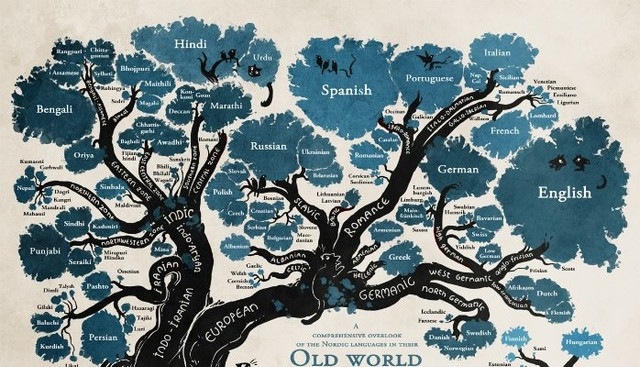
,
for example, considering Spanish and Portuguese to be very close, the more likely it is that there could be substantial passages in one that could possibly be translated one word at a time to the other. But I suspect that even then a full idiomatic translation would show substantial differences.
Here's an example within my own scope of knowledge. Lowland Scots is a very close derivative of "standard (king's) English. As a result, it is often possible to translate between the two one word at a time.
However, there are idiomatic usages in Scots that defy such a process. For example, you might think that the Scots:
- "See ma mammy, see ma dinner ticket ..."
would be
- See (or look at) my mother, see/look at my dinner ticket ...
In English.
But (A big but!), in this type of construction, "see"
may have nothing at all to do with seeing, looking, etc. - rather, it
may be used as a mechanism to prime the listener to the subject(s) of the following utterances, and so should be translated as:
- I'm going to talk about my mother, and about my dinner ticket.
One word at a time translation could be highly misleading until you saw enough that you could determine which use of "see" is intended, because I could be pointing and saying "Look over there at my mother". But the second "see" makes that not at all likely.
With word-for-word translation between languages presumably far apart on the tree, I believe that it's extremely unlikely that Joseph could avoid producing nonsense in English, especially since he did not return to correct previously translated RE characters.
There's a further potential unexploded bomb that was uncovered by the KEP, but I'll save that for a later comment, as I still need to think about how to explain my thoughts.
I'd really appreciate some correction or validation of these ideas from someone with actual linguistic chops.