Brent Metcalfe wrote:Hi Dale,
Sorry for the delayed response...
No problem -- I can continue the conversation from my side, and await your input.
I wished to call to your attention an assertion made in the
History of Wayne County New York (1789-1877) on pp. 149-151, where "Joshua and Gad Stafford" are identified as having been members of the early Mormon
church, at Manchester, New York.
Probably this is an over-generalization of Pomeroy Tucker's earlier identification of these two cousins, as having
been followers of Joseph Smith, Jr., in the sense of being his money-digging companions. The first Church of
Christ baptisms were at Fayette, not in Manchester.
Nevertheless, one of Gad Stafford cousins, Dr. John Stafford, claimed to have witnessed Lucy Mack Smith's
baptism at Manchester, which occured a day or two after the Church was organized, in early April of 1830.
The Stafford family evidently owned (or used) land immediately adjacent to the Joseph Smith, Sr. family, on
the south border of the Smith farm -- and the Staffords were apparently the next family living south of the
Smiths, on Stafford Road, in the 1820s.
Therefore, Dr. John Stafford's claim, to have witnessed Lucy's baptism, is not so remarkable after all -- as the
Staffords were the Smith's next door neighbors.
Getting back to Gad Stafford -- even if he never became a "baptized" follower of Joseph Smith -- he was in a
position to know something about Joseph Smith, Jr. and Smith's claims to divine manifestations, angelic visits,
etc. Gad Stafford shows up on the Auburn township tax rolls for the year 1829. He was thus a resident in
that township of southern Geauga county for that year. He might have arrived in Geauga county the year
before, but if not a resident for most of 1828, would not have been included in the tax records.
Here we see the cousin of Dr. John Stafford (who witnessed Lucy's baptism) -- Gadius Stafford (himself listed
in the 1860s as an intimate acquaintance of Joseph Smith) taking up residence in Auburn, Ohio in 1828-29.
At first he occupied a house in "The Center" -- in what was then called "Kirtland tract," but land records show
that he subsequently obtained a farm on a road to Mantua (the next township south of Auburn). I'll paste
in a map of Auburn below -- but please consult the enlargement, in order to follow the rest of my argument:
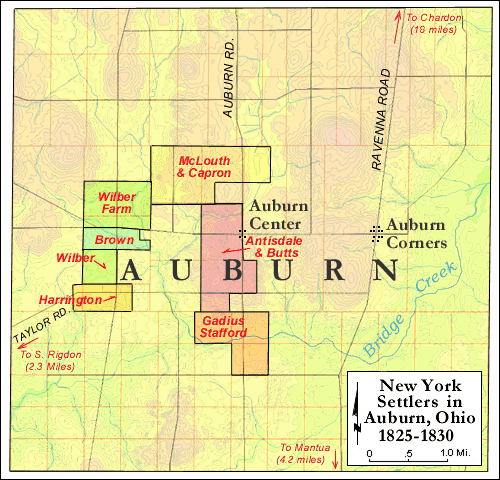
enlargement here:
http://sidneyrigdon.com/PICS/Aub1830L.gifAs will be seen on the land map, Eliza Snow had family members living in southern and eastern Auburn twp.
In her history, Eliza mentions that she herself lived in Auburn for a while (though she mostly lived in Mantua).
Consulting the enlarged map, we notice that a person standing on "E. Snow's" property, looking eastward,
could see the property of "J. Stafford" -- and, just beyond that, perhaps make out the tops of the trees on
"G. Stafford's" property. Joshua Stafford did not arrive in Auburn until after the Book of Mormon was printed.
But Gad Stafford was in Auburn at the time the book was still being printed, and according to John Stafford,
the Smith family were distributing proof sheets from the book before the printing was even finished. Warren
Cowdery, in Freedom, NY, received such proof sheets c. 1829.
All of which proves..... what?
Only that Eliza R. Snow was, at the time she had her "shining seraph" poem published, living within walking
distance of a Joseph Smith follower -- and one whose family members back in Manchester, had access to
proof sheets from the Book of Mormon (had they wished to send a few to cousin Gad in Ohio).
Ergo: Newspaper accounts and Rigdon sermons were not the ONLY sources from which Eliza might have
learned of reports of angelic visitations occurring in Manchester, New York, before 1830.
possible sources for Eliza R. Snow's knowledge of golden Bible angels:
1. local rumors and reports, repeating news from New York, from 1827 onward
2. Elder Sidney Rigdon's sermons and personal instruction, from 1827 onward
3. Elder Orson Hyde's conversations, from 1827 onward
4. Newspaper articles, such as in the "Painesville Telegraph," from fall of 1829 onward
5. Gad Stafford (or Stafford's neighbors), from 1828-29 onward
6. Lawrence Greatrake's pamphlet attacking Ohio Reformed Baptists, from 1826
UD
