The Spaulding Fable...over at BCC

The catch-all forum for general topics and debates. Minimal moderation. Rated PG to PG-13.
Post Reply
_Roger
_Emeritus
Posts: 1905
Joined: Mon Mar 02, 2009 6:29 am

Re: The Spaulding Fable...over at BCC

Post by _Roger »

mikwut:

Roger,

Thank you for the response. I will respond as follows, but I must admit your a tough one to find focus with.


Thanks.... hey wait a minute was that an insult? LOL.

Would you like me to demonstrate? Or would you prefer that we keep the focus on the S/R spoof?

I prefer the topic of this thread as I have mentioned many times.


That's what I figured.

But, you can call my religious beliefs whatever you want, you can fable, spoof, poke fun, laugh and sneer at them.


Have you ever seen me do that? On occasion I've been known to sneer at Joseph Smith and some of his earliest cronies but I generally avoid sneering at anyone I am having a discussion with--unless they prove themselves extremely worthy of it. (I don't think you're anywhere near sneering level yet, by the way... but don't push it! LOL.)

More to the point here, I'm glad you posted John Hammer's spoof (saving me the trouble of looking it up and posting it here) I didn't realize it was so short. But I like Hammer's writing. It shows creativity. I have not had the time yet to fully digest Uncle Dale's responses, but my guess is he's pretty much taking all the thunder out of Hammer's creativity. Regardless, it's still a fun read.

But I'm not very sensative about "spoofs" on S/R. I suppose that's why I find Hammer's piece funny. I really don't have the emotional attachment to S/R that you have to the official explanation. I just think it's the closest to being the "correct" explanation. If it were to collapse tomorrow, it would not be a major loss to me... I'd just go back to Smith-alone.

I am not interested in that discussion right now but have at it.


I might just to see if LDS are as "good sports" as us Spaldingites. For the time being I'll refrain, though.

Although, I will respect your religious views and take them seriously because I believe religious beliefs to be warranted and deserve to be taken seriously.


So do I, but, as an aside, you, of course, recognize that Joseph Smith has given critics like me plenty of fodder? Put your emotional attachment to Smith aside for two seconds.... do you have any problem thinking of someone like Warren Jeffs as a false prophet? I doubt it... and if not then would you feel guilty about thinking of Jeffs in less than reverent terms? I doubt it. It's not so much YOUR religious beliefs I have a problem with as it is the actions and words of your founding prophet.

With that said, if my religious beliefs are 100% bologna and you write the greatest spoof of them of all time, in fact it is so brilliant, full of depth and rich that I abandon my religious beliefs whole heartedly and with absolute abandon - guess what?, the S/R theory has gained, none, nada, nothing in regards to historical evidence or warrant. So why do you keep focusing on it?


Actually it has gained... because there would be one more person in the world who rules out the official version leaving only S/R and S-A to compete.

Of course you are, and of course it is plain and obvious, just as obvious as my concern is. Your 200 or so posts all concerning the S/R theory and your initial post requesting input about it all obviously shows you care and care what others think, why does it matter to you that you come across as not having any thought or regard concerning the matter of what others think of your thought. We empirically show our care when we post and respond. There's nothing wrong with that and no need for you attempt to dodge so being thoughtfully engaged and caring. Let's not get lost here though, I will allow you to not be concerned.


Sheesh.... thanks... I think.

Who all differ on their theories. So maybe we need to have the Smith Alone, the TBM, the UD S/R theory, the Art Vanick S/R theory, the E.D Howe S/R theory, etc... which one do you think is the "best explanation"?


Maybe so. You just scored a point there on the "disunity in the opposition" score-card, but... I wonder if you might explain for me whether Charles Anthon actually proclaimed the characters to be the best translation of reformed Egyptian he'd ever seen or if he said he could not translate them? I've been wondering which version is the right one. Should we have a "Anthon-as-verifier-of-God's-translation" theory and a "Anthon-as-fulfiller-of-Isaiah" theory? (It's okay... you didn't need that point anyway. Easy come easy go. : )

Which, no offense, you are showing in your responses to MG a great deal of that (bias).


I know. I kind of like my bias. I think it's better than everyone else's.

Yes objective purveyors would look at all the theories and all the historical evidence, but that doesn't devoid anyone of the critical examination of each independently. This thread is about the critical examination of the S/R theory. If it doesn't have warrant if it is shown to be vitally flawed or lacking it isn't in the conversation at all.


Maybe that works for you but I cannot consider a theory in a vacuum. Maybe it's flawed logic, but the way I see it, there are 3 major competing explanations for the Book of Mormon. I think chances are pretty good that one of them or at least some variant of one of them is much closer to being correct than the others. I just like trying to figure out which one that is.

So the angel still has them or transported them to heaven or what? Do you assert that they tangibly exist somewhere?

I don't know. I would be metaphysically speculating just as if I asked you if Christ's wounds still tangibly exist somewhere? Would you mind succinctly stating what that has to do with the S/R theories' evidential support?


There is a fairly decent amount of evidence that Christ was a real person. As to what it has to do with S/R's evidence, it goes back to not considering things in a vacuum. Admittedly, S/R rests on a hypothesized ms that either does not exist or is the Relief Society. I don't think that's news to anyone. Admittedly that's a weakness to overcome. But you've got an even greater weakness to overcome... which I've already detailed and am too lazy to rub it in again.

Well forgive me but I don't think that is quite accurate.

I can't forgive you then, because it is indeed quite accurate.


I thought LDS were supposed to be forgiving?!

Okay, regardless of your lack of mercy.... you are wrong.

If that is truly the case then you have to acknowledge that your own explanation fails to even get off the ground because it cannot be placed into any historical model other than the 19th century--which is not what your explanation postulates.

This is not only beside the point and false, but who cares


Ummm.... no, it's not beside the point; no, it's not false and I'm sure somebody, somewhere cares.

- I am not trying to convince you of my theory,


Well then when you convince me that S/R is a bunch of nonsense how would you prefer that I respond at that point?

my theory is admittedly not purely based on natural historical research, the S/R theory is. As already stated too many times to count, if my theory is wrong it does and says nothing regarding the S/R theory.


Then you must admit that your theory is either wrong or at the very least every time you bring up a weak spot in S/R then you need to allow me to demonstrate a corresponding weak spot in your theory that WOULD count if you were actually being fair, objective and evaluating the two on an even playing field.

I can demonstrate such to myself, that is consistent with the theory itself. Just like your aren't going to convince say, EAllusion of the Messiahship of your Savior and Redeemer nor can demonstrate that he ever existed satisfactorily to convince say, Sethbag or Some Schmoe. But you can demonstrate to yourself, through accepting your own experience as a sinner as evidence, by accepting his saving grace in your own life and walk, by experience faith and repentance, hope, belief and spiritual growth, and you then accept the historical framework consistent with that interpretation as do I.


I have to recognize that the skeptic is well within his rights to reject the supernatural elements of, say for example, the Bible. If I want to have a discussion about miracles with a skeptic I have to recognize that my own personal experience doesn't count for much. I can relate my experience, but that's about as far as it goes. I have to recognize that the skeptic is free to reject the Bible if he is only going to consider things on a rational basis. I cannot use my faith as a means of disallowing the critic to evaluate the Bible on his own terms. I can explain my personal reasons, but I cannot proclaim that an unestablished supernatural means of determining truth is superior to other means when discussing with someone who does not accept the supernatural. I must either concede that the skeptic is well within reason to reject the supernatural explanation or rationally explain why I believe the supernatural should be considered. That's a difficult thing to do, to be sure, but not impossible.

What you want is the freedom to criticize S/R using a rational framework, while disallowing rational criticism of your own explanation on the grounds that YOU explain the Book of Mormon using a different set of rules. In short, you want to play tackle football while requiring that my team cannot tackle. I try to avoid getting into games where the rules are stacked so clearly in the favor of the opposing team. It's not that I'm smart... it's just that I'm not that stupid. (Yes you can quote that).

Not close enough in time or space. And no I don't think you do have such. Not with the purposeful attention and first hand experience. You also have witnesses that say the opposite. I have no witnesses that say J.S. showed him/her the plates and they were fake. Or he showed them an angel and it was fake and staged or that they were lying. But again, this isn't relevant towards whether an objective observer would accept the evidence for the S/R theory. Nothing whatsoever.


Well this is where my own personal experience does come in handy. (And it has nothing to do with the supernatural by the way) ... see my posts to Wade about my own experience reading two books more than 20 years ago. My experience may not mean much to you, but having an experience similar to that of the Conneaut witnesses gives me practical knowledge of jsut how realistic it is for people to remember names from a book they read more than 20 years ago.... the Conneaut witness testimonies are quite plausible.

Oh, and by the way... you do have some witnesses who admit to not seeing the plates with their physical eyes... sorry but that's a strike against the official version.

I have an extant Spalding ms that parallels the Book of Mormon


No you don't. No one can be taken seriously in believing the Roman Story has any basis for the Book of Mormon, not even you Roger. It also contradicts so many facts that I won't spend the time on, because you don't understand or get it which Ben already showed you in many ways. It is ridiculous. If the Roman Story was not the purloined, borrowed, or copy pages of the Book of Mormon it doesn't help you.


This may come as a shock to you but... I don't believe Ben has made his case. At all.

Out of curiosity---for Dale, who I know hangs on my every word---has Vernal Holly's identification of place name parallels been discussed on this board?

and an 1838 discovery narrative written by Joseph Smith. You have nothing written by Nephites no examples of reformed Egyptian and no such thing as Book of Mormon geography.

I have witnesses that have Joseph Smith speaking of Book of Mormon themes well prior to ever any possibility of reading Spalding's Manuscript from Rigdon.


So far as I know that would be Lucy Mack Smith? Or do you have other witnesses? I agree that the timing of Lucy's comments is interesting. I am not sure that her quote can be pinpointed to the time prior to Alvin's death, but if so, it could be significant. On the other hand... when did Lucy write her book?

I think you might have something on the timing of Lucy's quote. I would be interested in hearing what you've got on this and your take on it. Of course the interesting thing when looking at it from your pov is that he allegedly hadn't gotten the plates at that point either.

I also have the fact that you don't have God telling you that an imaginary manuscript is warranted speculation. And once again, it doesn't matter Roger!


No I think it does. If it was an imaginary ms then we'd have to deternmine if Wade's logic of false-memories on a group level works or not. What happened to Wade, by the way? Did he get bored with us? Last I knew he was going to show us how to correctly apply the science of false memories to the Conneaut witnesses.... ?

If you are going to attempt to apply a historical framework then your explanation fails from the outset.

I plainly and clearly told you my framework includes an answer to prayer, not to mention it is the one that all the main parties state as the historical narrative so it hardly, "fails from the outset". Nice try.


I'm just telling you.... if you want to play tackle football I am going to tackle too. Smile.

Not to mention, that I don't need any of the begging evidence you ask for (although I disagree with you) to determine that the S/R theory does not have historical warrant. Again, the two aren't the same. Your defending a completely natural historical investigation, you then turn atheist yourself and poke fun at the supernatural explanation - all the while kidding yourself that that somehow helps the very theory your defending naturally one bit.


Turn atheist? What are you smoking, mikwut? Is it just me or are you hypersensative to any criticism revolving around missing plates? Dude... you really think you can sneer at the idea of a hypothesized ms and NOT expect me to note the idea of a hypothesized set of golden plates? How does that make me an atheist?

You wrote:
Do you mean there is presently not enough (any?) evidence available to support some vital aspects of the theory?


I wrote:
Yes. (not enough)


You wrote:
Thank you. That's good enough for me. It does not yet have enough evidence to support it. It is interesting and fun and I will assume then that is the universe of our further discourse.


Look.... I don't know if you feel that your position is so weak that you have to play underhanded to stay in the game or what... but anyone can see your little twist here, mikwut. I'm being straight with you. I'm not trying to hide anything or trick you or "win" something. You asked:
Do you mean there is presently not enough (any?) evidence available to support some vital aspects of the theory?


I answered truthfully:
Yes. (not enough)


Now you twist that into:
It does not yet have enough evidence to support it.


That is not what I stated, mikwut.

There are some aspects of S/R that do not have enough evidence to support a definite conclusion. Does that mean the whole theory is entirely devoid of evidence? Not at all. There are some aspects of S/R that have strong evidence. I can pretty confidently proclaim, for example, that Sidney Rigdon was lying when he claimed not to have been in Pitsburgh before 1822. Given that, I have to ask, why would he lie about that? And the case moves on from there.

If you want to point out the weak spots in S/R I am all ears. I would like to know what they are because it helps me determine if I made the right move converting to it.

All the best,

R
"...a pious lie, you know, has a great deal more influence with an ignorant people than a profane one."

- Sidney Rigdon, as quoted in the Quincy Whig, June 8, 1839, vol 2 #6.
_Uncle Dale
_Emeritus
Posts: 3685
Joined: Wed Feb 07, 2007 7:02 am

Re: The Spaulding Fable...over at BCC

Post by _Uncle Dale »

Roger wrote:...
has Vernal Holly's identification of place name parallels been discussed on this board?


I can't recall right now. Various LDS writers have written rebuttals. I don't think Vern's thesis
is very strong -- but in a few cases I remain open to his interpretations -- Kiskumen -- Morianton --
etc. Vern and I had a disagreement over the placement of the River Sidon -- with him opting for the
Genesee and my arguing for the Niagara. I think I won him over in the end -- but it never got
changed on his maps

Turn atheist? What are you smoking, mikwut?


There may be times when it is useful to try and put ourselves into other investigators' shoes. Many
former Mormons give up on religion altogether when they leave the LDS Church. I try and understand '
their viewpoints --- some post on this MB.

One of the arguments that such "atheists" bring up, in favor of their new positions, that that various
arguments leveled at Mormonism and latter day scripture can be brought to bear against the Bible
and Christianity in general. For the most part I do not support such analogies --- but now and then
they manage to convince me that mainstream Christianity may have some historical/theological problems
of its own.

For that sort of reason, I try and put myself in their shoes now and then -- that, and perhaps because
one of my most influential professors in theological seminary was an avowed atheist -- my Philosophy prof.

... There are some aspects of S/R that do not have enough evidence to support a definite conclusion.
Does that mean the whole theory is entirely devoid of evidence? Not at all.


There are MANY such "aspects." And even the strongest testimonial evidence can easily be disputed by
anti-S/R critics. The most solid evidence is documentary -- such as public records information, some
contemporary newspaper accounts, old letters, journals, etc.

For example, it would not mean much to me, if I could only place Joe Smith's early follower, Gad Stafford,
within walking distance of Rigdon's Ohio cabin, based only on human recollection. When I see his signature
on 1820s Ohio property tax duplicates, I feel I have better "evidence." When I read contemporary accounts
of Sidney Rigdon, published by his successor in the Pittsburgh Baptist pastorate, Elder Lawrence Greatrake,
I also feel like I'm on firmer ground. And when I see Mary Rigdon in the 1810 census for Amity, or Hugh
Wilson in the 1823 minutes for Rigdon's ouster in Pittsburgh, I feel I'm on firmer ground.

Funny thing, how Mormons never dispute that sort of evidence, isn't it? They don't claim that the historical
record is "devoid" of that type of documentation -- they just ignore it or say it is meaningless.

UD
-- the discovery never seems to stop --
_marg

Re: The Spaulding Fable...over at BCC

Post by _marg »

Uncle Dale wrote:
marg wrote:...
I don't care what he says or what he believes.


I care -- to this extent. That, if we are supposedly dialoging upon the level ground of objectivity, then
neither one of us should have stated (or unstated but implied) prejudices which automatically renders
any evidence presented by the other as being invalid.


Agreed. My comment was within the context you gave that Mikwut stated he'd accept the S/R theory if you gave him evidence of a Smith - Rigdon meeting before 1830. I appreciate I didn't word my comment well.. I mean I don't care what sorts of enticements he gives, or whether he claims he knows a Smith alone theory is better or he claims he's rational, ..what I care about is what he offers as far as reasoning and evidence.

Example -- my opponent may have a prejudice against black people, which has already convinced him/her,
that anything said by such a person is a lie -- THAT would preclude our dialoging upon the level ground
of objectivity, if my skin were black.

or --

Another Example -- my opponent may totally believe God has revealed to him/her, that anything I may
say about the past will be untrue -- THAT would also preclude an even-handed discussion.

I care to KNOW about any such prejudgments, because very likely I could not overcome them by anything
I could say or do. Any evidence I tried to offer for discussion would be prejudged as false or irrelevent,
if I were not meeting my opponent's pre-set conclusions. He/she would be operating under false pretenses,
if/when objectivity was invoked.


Right well that's what intellectual honesty is about. And for a fruitful discussion to take place both parties must have an open mind and be willing to change it upon new evidence or reasoning which would warrant it. Of course if you learn that an individual has a closed mind such that they are unwilling to look at new evidence..then the discussion can not proceed toward some best fit truth. Both parties must be intellectually honest, and that means looking at evidence and/or reasoning objectively and maintaining an open minded attitude to new evidence and reasoning and then willing to change should it be warranted.

Now I realize I appear to Mikwut as if I have a closed minded attitude towards the supernatural. But I don't. I'm perfectly willing to look at evidence. There is no reason for me to want to reject supernatural claims of angels, but I know they defy natural physical laws and without evidence I should reject such claims. Claims not supernatural but extraordinary none the less requires greater evidence than non extraordinary claims, hence I reject the Book of Mormon is an ancient historical account without evidence to warrant such a claim.

If he wants to discuss rationally, all he has to do is present a better fit theory to the data than the
S/R theory, that would go a long way to overturning it.


You have already tried to get his talking points on that subject -- but he does not appear to be open
to presenting a case for the non-Mormon to accept the LDS version of history. Were his presentation
even part-way successful, it would eventually lead to an LDS baptismal challenge. Even before that
point were reached, the discussion would be steeped in supernatural claims. Again, such a discussion
would not be conducted on the level ground of objectivity.


Well a better fit theory is going to require a naturalistic explanation unless he's got evidence to support the supernatural claims.

About the only solution to the problem I can envision, is a sort of gentleman's pre-agreement, by
which the Mormon stated his/her testimony, and I agreed not to present any arguments that ran
counter to that testimony. Of course that would severely limit the discussion. We might quibble over
the exact date of Solomon Spalding's birth -- or whether or not Sidney Rigdon's "word-print" had
accurately been defined.


You want to be able to dialogue with him? In a sense it's virtually impossible if he doesn't understand the concepts of being open minded to new evidence(intellectual honesty) and doesn't understand why some claims are so outrageous that without good evidence they should be rejected. It is a matter of you assessing the individual and determining if they are worth dialoguing with. Some people have it..intellectual honesty and some don't and some might apply it to some areas in their life and not others.

It really is up to Mikwut to demonstrate to you, he's open minded to truly looking at all the data and evaluate it with objectivity. From what I've seen of the apologists so far, their approach is to simply poke holes where ever they can in the S/R theory, often taking bits of data out of context in order to weaken it as well before attacking it. That's a reason for example Mikwut wants to only look at the S/R theory. If he was objectively minded he should be interested in looking at all the data and seeing what sort of explanation it leads to. Instead he wants to focus entirely on bits and pieces of the S/R theory to attack it and generally the apologists are unreasonable in their evaluation within the larger context of all the data, what those attacks entail. In essence they are unreasonable typically in their assessments. Their motivation is not to find the best fit, their motivation is eliminate a theory they find most threatening.

But not much more.

I could present no evidence for any of Spalding's or Rigdon's writings having been reproduced within
the Book of Mormon text ----- because that would entail arguing against my opponent's testimony.


Right so if you are hindered from presenting data for evaluation, it's not an intellectually honest discussion, it's not likely to be productive, nor reach a reliable conclusion. The ground rules are neither party should be hindered from presenting data and reasoning.

His testimony simply is NOT a set of beliefs equivalent to my mutable set of beliefs.

His testimony falls more into the category of mathematical certainty. Such as 2+2 = 4. It cannot be
disputed: or, at least the testimony-bearer has pre-determined that it is immutable.

Do you see my dilemma here?


Of course. You can dialogue with him or other apologists on the Net, try to explain concepts in reasoning as well, but it's a very difficult and usually not a particularly fruitful endeavor. Perhaps over time, small changes occur.
_Uncle Dale
_Emeritus
Posts: 3685
Joined: Wed Feb 07, 2007 7:02 am

Re: The Spaulding Fable...over at BCC

Post by _Uncle Dale »

marg wrote:...
Of course. You can dialogue with him or other apologists on the Net, try to explain concepts in reasoning
as well, but it's a very difficult and usually not a particularly fruitful endeavor. Perhaps over time, small
changes occur.


I have the feeling that things will get a bit easier once Craig and I have gone through the "theory"
from beginning to end, and presented our outline. At least in that situation we will not have to defend
any obviously invalid or highly questionable assertions made by past proponents.

The outline alone will comprise one very long web-page -- with a couple of dozen additional pages of
explanation -- all linked to my hundreds of previous web-pages on related subject matter.

But it will take a while to get all of that stuff nailed down -- and, since it is a presentation on HOW the
S/R authorship COULD have happened, it will probably only serve to frustrate the LDS critics. What
they generally want to see from people like myself are clear-cut, positive assertions about what
Spalding did or did not write -- where and when Joseph Smith met Sidney Rigdon, etc. etc. I probably
will NEVER get to that point, unless some "miraculous discoveries" turn up.

What I would really, really like to do, is to influence some educated Mormon (like Wade or Nevo) to go
out and conduct on-the-ground historical research of Spalding's old correspondence -- public records,
journals, etc. with documentation of the "Conneaut witnesses" -- and obscure biographical information
on Rigdon. The Mormons seem extremely reluctant to conduct any such new investigations --- perhaps
they are afraid that all they will turn up is more material supportive of the S/R claims.

Oh well --- back to my more important work. The discussion here appears to have "dwindled in unbelief."

UD
-- the discovery never seems to stop --
_marg

Re: The Spaulding Fable...over at BCC

Post by _marg »

Uncle Dale wrote:

I have the feeling that things will get a bit easier once Craig and I have gone through the "theory"
from beginning to end, and presented our outline. At least in that situation we will not have to defend
any obviously invalid or highly questionable assertions made by past proponents.

The outline alone will comprise one very long web-page -- with a couple of dozen additional pages of
explanation -- all linked to my hundreds of previous web-pages on related subject matter.


Sounds like it will help organize online material.

But it will take a while to get all of that stuff nailed down -- and, since it is a presentation on HOW the
S/R authorship COULD have happened, it will probably only serve to frustrate the LDS critics. What
they generally want to see from people like myself are clear-cut, positive assertions about what
Spalding did or did not write -- where and when Joseph Smith met Sidney Rigdon, etc. etc. I probably
will NEVER get to that point, unless some "miraculous discoveries" turn up.


Probably nothing will satisfy the Mormon believer. But quite frankly Dale there is more than enough information for the S/R theory. There is so much good data now, that it is beyond a reasonable doubt the most likely explanation.

What I would really, really like to do, is to influence some educated Mormon (like Wade or Nevo) to go
out and conduct on-the-ground historical research of Spalding's old correspondence -- public records,
journals, etc. with documentation of the "Conneaut witnesses" -- and obscure biographical information
on Rigdon. The Mormons seem extremely reluctant to conduct any such new investigations --- perhaps
they are afraid that all they will turn up is more material supportive of the S/R claims.


The more information the better.

Oh well --- back to my more important work. The discussion here appears to have "dwindled in unbelief."


Hammel & Vogel offered no substance. I think Roger was hoping someone would offer something, because he couldn't believe how well the S/R theory explains and yet doesn't have the acceptance it should. I think he's pretty much confirmed for himself, there really are no major problems with the S/R theory that warrants rejecting it and in fact quite the opposite, rather than rejecting it should be accepted hands down. No other explanation comes even close as an explanation.

You've done more than enough, and the evidence that does exist is more than enough.
_Roger
_Emeritus
Posts: 1905
Joined: Mon Mar 02, 2009 6:29 am

Re: The Spaulding Fable...over at BCC

Post by _Roger »

UD:

I can't recall right now. Various LDS writers have written rebuttals. I don't think Vern's thesis
is very strong -- but in a few cases I remain open to his interpretations -- Kiskumen -- Morianton --
etc. Vern and I had a disagreement over the placement of the River Sidon -- with him opting for the
Genesee and my arguing for the Niagara. I think I won him over in the end -- but it never got
changed on his maps


Why do you not think the thesis is very strong? The names seem very similar to me. One or two similarities are no big deal but he lists a bunch.
"...a pious lie, you know, has a great deal more influence with an ignorant people than a profane one."

- Sidney Rigdon, as quoted in the Quincy Whig, June 8, 1839, vol 2 #6.
_Uncle Dale
_Emeritus
Posts: 3685
Joined: Wed Feb 07, 2007 7:02 am

Re: The Spaulding Fable...over at BCC

Post by _Uncle Dale »

Roger wrote:...
Why do you not think the thesis is very strong? The names seem very similar to me. One or two similarities
are no big deal but he lists a bunch.


For one thing, Vern never published his research into the sources for the 19th century names
he listed. I know that he conducted such investigations in the volumes available in the SLC
Family History Library -- and that he was certain that they all existed before Spalding's death
in 1816. But he failed to document that fact in his booklet.

Because of that, modern LDS critics have asserted that several of Vern's listed place names did
not exist (or were not on the map or gazetteer tabulations) as early as 1816. Some Mormon
critics have even asserted that most of the names did not exist until after 1830.

Another problem is that Vern did not document variations in spelling for his 19th century place names.
Thus, LDS critics can point out that "Kiskiminetas" is really nothing like "Kishkumen," etc. There
were alternative spellings (such as Kishkemenetus) and alternative pronunciations for some of these
place names, but Vernal did not take the trouble to explain that.

See the FAIR rebuttal here:
Image
http://en.fairmormon.org/Book_of_Mormon ... th_America

That comprises most of the LDS rebuttal -- but some points are poorly stated there.
For example, it matters not whether Joseph Smith knew (or could know) any of these place names,
because Vernal's thesis was that Spalding made use of them in "Manuscript Found," when Smith
was a mere child.

Another example is that the FAIR people refer to "Moriancum," when Vernal's
argument was that "Moraviantown" became "Morianton" in "Manuscript Found." Vernal made
this argument based upon Solomon Spalding's interaction with Moravian missionaries, who owned
a large tract of land, immediately adjacent to his own property on the OH/PA border. But in
his booklet Vern neglected to document "Moraviantown" was pronounced/slurred to "Morianton"
or some similar sounding word.

Another example is that the FAIR people argue that Vernal's placement of names on the map is
not logically consistent with the geography presented in the Book of Mormon -- thus he has placed
names in locations which do not perfectly agree with the Book of Mormon text. This argument presupposes
that the Book of Mormon has an internally consistent geography -- and, if Spalding created that georgraphy
from the Great Lakes area, that no subsequent contributor to the Book of Mormon (Rigdon/Pratt, etc.)
made any changes to that supposed, original and consistent geography. But, of course, the
S-R explanation advances the idea that Rigdon/Pratt/Cowdery (and perhaps Smith) did not fully
understand Spalding's writings and were not fully successful in extending them in a coherent way.

Had Vernal published ALL of his research -- and had he engaged in some self-criticism of his
tabulated results, I think he could have strengthened his thesis. But he was trying to cut down
the size of his booklet, to make it more easily readable (and to lower the sales price). When he
edited down his material, he eliminated too much of his reference text, citations, etc.

All of which leaves his thesis a lot weaker than it could have been, when he published it.

UD

ps -- And, we still have the problem that FAIR writers have a pre-existing Divine testimony to uphold,
and thus cannot approach writing a rebuttal with open minds. Nevo and mikwut have recently argued
that this fact is irrelevant -- or, that not all modern Mormons claim such a Divine testimony. Be that as
it may, I still do not believe that modern Mormons can maintain their position in the LDS Church, by
stating their openness to a 19th century origin for the book. I simply do not believe that the vast
majority of active, observant Mormons have the freedom of mind which would allow them to advance
in the Church, receive endowments, magnify callings. etc., while refusing to testify that the "Book of
Mormon is true."

Now mikwut says THAT is totally unrelated to discussions between Mormons and non-Mormons on
the probable origin of the book. However -- if I point to something like Vernal Holley's publication,
as providing evidence for the S-R explanation (or even for the Smith-alone explanation), the Mormon
I converse with still operates out of a mental environment in which he/she is not allowed to view
such proffered "evidence" without prejudice. That prejudice might be "My Bishop told me the book is
true" -- or it might be "God told me the book is true;" but either way it exists for the overwhelming
majority of active, observant Mormons. And it stands as an impediment for rebutting critics such
as the FAIR people. They make no effort to add to Vernal's tabulation; nor to admit that some
reasonable people might be able to accept parts of his evidence, etc. Their response is 100%
negative -- just the sort of response designed to uphold and strengthen pre-existing testimonies,
that the "book is true beyond a shadow of a doubt."

I find that intellectual environment frustrating, for the objective exchange of information, such as
the possible validity of some of Vernal's conclusions:
http://sidneyrigdon.com/vern/vernP0.htm
Last edited by Bedlamite on Sun Aug 16, 2009 4:30 pm, edited 1 time in total.
-- the discovery never seems to stop --
_mikwut
_Emeritus
Posts: 1605
Joined: Thu Feb 14, 2008 12:20 am

Re: The Spaulding Fable...over at BCC

Post by _mikwut »

Roger,

I appreciate the dialogue. We seem to be at an impasse. WE are having two different conversations. I am having the conversation that asks does the S/R theory have historical warrant, should it be taken seriously historically? I believe vital (meaning necessary, without them it fails) evidence is lacking to support the theory. It was no trick, but you seem to agree. If it lacks enough evidence to vitally support it it is not worthy of belief.

You are having a conversation that assumes the truth is found in one of three competing theories, one best explains everything, and it is a game of shells that whoever topples the others wins. Way to unfocused for a thread, it is confusing and a shotgun blast. Although I believe the Smith alone theory explains much, much more than the S/R theory and has much more convincing evidence and doesn't lack anything vital to support it (and a small aside nearly every professional, I don't know of an exception, historian believes likewise) you seem to favor the S/R theory because you remember the names in War in Peace and a non-plagarized document somehow supports a discovery narrative, among other rationales. Fair enough.

But, given your predilections we can't even have that interesting conversation because every piece of evidence I provide or would provide you simply attack religious beliefs, and still seem to believe that that is evidence for the S/R theory, which it self-evidently and plainly is not. I view this as diversionary and lacking focus for the issues.

It is interesting to me that you, marg and UD place these wierd, bizarre gateways to dialogue about a purely natural historical question. When history of the United States, political histories, etc.. are commonly discussed in scholarly circles, after I have professed my belief, no such attack of it is considered necessary. If an atheist argues for the Smith Alone or the S/R theory as more evidentially supported I won't begin discussing the anthropic principle and the fact that he/she believes that something came from nothing and mind is just mud, for that would surely, plainly and obviously be a diversion tactic and show that I am not confident in just discussing which ever side I opposed the atheist on. You marg and Dale seem to have found a new logical principle, I have called it the snickerdoodle recipe with marg and well, it muddies the dialogue, confuses issues and lacks focus on the evidence. It is, no offense, juvenile and silly. In historical journals a pre-religious discussion isn't going to be found before the article on the weaknesses and lack of historical support for the S/R theory, I hope you all don't start criticizing Fawn and Lester anytime soon for that.

If you do want to discuss in a separate thread the evidential support and undergirdings for my religious beliefs I would be happy to do so, just not as a diversion but in a focused thread.

my best regards, mikwut
All communication relies, to a noticeable extent on evoking knowledge that we cannot tell, all our knowledge of mental processes, like feelings or conscious intellectual activities, is based on a knowledge which we cannot tell.
-Michael Polanyi

"Why are you afraid, have you still no faith?" Mark 4:40
_Nevo
_Emeritus
Posts: 1500
Joined: Sat Feb 24, 2007 4:05 pm

Re: The Spaulding Fable...over at BCC

Post by _Nevo »

Uncle Dale wrote:There are MANY such "aspects." And even the strongest testimonial evidence can easily be disputed by anti-S/R critics. The most solid evidence is documentary -- such as public records information, some contemporary newspaper accounts, old letters, journals, etc.

For example, it would not mean much to me, if I could only place Joe Smith's early follower, Gad Stafford, within walking distance of Rigdon's Ohio cabin, based only on human recollection. When I see his signature on 1820s Ohio property tax duplicates, I feel I have better "evidence." When I read contemporary accounts of Sidney Rigdon, published by his successor in the Pittsburgh Baptist pastorate, Elder Lawrence Greatrake, I also feel like I'm on firmer ground. And when I see Mary Rigdon in the 1810 census for Amity, or Hugh Wilson in the 1823 minutes for Rigdon's ouster in Pittsburgh, I feel I'm on firmer ground.

Funny thing, how Mormons never dispute that sort of evidence, isn't it? They don't claim that the historical record is "devoid" of that type of documentation -- they just ignore it or say it is meaningless.

Just out of curiosity, Uncle Dale, why do you suppose that it is meaningful that Gad Stafford was "within walking distance" of Sidney Rigdon's cabin in the 1820s? And just how far away was this "walking distance" anyway—a quarter-mile? a mile? five miles? ten?

This is precisely the sort of tenuous "evidence" that the Spalding-Rigdon theory is built on. You say Gad Stafford was an "early follower" of Joseph Smith. But when we look at the evidence for this claim we discover that the only source is Pomeroy Tucker (not always a reliable informant, especially when reporting local gossip), who lists "William Stafford, Joshua Stafford, [and] Gad Stafford" among the "pioneer Mormon disciples." That sounds promising, right? Well, no, actually, since Tucker goes on to explain that these early followers made "a profession of belief either in the money-digging or golden Bible finding pretensions of Joseph Smith, Jr.; and probably, indeed, not more than one-half of these can be said to have been genuine converts under one head or the other" (emphasis added). In other words, Tucker may be saying nothing more than that the Staffords were believers early on in Joseph's "money-digging . . . pretensions" but later became disillusioned with him. William Stafford 1833 affidavit seems to corroborate this view:

"When they [the Smiths] found that the people of this vicinity would no longer put any faith in their schemes for digging money, they then pretended to find a gold Bible, of which, they said, the Book of Mormon was only an introduction" (Vogel, EMD, 2:62).

There is no evidence, in fact, that any of the Staffords were early believers in the Book of Mormon. So why, again, is it significant that an acquaintance of Joseph Smith, possibly an early money digging accomplice who ultimately rejected his claims to be a treasure seer, lived "within walking distance" of Sidney Rigdon's farm? Stafford may have known where Rigdon lived but did he ever visit him? Is there any evidence that they ever formed a close acquaintance?

I can imagine that after news of the "gold Bible" reached Ohio, Stafford may have brought up his former neighbors the Smiths in casual conversation. But you seem to want to place Stafford and Rigdon's hypothetical meeting in 1826. And what would such a hypothetical conversation have looked like? "Yeah, I had these money-digging neighbors back in New York. Real oddballs, I tell ya." "Reeally?" says Sidney, stroking his beard thoughtfully.

Is it any wonder that "Mormons" ignore this type of "documentation" or say it is meaningless?
_Uncle Dale
_Emeritus
Posts: 3685
Joined: Wed Feb 07, 2007 7:02 am

Re: The Spaulding Fable...over at BCC

Post by _Uncle Dale »

Nevo wrote:...
Just out of curiosity, Uncle Dale, why do you suppose that it is meaningful that Gad Stafford was
"within walking distance" of Sidney Rigdon's cabin in the 1820s?


It is meaningful fact, in response to LDS claims saying that there is no possible way that
Joseph Smith and Sidney Rigdon could have met before 1830. In other words, it is relevant
in keeping the scholarly dialog going. On one hand we have Mormons saying that it is a
waste of time for anybody to conduct research into possible pre-1830 Rigdon-Smith connections,
and on the other hand we have Larry C. Porter, on page 34 (column 1) of his doctoral thesis
stating that Gad Stafford was either one of the very early "members of the church," or a
person "acquainted with the movement." Porter goes on to state that some of the listed
people were not necessarily "converts" -- baptized early members -- but, as Pomeroy Tucker
observes, believed either in "the money-digging" or "gold Bible finding" pretensions of Smith.

I do not go so far as the LDS Palmyra historian, Willard Bean, who lists Gad Stafford as
"Among the early converts from Palmyra... [or] From Manchester..."
http://olivercowdery.com/smithhome/smit ... m#1938-069
but I do count him as a Joseph Smith associate and member of the Smiths' neighboring family
at Manchester -- a family of admitted money-diggers, who both sought buried treasure with
their own peepstone and sought buried treasure in company with Joseph Smith, using his
peepstone, in the mid-1820s in Manchester, New York.

The fact that a documented associate of Joseph Smith, and participant in his supernatural
claims and activities, lived so close to Sidney Rigdon in the same mid-1820s, is a fact worthy
of further study -- and a fact which rebuts Mormon claims that Rigdon and Smith could not
possibly have known of each other's existence during that early period.


And just how far away was this "walking distance" anyway—a quarter-mile? a mile? five miles? ten?


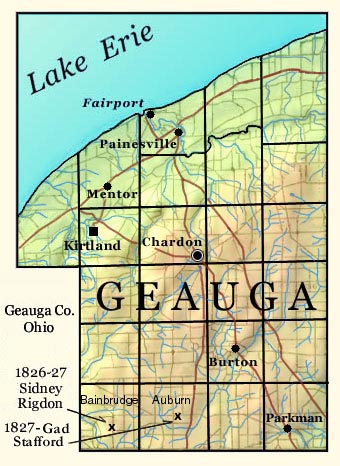
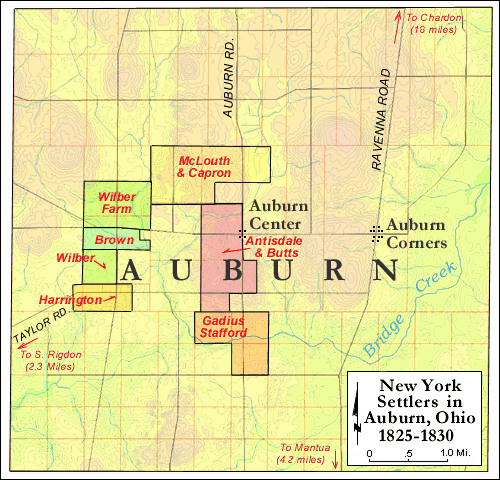
Rigdon lived in the center of Bainbridge township, Geauga Co., Ohio -- while Gad Stafford and
his Stafford relatives lived in the center of adjacent Auburn township. The townships were six
miles across. Three roads led away from Rigdon's cabin in 1826 -- one north, one south and one
east -- to Auburn township. Traveling two miles east, Rigdon entered Auburn, and almost
immediately thereafter encountered farms then being pioneered by recent migrants from the
Palmyra-Manchester area of western New York. There was a regular colony of these former
New Yorkers residing in "Kirtland," which was the land-office name for Auburn Center.

Image

and

Image

and

Image
larger map:
http://sidneyrigdon.com/PICS/Aub1830L.gif

In other words, Rigdon's neighbors on the east were former Smith family neighbors; while Rigdon had
no neighbors in the wilderness to the west of his cabin.

This is precisely the sort of tenuous "evidence" that the Spalding-Rigdon theory is built on.


Again, you mistake my intentions. I do not say that Mr. Stafford's presence in Auburn proves
that Joseph Smith knew Sidney Rigdon. Stafford did not purchase land in Auburn until late
in 1828, when Rigdon had already moved north to Mentor.

What I am saying, is that the presence of so many previous Smith family neighbors, immediately
to the east of Rigdon's 1826-27 residence, adds strength to the claim of George Wilber, saying
that Joseph Smith was in the Auburn-Bainbridge area in 1826. If you look at the maps, you'll
see that the Wilbers are practically the ONLY family east of Rigdon who did NOT come from the
Palmyra-Manchester area (although they did come from Ontario Co., NY).

What I am saying, is that one place to search for evidence documenting Smith's spring-summer 1826
absence from LDS-generated chronologies, is in Bainbridge and Auburn townships. John Reed says
that Smith went west after his 1826 hearing before Judge Neeley in Chenango county, NY. There
was an annual migration precisely out of the Palmyra-Manchester area, to Auburn, Ohio, in the
1820s. At the same time that Joseph Smith disappears from the LDS chronologies, his neighbors
were moving in wagons, on horses and on foot to Sidney Rigdon's neighborhood. At the same time
that Smith disappears from the LDS chronologies, he is reported visiting in Rigdon's neighborhood.

You say Gad Stafford was an "early follower" of Joseph Smith. But when we look at the evidence for this
claim we discover that the only source is Pomeroy Tucker (not always a reliable informant, especially when
reporting local gossip), who lists "William Stafford, Joshua Stafford, [and] Gad Stafford" among the "pioneer
Mormon disciples." That sounds promising, right? Well, no, actually, since Tucker goes on to explain that these
early followers made "a profession of belief either in the money-digging or golden Bible finding
pretensions of Joseph Smith, Jr.; and probably, indeed, not more than one-half of these can be said to have
been genuine converts under one head or the other" (emphasis added). In other words, Tucker may be
saying nothing more than that the Staffords were believers early on in Joseph's "money-digging . . . pretensions"
but later became disillusioned with him....


So -- you are saying that the Staffords were NOT Smith neighbors and did NOT move to Auburn -- and
that "Kirtland" in Auburn was NOT settled by Smith neighbors -- and therefore Sidney Rigdon could NOT
have encountered any people who knew the Smiths personally, merely by strolling a couple of miles east
of his cabin doorstep?

...
There is no evidence, in fact, that any of the Staffords were early believers in the Book of Mormon. So why,
again, is it significant that an acquaintance of Joseph Smith, possibly an early money digging accomplice
who ultimately rejected his claims to be a treasure seer, lived "within walking distance" of Sidney Rigdon's
farm? Stafford may have known where Rigdon lived but did he ever visit him? Is there any evidence that they
ever formed a close acquaintance?


So -- you are saying that there is no logical reason to investigate the origins/activities/records of Rigdon's
near neighbors in 1826-27, because none of them were ever baptized Mormons?

You are missing my point entirely. Gad Stafford is the visible tip of an iceberg, so far as the matter of
former Smith neighbors congregating near Rigdon's cabin is concerned. When we study that over-all
pattern of settlement, we see people like Isaac Butts, moving back and forth between Manchester and
Auburn, and knowing BOTH Sidney Rigdon and Joseph Smith in the 1820s. We see Porter Rockwell's
sister moving there -- though her husband did not purchase any land in Auburn until after the Book of Mormon appeared.

I can imagine that after news of the "gold Bible" reached Ohio, Stafford may have brought up his former
neighbors the Smiths in casual conversation. But you seem to want to place Stafford and Rigdon's
hypothetical meeting in 1826, a year earlier.


I do not know when Gad came to Auburn. As in the case of Isaac Butts, we see historical reports of many
New Yorker men who first came to Geauga county to work for other pioneers, as single men -- or who
came for a summer or two, in order to build a home -- before they permanently moved to Ohio with their
brides, to farm their new homesteads. The point is not WHEN Gad first resided in Auburn -- the point is
that he is accepted by such scholars as Larry C. Porter as being a Smith associate -- and by the primary
early LDS historian of Palmyra (Willard Bean) as having been a baptized convert.

These people, moving from the Manchester-Palmyra area of New York, to Geauga county, Ohio, before
1830, already knew something about the "gold Bible" and "Joe Smith." Eliza R. Snow, who lived immediately
adjacent to Auburn on the south (and who had close family members residing in Auburn) says she knew
about the "gold Bible" in 1829 -- many months before any copy reached Ohio.

Another of Porter Rockwell's sisters moved to a farm eight miles north of Rigdon's cabin in the early 1830s.
That area was a special congregating point for Palmyra-Manchester people moving westward. In 1826
Parley P. Pratt relocated to this same general area -- where his Pratt uncles, Allen and Samuel moved
around 1830 -- Samuel Pratt to the same township as the Rockwell girl.

These people knew of Joseph Smith and his "gold Bible" well before Mormon missionaries ever made it
to Ohio. They are the logical population, among which to search for possible pre-1830 Smith-Rigdon
contacts. Or --------> are you advising me NOT to conduct such further research?

UD


Is it any wonder that "Mormons" ignore this type of "documentation" or say it is meaningless?[/quote]
Last edited by Bedlamite on Sun Aug 16, 2009 5:49 pm, edited 1 time in total.
-- the discovery never seems to stop --
Post Reply