Roger wrote:Dale:
Don't have time to read it at the moment, but do you by chance have a rough outline of such tenets
to be looking for? I am not nearly as familiar with LDS (or RLDS) doctrine as you are.
That's pretty much what I want others to do for me -- to make the comparisons and the list.
In the early 182os Alexander Campbell and/or his closest followers would have pretty
much matched the unnamed preacher that Lucy Mack Smith recalled visiting her neighborhood
and advocating a union of all the Christian sects.
Campbell started out by professing much the same philosophy -- but then went
on to demand the abolition of Christian creeds. That led him into arguments with
other theologians, as to what was objectionable in various creeds, confessions,
and articles of faith.
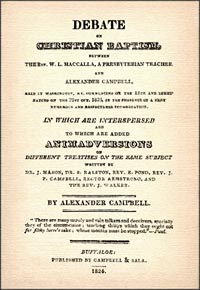
As we see in the 1823 debate with the Presbyterian minister Walmart. L. M'Calla, the
tenet Campbell found most damnable was the doctrine requiring infant baptism
by sprinkling (or pouring). In his 1823 debate he presents his arguments against
this Calvinist and Catholic doctrine, and advocates instead an adult, believer's
baptism, conducted according to biblical practice.
From this initial point of contention, Campbell went on to accuse the infant-baptizers
(along with sprinkle-baptizers such as Methodists), of having long, long ago left
the purity of original, apostolic Christianity, in what was a very early (and nearly
universal) great apostasy.
That left Campbell to fellowship only Baptists, and a few reformers, such as the
1820s followers of Barton Stone (a former Presbyterian).
Then -- beginning in the mid-1820s -- Campbell began to part ways with the
Baptists as well. He derided their requirement of a miraculous conversion
experience, saying that the Holy Ghost in modern times bestows no such
miracle upon sinners -- that the only miracle necessary for conversion to
Christianity was the miracle of scripture conveying the gospel message.
This meant that Campbell was denying the validity/truthfulness of ALL the
Baptists' individual professions of having been "born again." Campbell
taught that a convert was NOT "born again" by any such pre-baptismal miracle,
but only regenerated in the ordinance of baptism, properly administered..
All of this destroyed totally the Calvinist precept of "election." For Campbell,
God did NOT choose who would be converted and who would not -- and God
did NOT send the Holy Ghost to change the hearts of elect sinners prior to
baptism. According to Campbell (in the mid-1820s), practically ALL of
Christendom was following a practically evil, apostate pseudo-religion.
None of this served to make Campbell very popular, among most Christians.
Then, at the end of the 1820s, Sidney Rigdon went one step farther, and
accused the Campbellites of having no Divine authority to baptize.
Thus, even to the extent that Campbell was right, in his condemning
nearly all Christians of a terrible apostasy, he could not correct the
situation by requiring converts to undergo faith, repentance, immersion,
remission, and bestowal of the Holy Ghost, --- because Campbell had
no authority from God to conduct the very ordinance that Campbell
himself was placing overwhelming existential stress upon.
A sinner might indeed have faith; and he might indeed repent; and
God might indeed accept that repentance, and welcome the convert
to be baptized for the remission of sins. But, at that very point, Elder
Rigdon stepped in and asserted that a Campbellite baptism (even
properly conducted, with correct theological precepts) was useless.
It was useless, because God rejected the repentant sinner's choice
of a baptizing elder. If that elder were a Campbellite, he possessed
no God-given authority to baptize. And, if that elder were a Campbellite,
he did not himself possess the Gift of the Holy Ghost, and could not
convey the Holy Ghost through the laying on of hands in confirmation.
Thus, to an external observer, a Mormon baptism conducted by Elder
Sidney Rigdon, and a simultaneous baptism conducted by Elder
Alexander Campbell might appear identical. But --- to God --- only
Sidney's administration of the ordinance was acceptable and valid,
because only Sidney (and fellow Mormon elders) truly held the
latter day priesthood, and only they (Mormons) were speaking
truthfully, during baptismal rites, when they said aloud, for all to
hear: "having authority from God..."
The 1824 "Debate" book provides a foretaste of what was coming, in
the way of "restorationist" theology and practice. When Campbell and
Rigdon sat together, listing to their opponents during that debate,
probably neither one of them realized, that within 7 years, the "latter
day work" would have progressed so far, that even Campbell himself
would be accused of belonging to an apostate sect ----> by Elder Rigdon.
UD