Scratch wrote:I agree that MDB is a fine place, and that the aptly named MADboard positively sucks.
My dear Scratch.....This is truly a sig-worthy comment!

Scratch wrote:I agree that MDB is a fine place, and that the aptly named MADboard positively sucks.
I still believe that the expansions that I identified in 1987 are valid with two notable exceptions. I believe that the masonic stuff is influenced in its verbal formulation by the anti-masonic terminology, but it is clear to me (as it was in 1987) that antimasonry cannot account fully for what we find in the Book of Mormon regarding secret combinations. Further, I badly misconstrued Alma’s teachings on the atonement to reflect Anselm’s satisfaction theory. In the second volume of Exploring Mormon Thought I have a chapter where I exegete LDS scripture regarding soteriology and I pay special attention to the theory of atonement in the Book of Mormon. It turns out that the view of the Book of Mormon regarding atonement is miles away from Anselm and provides a new (so far as I am aware) view of atonement that I believe is much more edifying and inspiring. I really blew that in my 1987 essay. Culpa mea. However, the remainder of the expansions that I identified in 1987 remain solid in my view and I still believe that form criticism is the best way to get at expansions in the Book of Mormon.
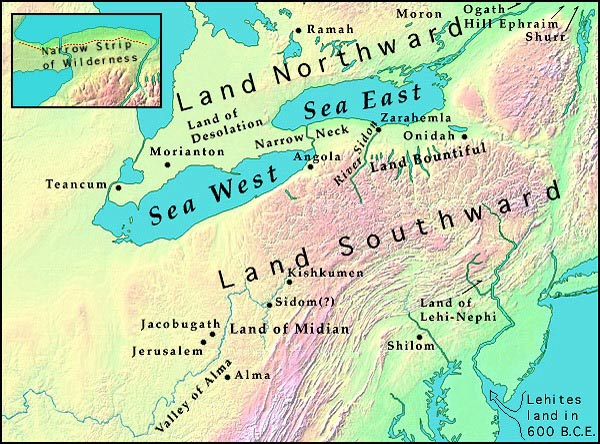
I am as yet undecided on the finds at Nahom in Arabia. The passage of the Pacific Ocean given currents and length of travel seems so highly improbable that it is not really a good candidate. As for islands – it may be that more than one island is referred to (the Book of Mormon refers to “isles” plural). I don’t know what Jacob meant by an “isle of the sea” (but he expressly states that they are on an isle of the sea)– but I see no reason that outlying areas like Belize wouldn’t work as well. I simply suggest that we keep open about the configuration since the narrow neck of land could be defined by large lakes as well as oceans or seas. So it could be a lot of different areas where there are two lakes that create a narrow neck of land between them (and that opens up a lot of possiblities). One thing I am clear about, the Mayan culture is a not a Book of Mormon culture.
Does Royal Skousen show that the Book of Mormon was dictated with a ticker-tape appearing across the seer-stone/urim & thummim? How could looking at an English translation ms. with scribal corrections tell us that? His argument makes no sense to me because it goes way beyond what the evidence reasonably shows. Admittedly David Whitmer believed in the ticker-tape theory of translation; but he was upset when Joseph altered the revelations in the D&C too. He and Joseph had different ideas about scripture. I see his story about the method of the Book of Mormon translation as something he adopted to bolster his fundamentalist view of scripture (a wildly untenable view promulgated by the likes of the Tanners).
the Church will not hire anyone who believes the documentary hypothesis of the Pentateuch. Indeed, they gauge how faithful a scholar is by whether s/he believes that Paul wrote Hebrews (and that is really odd because I cannot think of any good reason to believe that Paul wrote Hebrews and a lot of really good arguments that he didn’t). Church education insists on teaching a more or less fundamentalist view of sripture. Adam was real and evolution is false; the flood was world-wide; languages differ because of the tower of babble etc.
You are correct that allowing midrashic commentary goes beyond merely allowing interpretation in translation. Call the latter the “minimal expansion thesis” and the former the “maximal expansion thesis.” I obviously accept both and believe that both phenomena are demonstrable in the Book of Mormon text. My point is that everyone at FARMS must accept at least the minimal expansionist thesis — and I believe that anyone who looks at the text seriously will see that the maximal thesis is also required to make sense of how the book handles KJV quotations. Moreover, I believe that the minimal thesis entails the maximal thesis because at times any competent translation must explain what is really being said rather than just rendering the words. For example, the English “beat around the bush” wouldn’t mean anything without explanation as to how the idiom is used.
The discussion in Mosiah 13-16 incorporates the KJV of Isaiah 53 and then gives commentary some of which is dependent on the peculiar phrasing and translation of the KJV version of that chapter. The discussion is rather clearly influenced by Christian discussion of God’s unity and the relation of the Father to the Son. However, as I stated in the article I don’t believe that Joseph Smith was aware that the revelation as received constituted his midrash. Rather, he thought it through and when he knew it was right that constituted the translation (and it is possible that the seer stone then reflected the that translation).
How loud the applause was by a bunch of LDS is beside the point! Barker’s arguments have not been well received by other scholars. Her arguments are flimsy in my view and based on begging the questions constantly. I am quite sure that there is not a large acceptance of her views among scholars because she is long on assertion and short on evidence. The fact the LDS may be enthusiastic because it supports our preconceived idea of what the evidence should say (as I believe it does for her as well), we still need sound evidence — and I don’t see much that she offers.
I consider the Small Plates and God’s provision of an alternative basis of translation as easily explainable as merely Plan B when Plan A didn’t pan out. God probably has an innumerable list of contingency plans — and that is why I call my theory “contingent omniscience.” Interesting view that the entirety of the Small Plates are an expansion. Well, it could be. Yet I still find convincing evidence of the antiquity of the Book of Mormon in 2 Ne. 9-11 and especially in 1 Ne. 1.

So it could be a lot of different areas where there are two lakes that create a narrow neck of land between them (and that opens up a lot of possiblities).
One thing I am clear about, the Mayan culture is a not a Book of Mormon culture.
Uncle Dale wrote:Doctor Scratch wrote:..."Do you ever think?"
...
Which is exactly the point I've been trying to get across to Mr. why-me for
several years now -- over on MAD.
UD
why me wrote:...you never proved that sidney wrote the book
...
Uncle Dale wrote:My major purpose is to implant within Mormon minds the possibility that substantial
portions of their beliefs are wrong -- and that it has been their topmost leaders,
going back to the days of Smith and Rigdon, who originated these false teachings.