This whole thing has so many twists and turns.... I guess that's what keeps me interested.
Chris wrote:
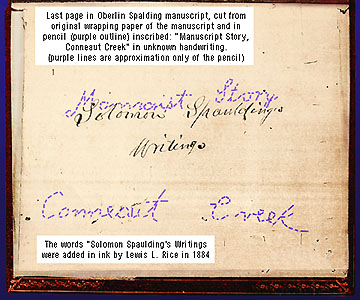
As for Howe's white-faced reaction to the rediscovery of Manuscript Story, perhaps he knew this would blow the Spalding theory out of the water.
I initially thought that was probably what was going on... until I dug a little deeper:
Howe thought MS-CC had been burned when his office burned:
The letter was from E. D. Howe, of Painesville, the aged author of the book "Mormonism Unvailed." Its purport was that he had seen the magazine article alluded to, and after a criticism on the statements made in it, he told Hurlburt that the manuscript which he (Hurlburt) had given to him, in 1834, was burned, with other of his papers, in his office, etc.
Dickenson,
New Light On Mormonism, p66
http://www.solomonspalding.com/docs2/1885DicC.htm
Then from Arthur B. Deming:
I told Mr. E. D. Howe that word had been received from the Sandwich Islands that Spaulding's manuscript from which the "Book of Mormon" was made, had been found there, without mentioning Rice's name. Mr. Howe trembled and become greatly excited. I told a clergyman in the town that he could not have been much more so if the Sheriff had read his death warrant. A few days later he said he was failing and wanted to die. I finally read to him Mr. W. H. Rice's letter
and that relieved his fears, for he said Rice used to edit the Telegraph and he probably had Conneaut story, which proved to be correct.
-Arthur B. Deming, "About Spalding," Naked Truths about Mormonism 1/1 (January 1888):
http://maxwellinstitute.BYU.edu/publica ... m=2&id=584
So if this report is accurate it appears Howe is agitated until he learns that MS-CC is what was recovered rather than MF.
But this is where things really get bizarre. This is Dickenson's account of her 1880 interview with Hurlbut. Keep in mind this is before the rediscovery of MS-CC and that Hurlbut is an old man (two years from death) and he's complaining... why are all these people contacting me about Mormonism after 40 years?
After reading it I again looked significantly at both Mr. and Mrs. Hurlburt, and asked:
"Do you believe the manuscript was burned?"
"Well, he says it was," Hurlburt replied, greatly disturbed.
"Was it Spaulding' s manuscript that was burned?"
Hurlburt waited a moment before answering, his wife looking at him with a pleading, sad expression of countenance.
"Mrs. Davison thought it was; but when I just peeped into it here and there and saw the names Mormon, Maroni, Lamanite, Nephi, I thought it was all nonsense; why, if it had been the real one I could have sold it for $3000; but I just gave it to Howe because it was of no account."
"Had you any right to do so? You borrowed it, solemnly promising to return it to Mrs. Davison?"
He grew still more disturbed, and replied:
"Well, I forgot most all about it."
Now isn't that some kettle of fish! Hurlbut's obviously lying through his teeth. His story doesn't make sense at all if he's telling the truth. He peeps into it "here and there and saw the names Mormon, Maroni, Lamanite, Nephi" and thinks it was all nonsense? Nonsense!
This story is either contrived by Dickenson or Hulrbut is hiding something--badly.
Later in the conversation, Hurlbut allegedly says:
Why you must be crazy to ask such a question. Did I not say I gave it to E. D. Howe, and he says in the letter you read from him it was burned up in his printing house. Why, lady, if I knew where it was, I would give $1000 and my farm besides for it."
"You know," I laughingly said, "the report is you were paid $300 by the Mormons for the manuscript, and with that money bought this farm."
He smiled for the first time, and replied:
"Why, the Mormons hated me; they threatened me. I had a fight with Joe Smith, and had to have him bound to keep the peace with me."
Note that Hurlbut does not expressly deny selling the manuscript.
And then Dickenson interviews Howe as follows:
"The whole matter, then is between you and Hurlburt. Is there a possibility that the original Spaulding manuscript will yet come to light?"
"No, I don't think so, he replied, earnestly;
"the Mormons had too much at stake to let it exist." "Then you think Hurlburt destroyed it?"
"
I believe he had two manuscripts -- the original one and another -- the one he gave me which had no resemblance to the 'Book of Mormon.'"
http://www.solomonspalding.com/docs2/1885DicC.htm
So again, if Dickenson is reporting accurately, there is reason to suspect Hurlbut had both MS-CC and MF.
Then there's this from Briggs:
Briggs1875
International Review
September, 1881
James A. Briggs,
71 Columbia Heights, Brooklyn N.Y.
(Letter to the Editor
dated March, 1875)
My Dear Sir, --
I regret that I have not been successful in obtaining a copy of "Mormonism Unvailed," -- a book written and published by Mr. Howe, of Painesville, Ohio, some forty years ago, and written when the headquarters of Mormonism were at Kirtland, Ohio. In the winter of 1833-34, a self-constituted committee of citizens of Willoughby, Mentor, and Painesville met a number of times at the house of the late Mr. Warren Corning, of Mentor, to investigate the Mormon humbug.
At one of the meetings we had before us the original manuscript of the Rev. Solomon Spaulding, who came to Ashtabula County, Ohio, from Monson, Mass. It was entitled, "The [Lost Tribes]: or, The Manuscript Found." It was obtained from Mr. Patterson, or Peterson, a publisher of Pittsburfg, Pa., with whom negotiations had once been made towards its publication. From this work of the Rev. Mr. Spaulding the Mormon Bible was constructed. I do not think there can be any doubt of this. I
t was the opinion of the committee after comparing the Mormon Bible with the manuscript. The style of composition, the names, etc., were the same. In 1833 Joseph Smith was prosecuted by a man by the name of Hurlbut, I think, for assault and battery. I was a law student at the time in Willoughby, and was for the prosecution. The case was before a Justice of the Peace in Painesville, Ohio. The matter attracted a great deal of curiousity. The court was held in the old Methodist Church in Painesville, and the Justice who issued the warrant against the Mormon Prophet invited another Justice of the Peace to sit with him. Judge Bissell was the attorney for the Prophet. The trial lasted three days, and the church was filled to overflowing. During the examination of Smith, he gave the history of the finding of the golden plates of the Mormon Bible, how he was kicked by the Devil when he uncovered the plates and stooped down to get them. It was an interesting story; and, although it had nothing to do with the case under investigation, the Court, his own attorney, and the people all desired to hear the narration, and it came out under oath. Smith, Hyde, Pratt, and all the leaders of the faithful were there, except the ablest and most eloquent man among them all, -- the Rev. Sidney Rigdon. He had been a Baptist minister, and was a man of great natural eloquence. He is yet living, and, I think, could tell something about how the Mormon Bible was manufactured, if he would.
I guess, in my speech to the Court in the case, I must have been rather hard on the Prophet and his testimony and Mormonism, as I was told that one of his brethren said, "If it was not for his religion, he would whip that young Briggs." I was not whipped. Smith was bound over; and Mormonism, persecuted, mobbed, turned out, has flourished.
Yours truly,
James A. Briggs
http://solomonspalding.com/SRP/SRP13p2.htm#Refs2
Interesting that Briggs has MF being obtained from "Mr. Patterson" of Pittsburgh, which is probably not correct since Hurlbut allegedly displayed MF in Kirtland
before he went to Pittsburgh.
and...
I have no doubt we had the "Manuscript Found" before us, that we compared it with the Mormon Bible, that the style in which the "Manuscript Found" was written was the same as that of the Mormon Bible. The names -- peculiar -- were the same, not to be forgotten. The names Lehi, Nephi, Maroni, etc., and the expression "and it came to pass" often repeated. This manuscript did not go to Mr. Howe. What did Hurlbut do with it? Some few years ago I wrote to him and asked him who had it -- what he did with it. He did not answer my letter. He received it, as [it was] not returned to me. Dr. Hurlbut died in Ohio two years ago last June. He is silent now, the grave closed over him . . .
http://solomonspalding.com/SRP/SRP13p2.htm#Refs2
There's more, but I really need to get back to taxes.
All the best.
"...a pious lie, you know, has a great deal more influence with an ignorant people than a profane one."
- Sidney Rigdon, as quoted in the Quincy Whig, June 8, 1839, vol 2 #6.