Where did the Book of Mormon come from?

The catch-all forum for general topics and debates. Minimal moderation. Rated PG to PG-13.

Where do you believe the Book of Mormon came from?

 
Total votes: 0

_Uncle Dale
_Emeritus
Posts: 3685
Joined: Wed Feb 07, 2007 7:02 am

Re: Where did the Book of Mormon come from?

Post by _Uncle Dale »

Trevor wrote:
MCB wrote:Occam's Razor should not be an excuse for intellectual laziness.


In Chris's case, you can rest assured that it is not. Here is the guy who has worked to master just about every skill necessary to evaluate Mormon claims, including the formula to calculate the length of a papyrus scroll. Whether it is math, exegesis, or stylometry, Chris learns what he needs to know in order to grapple with the issues. At the same time, most scholars expect a certain minimum threshold of evidence before they'll take a claim very seriously. If Chris is not taking Spalding seriously, I would wager that this is the reason why. From what I have heard, however, he is at least taking the Jockers study seriously enough learn about stylometry.


I once asked Dan Vogel why the Smith-alone authorship explanation was a better
one than the Smith+helpers explanation.

His reply was that Smith+helpers was "an unnecessary, ad hoc" addition to
an already elegant and parsimonious authorship explanation.

In other words, given the accumulated evidence, it was simpler to apply the
intellectual "razor" and quickly dispose of any "unnecessary" thinking.

Perhaps that path works well for some people, but I fail to see why it should
be applied to researchers. If such investigators are being paid a salary by
the LDS Church, then I suppose they could be constrained by their bosses,
not to locate or report on any "unnecessary" documentary/factual discoveries.

But, if the Smith-alone researchers voluntarily place themselves under Mr.
Vogel's particular constraints, isn't there a possibility that they may overlook
and fail to report some new and important historical evidence?

UD
-- the discovery never seems to stop --
_marg

Re: Where did the Book of Mormon come from?

Post by _marg »

MCB wrote:And given all the information available, S/R people agree with Mormons, that Smith was not capable of writing the book on his own. There is ample evidence from Lucy's own pen, that the Smith family did not have enough money for educational expenses, and that Joseph missed out on a lot of school for health reasons.


I think that it is unlikely that any person would have dictated the Book of Mormon without notes, without any prewriting, without revisions and at a pace of 8 pages per day. So yes, even without the S/R data, I would be extremely skeptical of the claim Smith dictated the Book of Mormon in that manner.

Occam's Razor should not be an excuse for intellectual laziness.


I have found on the Net that even people who are extremely intelligent and quite logical will use Occam's Razor incorrectly. It's to the point that I think it shouldn't be mentioned as reasoning for choosing one naturalistic theory over another. It works well eliminating supernaturalistic explanations and eliminating unnecessary data which only complicates an accepted theory but certainly it doesn't work well if at all, in choosing between 2 or more very different competing theories.
_Trevor
_Emeritus
Posts: 7213
Joined: Mon Sep 03, 2007 6:28 pm

Re: Where did the Book of Mormon come from?

Post by _Trevor »

Uncle Dale wrote:Perhaps that path works well for some people, but I fail to see why it should be applied to researchers. If such investigators are being paid a salary by the LDS Church, then I suppose they could be constrained by their bosses, not to locate or report on any "unnecessary"documentary/factual discoveries.

But, if the Smith-alone researchers voluntarily place themselves under Mr.
Vogel's particular constraints, isn't there a possibility that they may overlook
and fail to report some new and important historical evidence?


Dale,

I have been far too snide and sarcastic with you guys. I apologize. I appreciate your work. I have spent many hours on your websites, and I have enjoyed reading much of the research and scholarship invested in S/R. I am not convinced yet, but someday, given the right evidence and argument, I may be. I can't speak for Vogel. I respect him for his intelligence, but I was not persuaded by his interpretive biography of Smith. As long as there are devoted S/R folk, I hope someone is out there chasing down this evidence you believe exists. I will happily confess my error if the evidence solidly lines up behind S/R. My opinion is that it is still premature to declare an S/R victory based on Jockers et al., and I am not moved by the historical evidence.
“I was hooked from the start,” Snoop Dogg said. “We talked about the purpose of life, played Mousetrap, and ate brownies. The kids thought it was off the hook, for real.”
_Uncle Dale
_Emeritus
Posts: 3685
Joined: Wed Feb 07, 2007 7:02 am

Re: Where did the Book of Mormon come from?

Post by _Uncle Dale »

Trevor wrote:
Dale,

I have been far too snide and sarcastic with you guys. I apologize. I appreciate your work. I have spent many hours on your websites, and I have enjoyed reading much of the research and scholarship invested in S/R. I am not convinced yet, but someday, given the right evidence and argument, I may be. I can't speak for Vogel. I respect him for his intelligence, but I was not persuaded by his interpretive biography of Smith. As long as there are devoted S/R folk, I hope someone is out there chasing down this evidence you believe exists. I will happily confess my error if the evidence solidly lines up behind S/R. My opinion is that it is still premature to declare an S/R victory based on Jockers et al., and I am not moved by the historical evidence.


Four years ago I received a breathlessly excited phone call from a Jack-Mormon
friend, directing my attention to what was billed as an "unpublished antique
manuscript on the early Mormon leader, Sidney Rigdon," up for bid at e-bay:
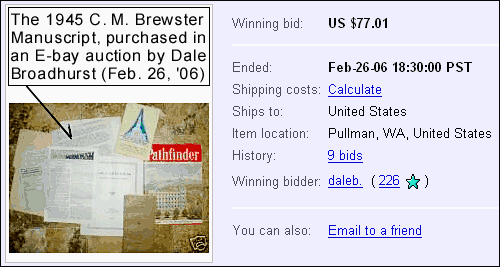
Image

By some luck of the draw, I outbid the cryptically designated "realLDShistorian"
bidder by a few bucks and ended up with a partial draft copy of the 1945
Carl Milton Brewster manuscript, "Did Sidney Rigdon write the Book of Mormon?"

Brewster's name had come up in my Ohio research previously -- as a local Ohio
scholar whose ancestors had known Rigdon, and who was somehow involved
with the 1934 Abram Garfield manuscript on Rigdon and Smith at Hiram, Ohio:
http://www.sidneyrigdon.com/features/hi ... m#garfield

So -- I was very interested to finally have the Brewster document arrive in
the mail, so I could hunt through his primary sources.

Alas, two misfortunes came in rapid succession -- the manuscript had been
"gutted," with frequent illegible cross-outs and many numbered pages
missing; and then, at the copy center, the quantity of copies returned to
me was only about half of what I'd left off for photoduplication. The "meat"
of Brewster's research and reporting was lost.

The two gems of information which I did obtain from the gutted document,
were a reference to an 1860s newspaper article on 1820s money-digging
in Rigdon's neighborhood of southwestern Geauga Co., Ohio, and an arcane
reference to an 1826 pamphlet, in which Rigdon was accused of having
associated with a "glass-looker" in that same area, either late in 1825 or
in 1826.

That is all I could glean from what must have once been a massive amount
of primary documentation on Rigdon's Dec. 1825 removal to Bainbridge, Ohio
and his subsequent several months, living in that obscure corner of the forest.

I never did locate the Geauga Co, newspaper article on Rigdon and mid-1820s
money-digging in that county. The closest I discovered was the next item in
Brewster's incomplete bibliography:
http://www.sidneyrigdon.com/dbroadhu/OH ... htm#120968

As for the pamphlet which documents Rigdon's association with a local Ohio
money-digger, it turned out to be Brewster's notes, taken from this item:
http://www.sidneyrigdon.com/1826Grtk.htm#1826RBap

When I discussed this with a very skeptical LDS researcher, his guess was
that Elder Greatrake had merely mentioned Gad Stafford (a money-digger
from New York), and that there was no "smoking gun" from 1826, proving
that Joseph Smith had been seen in Rigdon's neighborhood in Ohio.

I gave up looking after that. Gad Stafford is recognized as having been a
pre-1830 follower of Joseph Smith -- and one from a family known to have
possessed a peepstone used in New York money-digging activities.

But, even if I could have unearthed a c. 1826 legal document, containing
both Gad's name and Sidney's name, it would have proved nothing. A
neighbor of the Smiths, from Manchester, New York, showing up next to
Sidney Rigdon in Ohio before 1830 was useless information.

As my LDS friend pointed out to me, Rigdon's pre-1830 association with
Smith neighbor, Isaac Butts was a much more "solid" piece of evidence,
known since 1888, and which was equally meaningless.

That's about as close as I ever came. I'm disabled now, and living on a
pittance of a monthly Social Security check. I can pay my annual web
domain registration and my internet services connection, and that's it.

If there is useful evidence, still "out there," ready to be collected and passed
on to the writers of the next generation of Mormon history books, it will
not be stuff that I discover.

I'll be happy to watch and see.

Perhaps the next substantial documentary discovery will favor the Smith-aloners.

UD
-- the discovery never seems to stop --
_Trevor
_Emeritus
Posts: 7213
Joined: Mon Sep 03, 2007 6:28 pm

Re: Where did the Book of Mormon come from?

Post by _Trevor »

Uncle Dale wrote:Alas, two misfortunes came in rapid succession -- the manuscript had been "gutted," with frequent illegible cross-outs and many numbered pages missing; and then, at the copy center, the quantity of copies returned to me was only about half of what I'd left off for photoduplication. The "meat" of Brewster's research and reporting was lost.


I think I am going to be sick to my stomach. This was the only extant manuscript? And it was lost in the hands of some irresponsible boobs at Kinkos? Unbelievable.

Uncle Dale wrote:The two gems of information which I did obtain from the gutted document, were a reference to an 1860s newspaper article on 1820s money-digging in Rigdon's neighborhood of southwestern Geauga Co., Ohio, and an arcane reference to an 1826 pamphlet, in which Rigdon was accused of having associated with a "glass-looker" in that same area, either late in 1825 or in 1826.


Both of which I would be very interested in.

Uncle Dale wrote:When I discussed this with a very skeptical LDS researcher, his guess was that Elder Greatrake had merely mentioned Gad Stafford (a money-digger from New York), and that there was no "smoking gun" from 1826, proving that Joseph Smith had been seen in Rigdon's neighborhood in Ohio.


Well, it sounds to me like there were many such glasslookers at the time, but I think it is intriguing that Rigdon came in contact with such folk before Smith (or at the same time? or was it indeed Smith?). If I had a different life, I would love to pursue research on these seers.

Uncle Dale wrote:]I gave up looking after that. Gad Stafford is recognized as having been a pre-1830 follower of Joseph Smith -- and one from a family known to have possessed a peepstone used in New York money-digging activities.

But, even if I could have unearthed a c. 1826 legal document, containing
both Gad's name and Sidney's name, it would have proved nothing. A
neighbor of the Smiths, from Manchester, New York, showing up next to
Sidney Rigdon in Ohio before 1830 was useless information.


It may not have proved what you want to prove, but it is not unimportant, and the more such information we have, the better an understanding of these fellows we will have. This ultimately will change our understanding of the history, whether the results are what you are looking for or not.

Uncle Dale wrote:That's about as close as I ever came. I'm disabled now, and living on a pittance of a monthly Social Security check. I can pay my annual web domain registration and my internet services connection, and that's it.

If there is useful evidence, still "out there," ready to be collected and passed
on to the writers of the next generation of Mormon history books, it will
not be stuff that I discover.


I am terribly sorry to hear about your health. I hope it improves, and I am most sincere when I say this. I may not be convinced of your thesis, but i believe you are a real treasure to restoration studies, and I am sorry that you cannot pursue your work unimpaired. We need to discuss how we are going to make sure your papers and other work are maintained in the future. But that is for another day.
“I was hooked from the start,” Snoop Dogg said. “We talked about the purpose of life, played Mousetrap, and ate brownies. The kids thought it was off the hook, for real.”
_Uncle Dale
_Emeritus
Posts: 3685
Joined: Wed Feb 07, 2007 7:02 am

Re: Where did the Book of Mormon come from?

Post by _Uncle Dale »

Trevor wrote:...
This was the only extant manuscript?
...


It seems that the final draft is preserved in Brewster's papers in Pullman. One of
my friends hopes to go on vacation to western Washington next year, and will
then make a search through Brewster's uncatalogued papers at the University.
http://www.wsulibs.wsu.edu/holland/masc ... s/cg44.htm

There is also reportedly some correspondence preserved between Brewster
and his cousin, Fred Henry ---->
http://sidneyrigdon.com/books/Hnry1942.htm#comments

Fred Henry was the one who donated the 1934 Garfield manuscript to the
Hiram College Archives. There are also uncatalogued Henry papers in Hiram.

The 1826 Greatrake pamphlet is evidently preserved with the Alexander
Campbell papers (also uncatalogued) in the Bethany College Archives.

I get tired, just thinking about the legwork necessary. Unfortunately, past
experience has demonstrated that reliance upon letters and faxes to
distant librarians is the least useful and effectual method for such research.

UD
-- the discovery never seems to stop --
_Roger
_Emeritus
Posts: 1905
Joined: Mon Mar 02, 2009 6:29 am

Re: Where did the Book of Mormon come from?

Post by _Roger »

Chris:

Oliver's sin in this affair wasn't so much counterfeiting, as believing Joseph Smith. Oliver had been put in charge of the Kirtland Anti-Bank. He purchased the plates for printing the currency, and signed most of the printed banknotes. The problem was that there was no real collateral to back up the notes. Joseph had directed him to sign the notes, and then later accused him of counterfeiting when the bank scheme went under. Basically, Joseph threw him under the bus.


So goes the official story. I have heard that Cowdery was associated with counterfeiting even before 1830, but at the moment I can't back that up. Nevertheless, if we are to believe Sidney Rigdon, we might see Oliver as slightly less benign than your picture paints him:

Oliver Cowdery, David Whitmer, and Lyman E. Johnson, united with a gang of counterfeiters, thieves, liars, and blacklegs of the deepest dye, to deceive, cheat, and defraud the saints out of their property, by every art and stratagem which wickedness could invent, using the influence of the vilest persecutions to bring vexatious law suits, villainous prosecutions, and even stealing not excepted. In the midst of this career, for fear the saints would seek redress at their hands, they breathed out threatenings of mobs, and actually made attempts with their gang to bring mobs upon them. Oliver Cowdery and his gang (such of them as belonged to the church) were called to an account by the church for their iniquity. They confessed repentance, and were again restored to the church; but the very first opportunity they were again practising their former course. While this wickedness was going on in Kirtland, Cowdery and his company were writing letters to Far West, in order to destroy the character of every person that they thought was standing in their way; and John Whitmer and William W. Phelps were assisting to prepare the way to throw confusion among the saints of Far West. During the full career of Oliver Cowdery and David Whitmer's bogus money business, it got abroad into the world that they were engaged in it, and several gentlemen were preparing to commence a prosecution against Cowdery; he, finding it out, took with him Lyman E. Johnson, and fled to Far West with their families; Cowdery stealing property, and bringing it with him, which has been, within a few weeks past, obtained by the owner, by means of a search-warrant; and he was saved from the penitentiary by the influence of two influential men of the place. He also brought notes with him, upon which he had received pay, and made an attempt to sell them to Mr. Arthur, of Clay county. And Lyman E. Johnson, on his arrival, reported that he had a note of one thousand dollars, against a principal man of the church; when it was a palpable falsehood, and he had no such thing; and he did it for the purpose of injuring his character.

Senate document containing statement drafted by Sidney Rigdon
http://olivercowdery.com/smithhome/1838Sent.htm


Of course Rigdon's language is characteristically inflammatory, but he certainly retains no mercy when it comes to Oliver & David's character--even noting at another point in his statement the irony of such an attack on Book of Mormon witnesses. Rigdon has no problem believing their Book of Mormon testimonies, but now claims they have dishonored those testimonies. It's difficult to know where to put the blame. I certainly think both Rigdon and Smith were equally liable--if not more so--but the point here is that the character of all of these men is highly questionable.

Whitmer is the only one in the bunch I can't figure out one way or the other. But Whitmer's word is obviously no good. Vogel more than adequately demonstrates this.


Why do you say that? I think Whitmer was a fairly honest and sincere man, especially compared to some of the other bastards in the early Mormon movement.


Again, for me, Whitmer is a question mark. If we are to believe Sidney's rant above then Whitmer is evil. Whitmer was definitely into seer stones and the occult. Vogel demonstrates that his accounts of seeing the plates are contradictory. Whitmer later asserts: If you believe my Book of Mormon testimony, then you will also believe me when I tell you that Joseph Smith is a fallen prophet.

A case can be made that Whitmer was a sincere dupe, but I am skeptical.

For Joseph Smith, yes. But when Oliver observed Joseph with his head in his hat, that wasn't a vision. That was a concrete event.


Well the difference is that I think Oliver was in on the fraud. Other people saw Joseph with his head in the hat. That's not a big deal. I will say that if Oliver was not in on what was really going on, then either S/R is not true or Smith was a really good con man.

Yes, I agree. If Joseph set out to convince David, Oliver, and his money-digging circle, then the whole head in the hat thing makes perfect sense. But that's not what S-R says. S-R says this whole thing was a conspiracy designed by Sidney Rigdon, with the intent of starting a new religion.


I think that's oversimplified. I don't believe Rigdon's intent was to pull several other people into a conspiracy. Rigdon wanted to usher in the millenium. He was a true believer with real mental problems. I think his reworking of Spalding's novel took place over several years during which time his mind became increasingly more delusional. In the beginning he was probably intrigued by the thesis of the novel and may have taken it as truth. Rigdon had no problem imposing his own revelation onto pre-existing truth. Campbell, he thought, was right about some things, but wrong about others. Rigdon did not set out to look for a gang to commit fraud with. Instead I think he was looking for the right God-sanctioned person to help him bring new revelation to the world that would usher in the millenium.

I believe he was feeling out young Darwin Atwater's receptiveness to the idea. Atwater did not respond as he should if God was prompting him. There's no telling who else Rigdon viewed as a prospect. But when he came into contact with Smith, I believe Smith saw an opportunity and ran with it. I think from that point on Smith took the reigns and left Rigdon in the dust. The only thing that put a pothole in the road was the loss of the 116 pages. At that point I think Rigdon had to be brought back into the picture to help figure out how to proceed.


Rigdon had been around enough Campbellites to know that the head in the hat thing would not go over well with the average churchman. If he wanted to design an effective delivery system, he could not have chosen more poorly.


Rigdon did choose "poorly" in the sense that he choose a person (Smith) who was far more charismatic and cunning than he himself was. In a sense, he choose extremely well, for if he had chosen a lesser personality we would probably not be having this discussion and the world would not have Mormonism.

But I do not think Rigdon was ever in control of the way things played out once Joseph Smith was brought into the picture. As I say, I think Rigdon was consulted after the loss, but once the recovery plan was put into action, it was all Smith again from that point onward and Sidney was merely along for the ride.

Joseph knew that the magic stuff was a problem for many respectable religious people too, which is why as he revised his project in a religious direction he gradually censored out the magical aspects of the early accounts.


I agree. As time went on and he began to get more and more "respectable" converts he quickly began to realize the treasure-hunting lore and black magic needed to be censored out.

Originally Moroni had been a treasure guardian with his throat slit, and the tales of Joseph going repeatedly back to the hill to get the plates were full of black magic, astrology, and other such stuff. In later memory all these narratives were heavily revised and Christianized. I don't know how this evolution fits into the S-R theory.


Well I'm not sure how nicely it fits into Smith alone. There are some unknowns, but as I stated earlier, those unknowns are equally unknown no matter which Book of Mormon production theory you adopt. It's possible that Rigdon first came into contact with Smith in 1823 in Palmyra. That would explain the tales of the treasure guardian not allowing Smith access to the book.

How do we explain the idea that Joseph had to keep going back each year and was given different requirements? Why the need to bring someone with him? Why the need to be married? Who do you think really set those restrictions? You think Joseph came up with those restrictions on his own? Or perhaps invented them after the fact? I don't know. Do you?

Again, if Joseph and Oliver were conspiring to start a religion with Rigdon from the beginning,


See that's the thing... I don't think that's what happened. I think Rigdon wanted to usher in the millenium through new revelation. I think Smith saw an opportunity to get himself out of poverty and ran with it, and I think Cowdery came along at the right time and, given his familiarity with View of the Hebrews, fit like a glove once he was caught up on what this thing was all about.

then the head-in-the-hat translation method was a really stupid choice of approach.


I doubt if Rigdon had much say about it at that point. Remember, in the beginning Smith likely used a blanket. There was no head in hat at that point. That was merely Joseph's method for discovering treasures. The translation went painfully slow with Emma after the loss. I think this may be an example of what happens when the Book of Mormon is produced the way you think the whole thing was produced... with Joseph coming up with stuff off the top of his head.

By the time Oliver came into the picture Joseph was openly using the head in hat method but the pace improves dramatically. That suggests to me that Oliver was in on the fraud and the head in hat thing was just for show.

It makes a lot more sense if Joseph was the original mastermind of the Gold Bible project and gradually changed his conception of it from hermetic to religious.


Possibly, but again, I really don't think we're that far from each other. It makes sense if Rigdon starts the process, giving Smith something to work from and then Smith takes the ball and runs with it, almost leaving Rigdon wondering if he had done the right thing.

All the best.
"...a pious lie, you know, has a great deal more influence with an ignorant people than a profane one."

- Sidney Rigdon, as quoted in the Quincy Whig, June 8, 1839, vol 2 #6.
_Roger
_Emeritus
Posts: 1905
Joined: Mon Mar 02, 2009 6:29 am

Re: Where did the Book of Mormon come from?

Post by _Roger »

honorentheos:

I havn't read much recently on the S/R theory, as my previous reading left me decided that it was not realistic to place Rigdon physically in a position to do what he needed to do. So at that point there wasn't much distinction between Rigdon teleporting around vs Moroni.


Well then your comment makes more sense given that. Again, I suggest you look into the facts for yourself. You state that "it was not realistic to place Rigdon physically in a position to do what he needed to do"... and I would challenge you to back that up. Many people have looked into this and the bottom line is that there are gaps in both Rigdon and Smith's itineraries at interesting points.

If you are referring to Rigdon's oft repeated claim that he was never in Pittsburgh before 1822, this has been shown to be false by recent evidence. An 1816 Pittsburgh mail-waiting notice was discovered a few years ago with both Rigdon's and Spalding's names on it.

It was a bit tongue in cheek to say I feel the official LDS version is more credible and takes less faith to believe. I only said as much because of the number of people who weigh in on either side. It's human nature to give more consideration to a position held by a larger group than a smaller one.


Agreed. And although I think most LDS are basically nice people, I don't accept LDS testimonies as carrying any weight in the real world. 13 million testimonies are no more right than a couple. I would, perhaps, be more open to giving weight to LDS testimonies if no one was ever leaving the church or retracting their previous testimony.

That being said, I am open to new evidence for any theory and would consider better evidence for S/R.


Great. Welcome to the discussion.
"...a pious lie, you know, has a great deal more influence with an ignorant people than a profane one."

- Sidney Rigdon, as quoted in the Quincy Whig, June 8, 1839, vol 2 #6.
_marg

Re: Where did the Book of Mormon come from?

Post by _marg »

Roger wrote:

By the time Oliver came into the picture Joseph was openly using the head in hat method but the pace improves dramatically. That suggests to me that Oliver was in on the fraud and the head in hat thing was just for show.


It's been a while for me but If I recall correctly Cowdery was the scribe for 90 - 95% of the Book of Mormon. What evidence are you using to assume Smith used a "head in the hat"? As far as Emma's dad observing this, that would be an easy put on show. Smith & Cowdery worked in a separate small house on Emma's dad's property, I believe down the hill from the main house. So when Emma's dad would drop by and probably infrequently it would be a simple matter of seeing him approach and put on a brief show. So forget Emma's dad, that was an easy con. Cowdery is most probably in on the whole thing and I don't even think Cowdery claimed that Smith used a "head in the hat". So what other evidence is there to justify the "head in the hat"?
_Uncle Dale
_Emeritus
Posts: 3685
Joined: Wed Feb 07, 2007 7:02 am

Re: Where did the Book of Mormon come from?

Post by _Uncle Dale »

CaliforniaKid wrote:...
Oliver's sin in this affair wasn't so much counterfeiting, as believing Joseph Smith.
Oliver had been put in charge of the Kirtland Anti-Bank. He purchased the plates
for printing the currency, and signed most of the printed banknotes.
...


Show me even ONE bank note signed by Oliver.

Warren Parrish and F. G. Williams may have duplicated the Smith and Rigdon
signatures on some of the later currency -- but what evidence do you have
for any Cowdery signatures?

During his church trial before a Special High Council convened at Far West in
1838, one of the charges filed against Cowdery was the illegal fabrication
of bogus coins in Ohio -- evidently in Summit County.

Image

If he had been charged with banknote counterfeiting, then the evidence
available for inspection might have been the hundreds (thousands?) of
worthless notes he signed at the end of 1837 and the beginning of 1838,
as Vice President [later President?] of the Mormon Bank of Monroe, in Michigan.
That might have been cited as a sort of official counterfeiting -- by passing
worthless money printed by an equally worthless LDS bank.

Image

But you'll have to show me a Cowdery-signed Kirtland note, to make me believe.

UD
-- the discovery never seems to stop --
Post Reply