CaliforniaKid wrote:...
We'll also have to talk about Rigdon's influence on the movement post-1831
...
Hopefully, with at least a passing glance at Feb. 16, 1832.
UD
I'm shocked at how you can dismiss out of hand all the textual and historical evidence we've discussed and deny that it is evidence, Roger.
Ahhh! Here finally we get to something that is not a negative but actually exists! And yet opinions on this stuff are by no means settled! Debates rage about textual evidence for and against Rigdon, or Smith or Spalding or whoever. The fact is there are Campbellite friendly doctrines in the Book of Mormon. That is NOT evidence "that seems to indicate there wasn't one (a second ms) at all." Quite the contrary!
At best (for your theory) that would be why you would conclude Rigdon warmed up to it rather quickly. The point is a case can be made for both sides on this and that actually works against Smith alone because under your theory Smith had to come up with all this stuff himself, whereas our theory allows for contributions from the people who are more likely to have produced any given section.
So no... this is not evidence against S/R. Quite the contrary.
6. Strong textual evidence against Rigdon or Spalding, such as syntax and grammar, dumbed down nature of the text, J.S. dictation, theology such as concept of God different in Book of Mormon than Rigdon, historical insertions when timely and appropriate, as Chris calls them – Smithian memes. Metcalfe’s wherefore/therefore.
Sometime when I have more time, we're going to have to have a serious, in-depth discussion about Smithisms and Rigdonisms in the Book of Mormon.
If you're actually willing to be open-minded about this,
I think you'll be surprised how many Smithisms there are, and how little of the Book of Mormon's content could really have been written by Rigdon.
We'll also have to talk about Rigdon's influence on the movement post-1831, and the new elements it added that departed from Mormonism up to that point.
Uncle Dale wrote:CaliforniaKid wrote:...
We'll also have to talk about Rigdon's influence on the movement post-1831
...
Hopefully, with at least a passing glance at Feb. 16, 1832.
UD
Uncle Dale wrote:...
I'm getting tired of having to do all the investigative work myself.
Uncle Dale
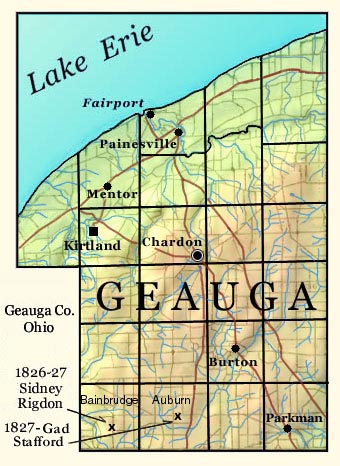
Rigdon's 1832 visit to Auburn
From the middle of September, 1831 until the end of March, 1832, Mormon leaders Joseph Smith, Jr. and Sidney Rigdon lived with their families on the John Johnson farm in Hiram twp., Portage Co., Ohio. During this same period Emily Rockwell Stafford moved with her husband, Christopher M. Stafford, from Manchester to Auburn. According to Christopher's 1885 statement to Arthur B. Deming, the couple arrived in Auburn on Dec. 2, 1831. Since Smith was living but a few miles away, it is not unlikely that he soon thereafter visited with these old neighbors from his home town. In the case of Sidney Rigdon, the history is clear -- he visited Auburn in company with Elder William E. McLellin on Sunday, Jan. 15, 1832 (only six weeks after the Staffords' arrival) and spoke in a religious meeting there for "about 2 hours," (see Journals of William E. McLellin 1831-1836, p. 69). The entire population of Auburn in 1830 was but 428 residents (including the children) and in a six-mile-square township, it is not unreasonable to assume that Christopher R. Stafford and his wife Emily Rockwell Stafford were among those "settlers" attending Rigdon's preaching service. Certainly Rigdon, Smith, Rockwell and the Staffords would have enjoyed ample opportunity to have met and to have been seen together in Auburn during that same winter.
Professor Brewster's assumption -- that Rigdon, Smith and Rockwell were seen together at the home of Rockwell's sister, in Auburn as early as 1826 -- is not only a highly unlikely one, it is an assumption that may have rested upon a garbled report of the three men having been seen together, at that sister's home, five or six years later.
http://www.sidneyrigdon.com/books/Brew1945.htm#comments
The Apostasy of Ezra Booth and Symonds Ryder 297
...
On September 6 Joseph Smith held a conference in neighboring Nelson and "upon testimony satisfactory to this conference it was voted that Ezra Booth be silenced from preaching as an Elder in this Church." 25 This was one of the earliest occasions in which a Church conference took action against a member for apostasy. The same day Booth was silenced, Ryder's attack first appeared in the newspaper. It garnered no written notice among Church members. Booth's struggles were still on Joseph Smith's mind when on Sunday, September 11, he received a revelation that focused sharply on the negligence of the missionaries for not preaching as they returned to Missouri: "I, the Lord, was angry with him who was my servant Ezra Booth, and also my servant Isaac Morley, for they kept not the law, neither the commandment" (D&C 64:15). Morley repented; Booth did not. The revelation also rebuked Joseph. This revelation provided deep insight into the nature of repentance and forgiveness. It reminded the Saints: "There are those who have sought occasion against him [Joseph] without cause; Nevertheless, he has sinned... I the Lord, will forgive whom I will forgive, but of you it is required to forgive all men" (D&C 64:10). Booth did not accept this invitation to seek repentance and forgiveness. Instead, he let his perceived grievances fester.
The next day, Monday, September 12, at a conference in Kirtland, Church leaders also silenced George Miller, a priest from Shalersville. By this time Symonds Ryder's published
__________
21 Ibid.
22 Ibid.
23 Ezra Booth, "For the Ohio Star, Rev. Ira Eddy, September 12, 1831," October 13, 1831, 5.
24 Ibid.
25 Donald Q. Cannon and Lyndon W. Cook, eds., Far West Record• Minutes of the Church of Jesus Christ of Latter-day Saints, 1830-1844, 12.
298 Hearken, O Ye People
attack had already been in print for six days. However, Miller and Ryder's defections paled in comparison to the impact of Booth's disaffiliation. Instead of responding to the call to repentance issued in revelation on September 11, on the same day as the September 12 conference in Kirtland, Ezra Booth wrote a letter to his long-time friend Ira Eddy, which Eddy quietly held for the next month.
One week later, Booth wrote a letter to Edward Partridge, now living in Missouri, who had shared in some of his earlier disappointments, hoping to influence Bishop Partridge to share some of his further antagonism. On September 20, Booth wrote: "You will probably be surprised, when you learn, that I am no longer a member of the Mormonite church." Furthermore, he described himself as one whom the Latter-day Saints were "pleased to nickname apostate." His purpose in writing was to encourage Partridge's defection: "Prove to your own satisfaction as I have done, the falsity of Joseph's prophetic declaration, 'if you turn against us you will enjoy no more satisfaction in the world.'" 26 Partridge ignored the letter.
Booth's defection encouraged the Methodist community, which had been devastated by his earlier conversion. After having suspended their meetings for a time, on Sunday, September 18, they gathered in the brick schoolhouse in Ravenna, reorganized their Sunday School, and began holding small group meetings.
In October Ira Eddy took Booth's letter to Lewis Rice, editor of the Ohio Star. 27 Published in Ravenna, the newspaper represented the journalistic competition to the Ravenna Courier in which Ryder had published his copy of "The Law of the Church." In seeing the Mormonites as good copy, however, Rice saw eye to eye with the unknown editor of the Courier. Rice had first mentioned the Latter-day Saints in his reprint of a negative article on December 9, 1830, not long after missionaries first arrived in Ohio. In it he scoffed at "the Golden Bible" as "doubtless, one of the veriest impositions of the present day." 28
Lewis Rice published Booth's first letter October 13 in the middle of page 5 without editorial comment. Booth acknowledged in the letter: "It is not my design at this time to enter into particulars relative to the evidence upon which my renunciation of Mormonism is founded," and he offered no doctrinal or theological challenges. Rather, he lamented that he had "sacrific[ed] my time and property to build up a system of delusion." He recounted his initial excitement at conversion, the disappointing trip to Missouri, and his subsequent struggles with believing. 29
This initial letter was apparently originally intended to stand on its own. However, it was well received and reprinted widely. At least one individual even mailed copies of the Ohio Star to family members across the country. 30 Rice went on to publish another letter every week for an additional six weeks and, after missing a week, printed two final letters together on December 6, 1831, for a total of nine Ezra Booth letters. The letters also moved from page 5 of the newspaper to pages 3-4, then page 3, and ended up for the last two weeks on page 1.
As the series began, with Letter 2, Rice included three paragraphs of introduction to Booth describing him as a "formerly highly esteemed preacher" and vouched for his character. Rice also mentioned "one of his [Booth's] letters" and "the letters," suggesting that Booth had already written this series, even though they bear dates of composition that follow the publication of each preceding letter. Letters 2-6 follow a chronological narrative
__________
26 Ezra Booth, "Mormonism, VI, November 14, 1831," November 17, 1831, 3.
27 Booth, "For the Ohio Star, Rev. Ira Eddy," 5.
28 "The Golden Bible," Ohio Star 1, no. 49 (December 9, 1830): 3.
29 Booth, "For the Ohio Star, Rev. Ira Eddy," 5.
30 Dennis Rowley, ed., "The Ezra Booth Letters," 135-36.
The Apostasy of Ezra Booth and Symonds Ryder 299
and were clearly written as a whole while Letters 7-9 may have been written afterward to build on the widespread interest. Rice also mentioned a "private note" with the letters, suggesting additional communication that led to their publication. Rice explained that Booth's motivation for writing the letters was to "rescue, if possible, the honest and conscientious" within Mormonism and "prevent others from falling into it." Interestingly, the conflict Booth experienced with Church leaders after his refusal to preach "along the way" not only disappeared from the description of the letters, but even the fact that Booth had been commanded to preach and failed to do so was adjusted. No longer had Booth served a mission but, according to Rice, he had gone to Missouri "in search of the 'Land of Promise'," one of the goals of the mission. 31
Ezra Booth's second letter gave a brief, rambling overview of Mormonism. He described the manner of performing baptisms, the ordination of members to the "High Priesthood," and the nature of continuing revelation, including Joseph Smith's role as revelator. The tone of Booth's descriptions was negative. For example, he sought to portray continuing revelation as destroying the scriptures. "Their revelations are said to be an addition to the Bible," Booth noted. "But instead of being an addition, they destroy its use; for every thing which need to be known... they can learn from Smith." He also noted: "Signs and wonders are to attend them, such as healing the sick, the blind made to see, the lame to walk &c." 32 But he conspicuously omitted the healing of Elsa Johnson, of which he was an eyewitness, even though non-members in Hiram later avowed that she was clearly healed by Joseph Smith.
Booth's third letter described some of the elements of. religious enthusiasm that existed in the community before Joseph Smith arrived. (See Chapters 8-10.) Booth acknowledged: "Most of those who were the principal actors, have since apostatized, and the work is unanimously discarded by the church." However, he still characterized speaking in tongues, pantomimed interaction with the Indians, and other elements of the community while on the Morley farm as part of Mormonism, claiming that because these expressions were rejected by Church leaders upon their arrival to Ohio the faith had "changed its character" rather than asserting its true character while replacing misguided beliefs. It is interesting that Booth tried to characterize those early Mormonite activities as part of "the principal foundation of the faith of several hundred of the members of their church" because they continued with the movement after leaving their early practices behind; but he left elements of his own involvement in those activities visible in his letter. For example, he commented that an interpreter of tongues "proffered his services as my interpreter," thus admitting that Booth himself had spoke in an unknown tongue. 33
Booth's fourth letter described the June conference in which he was a participant. (See Chapter 12.) He described the religious enthusiasm that became a prominent element during the conference and the expectation that the men would receive additional priesthood authority by which they could heal the sick and afflicted. Although Booth was very much a part of this experience, he wrote his account with a tone of skepticism, emphasizing that some attempts to heal in connection with the June conference failed. George A. Smith later noted during the conference that "Ezra Booth was bound his countenance distorted and numbers of the brethren looked at him and thought it was a wonderful manifestation of the
__________
31 Lewis Rice, "Mormonism," Ohio Star 2, no. 42 (October 20, 1831): 3.
32 Booth, "Mormonism, II, October 2, 1831," 2, no. 42 (October 20, 1831): 3-4.
33 Booth, "Mormonism, III, October 24, 1831," 2, no. 43 (October 27, 1831): 3.
300 Hearken, O Ye People
power of God but to their astonishment Joseph came forward and rebuked the foul spirit and commanded it to depart and in consequence there of Booth was relieved and several of the brethren were greatly tried. 34
Booth's fifth letter described his mission beginning at the end of the June conference. He acknowledged: "Not being much accustomed to travel on foot, I hesitated for a while" but finally went, preaching faithfully to seven congregations by the way. However, his focus was on his disillusionment and the fact that he and his companion, Isaac Morley, "commenced our journey home, before most of the Elders arrived" and completely missed the conference held in Independence, Missouri. 35
Booth's sixth letter described Independence and the laying of the cornerstone for a temple. However, he depicted the event as insignificant. The corner was marked with a stone so small it could be carried in one hand, and twelve men ceremoniously carried a scrub oak. His conclusion was clear that these were inadequate efforts to mark the grandiose effort to build the temple. 36
Booth's seventh letter was primarily a copy of a letter he had sent to Partridge shortly after his arrival back in Ohio "with but a little variation." There is no indication of where he changed the original letter, but Booth was critical of Partridge in one of his published letters to Ira Eddy while in this letter he was generally obsequious, hoping to persuade Partridge to his own view and against Joseph Smith. The letter to Partridge particularly challenged Joseph's character as a prophet. "Have you not often discovered in him, a spirit of lightness and levity, a temper of mind easily irritated, and an habitual proneness to jesting and joking?" Booth asked. He believed that such lightheartedness was unbecoming a prophet. Booth also challenged Joseph's self-assurance about his ability to receive revelation. When they arrived in Missouri, they found the Church smaller than what Joseph had seen in vision. Joseph insisted that eventually his vision would be fulfilled: "I see it, and it will be so." For Booth his confidence in what would happen was "better suited to an impostor, than a true Prophet of the Lord." 37
Although the introduction to Letter 7 noted the series "will soon be closed," the Ohio Star did not publish a Booth letter the following week. On Thursday, December 1, 1831, when a letter should have appeared in the newspaper, Joseph received a revelation at the Johnson home that he and Sidney Rigdon were to
confound your enemies; call upon them to meet you both in public and in private; and inasmuch as ye are faithful their shame shall be made manifest.
Wherefore, let them bring forth their strong reasons against the Lord. Verily, thus saith the Lord unto you -- there is no weapon that is formed against you shall prosper. (D&C 71:7-10)
Letters 8 and 9, Booth's last two letters, appeared together exactly a week later on December 8. In these letters, Booth published a document connected to the mission to the Lamanites that had first brought the four missionaries to Ohio. (See Chapter 7.) He reviewed early difficulties in the Church connected with Hiram Page's false revelation and the revelation Joseph Smith had received on September 1830 in response (D&C 28). He also mentioned
__________
34 Booth, "Mormonism, IV, October 31, 1831," 2, no. 44 (November 3, 1831): 3; George A. Smith, Sermon, November 15, 1862 [sic - 1864], 26; reproduced in Appendix: Sermons.
35 Booth, "Mormonism, V, November 7, 1831," 2, no. 45 (November 10, 1831): 3.
36 Booth, "Mormonism, VI, November 14, 1831," 2, no. 46 (November 17, 1831): 3.
37 Booth, "Mormonism, VII, November 21, 1831," 2, no. 47 (November 24, 1831): 1.
The Apostasy of Ezra Booth and Symonds Ryder 301
the difficulties connected with Laura Hubbell. (See chap. 10). He ended by asserting that his exposition had "in part accomplished, what I intended when I commenced it." 38 The week after these two final letters, Sidney Rigdon paid the Ohio Star to insert a notice in the newspaper challenging both Booth and Ryder to a public debate. 39 He announced he would preach on "the Christian Religion" on Christmas day at the brick schoolhouse in Ravenna where the Disciples of Christ typically met and where Symonds Ryder occasionally preached. 40 Rigdon invited Booth to join him there for a public discussion. In the same notice, he challenged "Simons Rider" to a debate (characteristically misspelling his name), because Ryder had "publicly declared the Book of Mormon to be an imposition." Rigdon requested Ryder to respond publicly through the Ohio Star. Ryder's response, instead of a paid notice, appeared as an article in the regular columns on December 29. Chastising Rigdon for "want of due respect to his superiors," Ryder noted that his and Rigdon's dwellings were only sixty rods apart (990 feet) and that they could easily discuss the matter in private. "But to undertake to correct him of his errors before the public, would be a most arduous task for me." He signed the notice (correctly), "Symonds Ryder." 41
Rigdon was given space in the news column of the Star to respond. "If Simons Rider is afraid to have his assertions put to the test," he challenged, "why make them? If he is certain (as he pretends) that the Book of Mormon is a 'base imposition,' why be afraid to come forward and prove it?" 42 Ryder refused to be drawn into a debate.
As Rigdon's choice of a date indicates, a religious debate was not considered out of place on Christmas day. In fact, Christmas as a festival was just then becoming popular in the region. The Johnsons still had young children at home, and the Smiths had two small children. They may have celebrated quietly with their guests although little is known about the celebrations of individual families in the region. Mary Ann Stearns, a four-year-old in Kirtland, first heard of Santa Claus in 1837 when traveling with her parents, Parley P. and Mary Ann Pratt, on their mission to New York. 43 However, as early as 1834 the Chardon Spectator and Geauga Gazette (Chardon was between Kirtland and Hiram), published an editorial defending Christmas celebrations.
[On Christmas Eve] the stockings have all been hung up, including that of the little one who can just waddle, and been filled by Saint Nicholas, and the hearts of the children made glad and prepared to spend a merry Christmas. To this custom some have objected, as superstitious, and tending to give children wrong impressions; but in our minds, it is associated with the delights of childhood. Children have never seriously believed, that St. Nicholas, with his little car... actually descended the chimney, and deposited gifts in the stockings, but that a mother's or a sister's hand placed them there.... We well remember that sometimes whips would be placed in the stockings to remind us that we had behaved naughtily, but with the bad, the kind hand which placed them, ever mingled good. 44
As promised, on Christmas day and the day following, a large group congregated in Ravenna to hear Rigdon preach an "exposition upon Booths letters." The sermons lasted for two days, even in Booth's absence. 45 Rigdon's text has not survived; but Joseph's description of their general preaching in Shalersville, Ravenna, and elsewhere probably captures its gist.
__________
38 Booth, "Mormonism, VIII-IX, November 29, 1831," Ohio Star 2, no. 48 (December 8, 1831): 1.
39 Sidney Rigdon, "To the Public," Ohio Star, December 15, 1831, 3.
40 History of Portage County, 528.
41 Symonds Ryder, "Letter to Mr. Editor," Ohio Star 2, no. 52 (December 29, 1831): 1.
42 Sidney Rigdon, "To the Public," Ohio Star, 3, no. 2 January 12, 1832): 3.
43 Mary Ann Stearns Winters, "Reminiscences," 6-7.
44 "Christmas," Chardon Spectator and Geauga Gazette, December 27, 1834, 3.
45 Hyrum Smith, Diary, December 25-26, 1831; Journal History, November 16, 1831, 2.
302 Hearken, O Ye People
They went about "setting forth the truth, vindicating the cause of our Redeemer; showing that the day of vengeance was coming upon this generation like a thief in the night; that prejudice, blindness and darkness filled the minds of many, and caused them to persecute the true Church, and reject the true light." 46 Lewis Rice, even though he lived and worked in Ravenna, did not cover the sermon in the Star. Significantly, neither Booth nor Ryder added anything after the sermons. Joseph Smith and Sidney Rigdon traveled around the region and continued to preach briefly while other missionaries also vigorously preached.
Four years later in the Mormon Messenger and Advocate, Rigdon characterized Ryder's backing down as showing "more honesty than some [sic - some others of] of his brethren" but had nothing else good to say about him. According to him, "Simonds Rider... could blow like a porpoise when there was no person to oppose him; but when called upon to be as bold in the presence of those whom he envied, as in their absence, he had recourse to... slander and abuse." 47 Ryder did not remain silent at this second thrust and threatened to sue Rigdon for slander. Rigdon retorted mockingly:
I have just received the desperate information, that Simons Rider [sic], in consequence of the notice which I have taken of him, is going to prosecute me.... O! I do not want to be sued for the terrible crime of telling the truth about a man. I know that the truth is a tight fit upon Simons, and I think it is likely that it hurts him some too; as no chastisement for the present is joyous but grievous, nevertheless afterward it yields the peaceable fruits of righteousness to them who are exercised therewith. And could Simons avoid suing me, for a little season, perhaps it might have that effect upon him. 48
Apparently, Ryder did not respond to this allusion to Hebrews 12:11. As he had done four years earlier, he withdrew from the public exchange.
Effects of the Ryder/Booth Defections
How accurate is Amos S. Hayden's retrospective claim that the defection of Symonds Ryder and Ezra Booth reversed the attractiveness of Mormonism in Hiram, leaving it "a very lean concern?" 49 Hinsdale, speaking at Ryder's funeral in 1870, stated that, although "a large number" of the residents of Hiram had joined the Latter-day Saints, Ryder and Booth did much to influence those "who had been swept away on its current." 50 Unquestionably, the public arguments, published in the press, against Mormonism had an effect. Some of that effect was actually positive, by increasing people's exposure to Mormonism. Ira Ames, living in New York, recalled: "When reading his [Booth's] letters, I felt an impression that there was something to Mormonism. There was considerable talk about it in the neighborhood." 51 Ames joined the Church when missionaries came to his village in June 1832.
Ambrose Palmer of Norton, Ohio, listened to Booth promote the Book of Mormon and then read his negative letters in the Ohio Star. Ultimately, he ignored the letters. Palmer recalled:
__________
46 History of the Church, 1:241.
47 Sidney Rigdon, "Brother Whitmer," Messenger and Advocate 2, no. 4 January 1836): 243.
48 Rigdon, "Br. O. Cowdery," Messenger and Advocate 2, no. 9 (June 1836): 334.
49 Amos S. Hayden, Early History of the Disciples in the Western Reserve, 221.
50 Hinsdale, "Life and Character of Symonds Ryder," 221.
51 Ira Ames, Autobiography and Journal, 6.
The Apostasy of Ezra Booth and Symonds Ryder 303
Ezra Booth preached at the "Bates Corners" in Norton, to a numerous assembly, where I for the first time, saw the Book of Mormon, and was taught from it. Not long after, we read Booth's letters as published in the "Ohio Star" and although he did not prove that the Book of Mormon was not true, yet he gave the whole work such a coloring, or appearance of falsehood, that the public feeling was, that "Mormonism" was overthrown. However, we afterwards received preaching from Brother Reynolds Cahoon, David Whitmer and Lyman E. Johnson, and later also listened to Brother Thomas B. Marsh and others, which left an impression on the minds of many, that was not easily eradicated; and the way being thus prepared, the Lord, in his providence, sent Brother Milton Stow among us, who baptized a number of persons. 52
Although it is impossible to quantify defections with any precision, one indication the two men had limited influence is the new conversions that continued as Symonds Ryder began to struggle during the summer of 1831 and Ezra Booth published his letters during that same fall. For example, Harvey Whitlock, whose hometown was Hiram, left on a mission after the June 1831 conference where Ryder was also called. He and his mission companion, David Whitmer, preached in Hiram a few days, then continued on to Paris, Ohio, less than twenty miles south of Hiram where they were on July 18. They baptized twenty-seven converts before going to Missouri, and twelve -- almost half -- came from Hiram: Pelatiah Allyn, Osias Allyn, James Green, Charles Raymond, Carnot Mason, Sylvester Smith, Albert Jackman, Francis Hulet, Eber Hinkley, Sapia Smith, Lucyan Smith, and Callista Rathbone. 53 An additional ten names were listed for neighboring Shalersville. The remaining converts likely joined in Paris and the surrounding areas in Portage County. Zebedee Coltrin and Levi Hancock, who were also called on regional missions at the June conference, baptized Salmon Gee and his extended family in Shalersville during July. 54 Most of these individuals remained active members until the following spring.
A second indication that missionary success continued during the summer is found in Baptist congregation records. The Baptist congregation that included Hiram and the neighboring villages voted to send a letter of admonition on July 9 to a Brother Packer's family, which was associating with Mormon missionaries. The letter has not survived, but it failed to pull the Packers back in line. On August 15 the congregation met in Nelson, "considered the case of Bro. and Sister Packer and an account of their departing from the Faith and joining the people called Mormonites." 55 The Baptists then voted to exclude the Packers as former members of their congregation from their religious community.
There does appear to be a shift in attitudes within the Portage County community after the Ezra Booth letters were published but responses were mixed. Samuel Smith and William McLellin arrived as missionaries in Nelson, just east of Hiram, on November 16, after half of the Booth letters had been published. They preached one day in Ezra Booth's hometown of Nelson and another day in neighboring Garrettsville. These missionaries did not experience the same large numbers of baptisms recorded during the summer and found that some of those they talked with seemed "hard hearted." Nevertheless, they found enough interest that they spent an entire day "conversing with those who came to
__________
52 Ambrose Palmer, Letter, in Journal History, December 31, 1831.
53 Zebedee Coltrin, Diary, 1832-34. Although officially catalogued as Zebedee Coltrin's diary, the first eight pages are titled "Harvy Whitlock Book" and are Whitlock's diary of his June 1831 mission with David Whitmer. Whitlock subsequently gave the diary to Coltrin who then used it to record his own missionary activities. Whitlock's account begins: "Hiram left house and started in obedience to the comds of God June 11 1831." He then provides an undated list of residents in Hiram and Mantua that were baptized through his efforts and those of his companion David Whitmer. Because William McLellin's name appears as the last baptism on this journey (August 1831) the baptisms in Hiram must have occurred in June as the companionship left on their mission.
54 Franklin D. Richards, Journal, June 6, 1844.
55 Garrettsville [Ohio] Baptist Church Records, 1808-60, July 9 and August 15, 1831.
304 Hearken, O Ye People
enquire." 56 McLellin recorded preaching success despite the attempts by a few to disrupt their meetings: "We had a very attentive congregation," he noted on November 17. "I opened meeting and spoke about and [sic] hour and some wicked wretch or wret[c]hes interupted the congregation by burning some odious smeling thing so that raised confusion in all the house and broke up our meeting." During the next few weeks as the last Booth letters came out, the missionaries continued to see success. They baptized "Reuben Field's wife" on November 27, Mother C Reed and Sarah St. John were baptized December 12, and on December 14 Elizabeth Everhart and Samuel Burwell were baptized. 57
Despite Booth's attacks in his letters that the Mormonites were not able to heal anyone, McLellin recorded in his journal three days after the St. John baptism that "Sister Sarah St John's child was scalded badly and Br Saml was there and laid his hands upo it and healed it in so much that it did not even so much as blister." The next day they laid hands upon Mrs. Smith, who was sick, and restored her to health. That evening the missionaries "prayed for and laid our hands upon a Mr Campbell's child who had a most remarkable sore face and next morning it was almost well." 58
Others found success in the same neighborhoods surrounding Booth's hometown of Nelson. Peter Whitmer served a mission to Shalersville just as the last Booth letter came off the printing press and baptized "Nancy Flet" [Follett] and John Follett on December 4. Before the year's end, John's brother King and others also joined. 59 Hyrum Smith and Reynolds Cahoon served a mission briefly during December 1831, preaching in towns surrounding Hiram on their way to Sidney Rigdon's Christmas sermon in Ravenna. They reported some missionary success and reached Hiram on December 24 -- in time to accompany Joseph Smith and Sidney Rigdon to the sermon. However, after the sermon they encountered "doubting members" north in Geauga County, including in Painesville near Kirtland, which led to some individuals being cut off from the Church January 2 and January 17, 1832. 60 In short, whatever the total damage, the response to Ryder and Booth's defections was mixed; but Latter-day Saints did not lose as much ground as the two men obviously hoped and as Hinsdale claimed for them. ...
__________
56 Samuel Smith, quoted in Journal History, November 16, 1831, 1.
57 Jan Shipps and John W. Welch, eds., The Journals of William E McLellin, 1831-1836, 63-66.
58 Ibid., 66.
59 Peter Whitmer, Journal, December 13, 1831.
60 Hyrum Smith, Diary, December 12-25, 1831; Reynolds Cahoon, Diary, January 2 and January 17, 1832.
http://www.sidneyrigdon.com/features/hiram2.htm#staker
Uncle Dale wrote:Uncle Dale wrote:...
frank talk about 1850s Utah
...
I would recommend that fans of The State of Deseret take the time
to read the accounts of non-Mormons who were moving through that
"inland empire" from the time of the California Gold Rush onward.
The first book published in California (at my web-site) tells multiple
stories of non-Mormons passing through the area under Brigham's
control during the late 1840s and 1850s.
Beginning in about 1850 the California newspapers (and later the
Nevada newspapers) are full of Gentile accounts -- providing a multiplicity
of personal and corporate views of what life was like during that time in
what became Utah. These are not faith-promoting stories.
Even the one living brother of Joseph Smith, Jr. petitioned Congress,
not to bestow statehood upon the Mormons, and warning of impending
attacks upon Gentile wagon trains moving westward, by Mormons
disguised as Indians (or Mormon attacks blamed on Indians). Joseph's
brother effectively predicted the Mountain Meadows Massacre, because
he personally knew the members of The Twelve and what those men's
ideas, desires and plans really were. None of which made William Smith any
better than they were -- but at least he confessed those sins in public.
However, it is not the stories of Mormons coming from Gentile pioneers
which should most concern us -- it is the stories emanating from the
LDS (particularly those of southern Utah) themselves, which should
arrest our attention and ill feelings.
To read the faith-promoting LDS histories, life in the Territory during the
1850s was one of idyllic struggle against persecution and hardships,
overcome by a godly people, led by The Lord's own Vicegerant upon earth.
The people were happy, wholesome, industrious, patriotic Americans,
who just needed a little "more religion" during "The Reformation."
The accounts given then, and in later years, by dissident LDS tell a much
different story. I can post hundreds of thousands of words on the subject,
all from participants in the settlement of Utah under Brigham Young, if
that is required ---- Challenge me upon one point and I'll answer back
with ex-Mormons' voices ten-fold.
The Reorganization fell heir to these leavers of Mormonism, by the
hundreds -- I think by the thousands. During and after the Civil War,
my home branch (then at Malad City, Idaho) became the largest RLDS
branch in the world. Each spring saw the departure of endless trains
of wagons eastward, escaping Brighamism.
Because the members of the Malad branch had such close and continuous
association with fleeing ex-Mormons, those hardy Reorganized Saints
built up a great stock of personal accounts of the tyranny, oppression
and horrors of existence under Danite rule.
That was my home branch -- relocated in later years a few miles northward.
The records of what it was like in Utah under Brigham's rule remained in
that branch, in text and personal memories until after my own baptism,
at least. They were not pretty stories. They were terrorist stories.
Challenge me on this, in another thread, and you'll hear such stories, until
it turns everybody's stomach -- I assure you. Mountain Meadows was the
tip of an ugly and bloody Utah iceberg. Believe it..... or not.
Uncle Dale
.
Blixa wrote:...
I don't think I've ever encountered anything like that....
Then again, popular interest in this subject is somewhere near 0.0001% --
Roger wrote:...
I suppose that's the real underlying problem.
...
CaliforniaKid wrote:Hi Unk,
Not sure if this is new, but the earliest mention I can find of the endowment of power seems to be very shortly after Rigdon joined the Church.
Peace,
-Chris