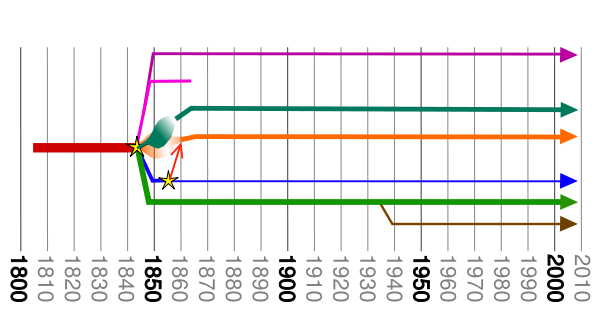
The red line is Joseph. From the top down you have Bickertonites, Rigdonites, Hedrickites, RLDS/CoC, Strangites, LDS, and FLDS
Those are just main sects. for the much much longer list look here.
malkie wrote:If programming languages were religion
PHP would be Cafeteria Christianity... the whole concept of "goto hell" was abandoned.
# ANB: To formulate ANB, I put first forward these two definitions:
# Set P = the following three propositions:
* (a) There exists a being who rules the entire universe.
* (b) That being loves humanity.
* (c) Humanity has been provided with an afterlife.
# Situation S = the situation of all, or almost all, humans coming to believe all three propositions of set P by the time of their physical death.
# Using the above definitions, ANB may be expressed as follows:
* (A) If God were to exist, then he would possess all of the following four properties (among others):
* (1) being able to bring about situation S, all things considered;
* (2) wanting to bring about situation S, i.e., having it among his desires;
* (3) not wanting anything else that conflicts with his desire to bring about situation S as strongly as it;
* (4) being rational (which implies always acting in accord with his own highest purposes).
# (B) If a being who has all four properties listed above were to exist, then situation S would have to obtain.
# (C) But situation S does not obtain. It is not the case that all, or almost all, humans have come to believe all the propositions of set P by the time of their physical death.
# (D) Therefore [from (B) & (C)], there does not exist a being who has all four properties listed in premise (A).
# (E) Hence [from (A) & (D)], God does not exist.
According to this objection, which may be called "the Free-Will Defense" or FWD for short, premise (A3) of ANB is false because there is something that God wants even more strongly than situation S and that is the free formation of proper theistic belief. God wants people to come to believe the propositions of set P freely and not as the result of any sort of coercion. He knows that people would indeed believe those propositions if he were to directly implant the belief in their minds or else perform spectacular miracles before them. But for him to do that would interfere with their free will, which he definitely does not want to happen. Since God's desire that humans retain their free will outweighs his desire for situation S, it follows that premise (A3) is false, which makes ANB unsound.
There are many objections to FWD. First and foremost, assuming that God wants to avoid interfering with people's free will, it is not clear that that desire actually conflicts with his desire for situation S. Why should showing things to people interfere with their free will? People want to know the truth. It would seem, then, that to show them things would not interfere with their will, but would conform to it. Even direct implantation of belief into a person's mind need not interfere with his/her free will. If that person were to want true beliefs and not care how the beliefs are obtained, then for God to directly implant true beliefs into his/her mind would not interfere with, but would rather comply with, the person's free will. An analogy would be God making a large unexpected direct deposit into someone's bank account. It would make the person quite pleased and would not at all interfere with his/her free will. Furthermore, as was explained previously in Section I, there are many different ways by which God might bring about situation S. It is not necessary for him to use either direct implantation or spectacular miracles. He could accomplish it through relatively ordinary means. It would be ludicrous to claim that free will has to be interfered with whenever anyone is shown anything. People have their beliefs affected every day by what they read and hear, and their free will remains intact. Finally, even the performance of spectacular miracles need not cause such interference. People want to know the truth. They particularly want to be shown how the world is really set up. To perform miracles for them would only conform to or comply with that desire. It would therefore not interfere with their free will. Hence, FWD fails to attack premise (A3) of ANB because it fails to present a desire on God's part that conflicts with his desire for situation S. That failure makes the Free-Will Defense actually irrelevant to premise (A3).
Even if there were people whose free will would be interfered with by God showing them things, it would seem that such people would be benefitted by coming to know how things really are. Quite apart from the issue of salvation, just being aware that there is a God who loves humanity and who has provided an afterlife for it would bring comfort and hope to people. A loving God would certainly want them to have such comfort and hope. So, even if it were granted that showing things to some people interferes with their free will, FWD would still not work well, for it has not made clear why God should refrain from showing them things of which they ought to be aware. Such "interference with free will" seems to be just what such people need to get "straightened out".
There is a further objection concerning God's motivation. FWD seems to claim that God wants people to believe the propositions of set P in an irrational way, without good evidence. But why would he want that? Why would a rational being create people in his own image and then hope that they become irrational? Furthermore, it is not clear just how people are supposed to arrive at the propositions of set P in the absence of good evidence. Is picking the right religion just a matter of lucky guesswork? Is salvation a kind of cosmic lottery? Why would God want to be involved in such an operation?
Sometimes the claim is made that, according to the Bible, God really does want people to believe things without evidence. Usually cited for this are the words of the resurrected Christ to no-longer-doubting Thomas: "because you have seen me, you have believed; blessed are those who have not seen and yet have believed" (John 20:29). Also, Peter praises those who believe in Jesus without seeing him (I Peter 1:8). But the message here may not be that God wants people to believe things without any evidence whatever. It may be, rather, that there are other forms of evidence than seeing, such as, for example, the testimony of friends. Perhaps God is simply indicating that he approves of belief based on the testimony of others. Note that, earlier, the resurrected Christ had upbraided some of his disciples for not trusting the testimony of other disciples (Mark 16:14). His words to Thomas may have been just a continuation of that theme. Thus, it is not clear that God desires irrational belief on the part of humans, nor is it clear why he should want that, if indeed he does.
As another objection to FWD, even if it were true that showing people things interferes with their free will, that seems not to have been a very important consideration for God. According to the Bible, he did many things, some of them quite spectacular, in order to cause observers to have certain beliefs. An advocate of the argument needs to explain why God was willing to do such things in the past but is no longer willing to do them in the present.
Finally, the claim that God has non-interference with human free will as a very high priority is not well supported in Scripture. According to the Bible, God killed millions of people. Surely that interfered with their free will, considering that they did not want to die. Furthermore, the Bible suggests that God knows the future and predestines people's fates. That, too, may interfere with human free will. In addition, there are many obstacles to free will in our present world (famine, mental retardation, grave diseases, premature death, etc.) and God does little or nothing to prevent them. This is not conclusive proof that God does not have human free will as a high priority, but it does count against it. It is at least another difficulty for the Free-Will Defense. Considering these many objections, the argument seems not to work very well. Let us turn to a different defense against ANB...
zeezrom wrote:If God wanted people to belong to a church, why would he allow so many schisms right after Jesus left the earth? If "The Church" was so important, why did Jesus not emphasize that and set up a system that would at least get things started on the right foot? For example, he could have instituted things like:
1. Thorough management and protection of source documentation
2. QA/QC of the written theology (with scholars and attorneys to check the wording)
3. Robust chain of command with system for smooth transition of leadership
4. checks and balances
But instead, Jesus avoided all of that. Maybe he thought by leaving out those details, men could figure out something on their own? Or maybe God didn't really care about starting a church that would take over the earth. Why would he not care about that? Maybe he is okay with people believing what they please? Then why would he say you have to be Christian or you go to hell?
Hmmm. The only sensible thing I can think of is that mankind came up with the church idea and the need for choosing a religion.
madeleine wrote:zeezrom wrote:If God wanted people to belong to a church, why would he allow so many schisms right after Jesus left the earth? If "The Church" was so important, why did Jesus not emphasize that and set up a system that would at least get things started on the right foot? For example, he could have instituted things like:
1. Thorough management and protection of source documentation
2. QA/QC of the written theology (with scholars and attorneys to check the wording)
3. Robust chain of command with system for smooth transition of leadership
4. checks and balances
But instead, Jesus avoided all of that. Maybe he thought by leaving out those details, men could figure out something on their own? Or maybe God didn't really care about starting a church that would take over the earth. Why would he not care about that? Maybe he is okay with people believing what they please? Then why would he say you have to be Christian or you go to hell?
Hmmm. The only sensible thing I can think of is that mankind came up with the church idea and the need for choosing a religion.
Of course this is from a very Mormon POV. This is the claim of the catholic church. (little 'c' catholic, meaning 'the universal church', which encompasses the church in the east and west)
EAllusion wrote:madeleine wrote:Of course this is from a very Mormon POV. This is the claim of the catholic church. (little 'c' catholic, meaning 'the universal church', which encompasses the church in the east and west)
The Catholics pre-schism or post have the same problem. Early source documentation of Christianity is nonexistent. God could put that on Bluray if he wants to. So why not better information if belief in catholicism is such a high priority for God? Either it isn't, which is a serious problem given catholic theology, or it is and...
madeleine wrote:Belief in catholicism is not what I believe God's priority is.
EAllusion wrote:madeleine wrote:Belief in catholicism is not what I believe God's priority is.
It should be given catholic theology. Belief in [x] should be a priority for any proposed God who believes drastic differences in afterlife outcomes hinge on belief status. That holds for anyone who thinks that faith in Jesus is a high priority of God, and doubly so if one's afterlife outcome hinges on that. To the extent that someone believes in a God like this, as most Christians do, that belief is contradicted by evidence indicating otherwise.