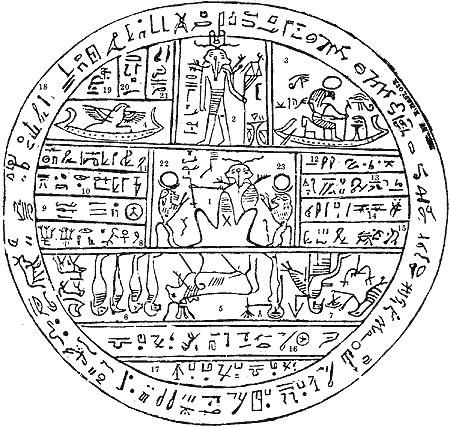
CaliforniaKid wrote:The third character isn't just Kiahbroam, Mak. It's Kiahbroam-KiaAhbroam-ZubZooloan. Only the KiaAhbroam element is actually translated when this character is dissected on page three of the Grammar, but that is because the other two elements had been translated on the preceding page.
I addressed some of my concerns with this interpretation on the thread I started. They are as follows: (1) The EA entry for Ki Ah broam-Ki Ah brah-oam Zub Zool oan has two ideographs, with the second one depicting the Zub Zool oan ideograph, plus others. The GAEL only has the one, and only that one is found in the translation manuscript; (2) There are numerous places where the transliterated names are repeated in subsequent characters with completely different meanings; (3) explanations such as "a follower of righteousness," "one who possesses great knowledge," and "a possessor of great knowledge" (found in Abr 1:2) are from earlier degrees of Ah broam not explained on the previous page. "The beginning," "before," and "down to" are contained in the EA explanation of Zub Zool oan, not on the previous page. "The first man, Adam, first father" is verbatim from Phah-eh (first degree), which isn't a part of the transliteration at all. The dissection of Kiahbroam, and several other fifth degree definitions, explain when meanings from earlier degrees are included (like "coming down from the beginning"); (4) elsewhere when fifth degree transliterations are incorporated into compound fifth degree transliterations (Zi - Zip zi, Zi oop hah; Ho oop hah - Ho e oop hah - Lish Zi ho e oop Iota; Ho e oop hah - Hoeoophahphaheh; Zub - Zool - Zub Zool - Zub eh - Zub Zool eh) the full constituent meanings do not, by default or by description, carry over. Only the definition of the compound transliteration, which incorporates meanings from constituent transliterations in its own way, is relevant; (5) Meanings from the earlier degrees and characters associated with the transliterated names are found outside of the text defined by the character in the margins of the translation manuscript. For these reasons, I don't think it can simply be asserted that the character in the margins is pregnant with all the words and phrases found in Abr 1:2b-3.
CaliforniaKid wrote:They are the Egyptologically correct characters to begin the text. See here for more detail.
Thanks.
CaliforniaKid wrote:That is "clear" when this character appears in the fifth degree of the GAEL, but not when it shows up for the first time in the EA documents. There the character has no obvious relationship to the character in the margin of Abraham 1:3, and its translation is less directly parallel to the text of the narrative. (If the Book of Abraham truly precedes the Alphabet, then its curious that the wording of this entry should be closer to the narrative in its final redaction than its initial one.) The characters surrounding it in the EA, moreover, have a closer relationship to verses 25-28 than 1-3. And indeed, these verses do include the words "first" and "beginning". If the translation was derived from the Book of Abraham narrative, those verses seem a more likely candidate source-text.
I completely disagree. First, the use of "beginning" in Abr 1:28 is explicitly associated with the fifth degree of the GAEL definition of Zool: "from any or some fixed period of time back to the beginning of Creation." That's the opposite of what we find in EA Zub Zool oan and Abr 1:3 ("from the beginning down to" as opposed to "running back to the beginning"). The use of "first" appears before "beginning" and three verses earlier. The order is switched. It's also linked to EA Zub ("first institution"), not Zub Zool oan. Abr 1:25-28 are explicitly associated with Toan tau ee tahee tahee tou es, Iota tou-es Zip-Zi, Zub, and even Zool. No, it's quite clear that EA Zub Zool oan is directly linked to Abr 1:3 (even the fifth degree of Zub Zool is not as close to Abr 1:3 as EA Zub Zool oan).
CaliforniaKid wrote:I guess what I'm saying, Mak, is that wherever these characters in the EA manuscripts came from, it wasn't Abraham 1:1-3. They are placed in relationship to that text only in the final stages of the EAG project.
That conclusion is demonstrably false. EA Zub Zool oan is absolutely unquestionably linked directly to Abr 1:3. I've explained this in great detail, and below I show several instances where the EA is closer to the narrative than the GAEL. Your argument above is insufficient and, surprisingly, uninformed.
CaliforniaKid wrote:Which means that when this character appears in the Grammar's fifth degree as a component of the characters associated with vv. 1-3, this is either an attempt at correlation to or composition of the Book of Abraham narrative using a grapheme and interpretation that had been derived from elsewhere. Composition seems more likely, given that correlation would require that the grapheme and its meaning already be present and discoverable in the manuscript narrative for those three verses. The same would have to also be true for the other EA graphemes I highlighted, which show up in the fifth degree as components of Chalsidonhiash (the "Chaldea" character).
Hopefully I have explained this clearly enough. If not, let me know, and I'll try to clarify.
I understand what you're saying, but I have to say your conclusions are quite unconvincing. There's no reason the graphemes would need to be already present, and the EA explanations are clearly linked to the narrative in many places, even moreso than the GAEL. EA Zi, for instance (Virgin, unmarried, virtuous, or the principle of virtue), is more fully linked to Abr 1:11 (These virgins were offered up because of their virtue) than any of the GAEL definitions (it's the only one that contains both "virtue" and "virgin"). EA Iota tou-es Zip-Zi also anticipates the narrative. EA Zub Zool Eh anticipates Abr 1:28, but after the first degree of the GAEL that association vanishes. EA Zub anticipates Abr 1:25. The expansions in the GAEL move away from that verse. EA Zub Zool anticipates Abr 1:3, but also completes the link between EA Zub Zool oan and Abr 1:3, since it has "from the first to any stated period after." "First," thus, represents a lexical distillation of "beginning" in "from the beginning, or before the foundation of the earth, down to the present time." The fifth degree of Zub Zool moves away from Abr 1:3 and cites Abr 1:31. EA Zool anticipates Abr 1:28. Smith's text of the EA is closer to Abr 1:28 than the fifth degree of the GAEL:
EA Joseph Smith Zool - from any or some fixed period of time back to the beginning of the creation
Abr 1:28 - I shall endeavor, hereafter, to delineate the chronology running back from myself to the beginning of the creation
GAEL, fifth degree, Zool - from any or some fixed period of time back to the beginning of Creation
I think you overestimate the strength of some of your assumptions.