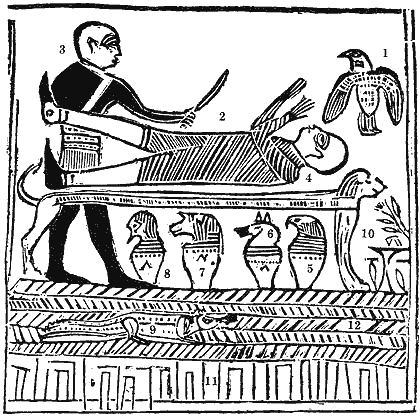
Will Schryver wrote:Chap wrote:I take it you don't dispute that the surviving papyrus is a normal Egyptian funerary text?
In the first place, since they all differ to some degree one from another, I don't know that there is really anything that qualifies as "a normal Egyptian funerary text," least of all the extant fragments of the Joseph Smith papyri, which are rather exceptional when compared to the larger body of extant Egyptian Book of the Dead literature (the human figure holding a knife above the living person on the lion couch being only one among several exceptional aspects).
Gosh.
Texts of a given genre vary from one to another.
Some may even have unique features not possessed by all other exemplars of the genre.
Therefore this papyrus is not a 'normal' Egyptian funerary text. Therefore it is not a Egyptian funerary text at all, but a highly mysterious document, demanding an astonishing explanation.
That explanation can only be that it is the writings of Abraham, who is thus not a semi-mythical figure from the self-imaginings of one of the many Semitic groups of the ancient Near East, but in fact a published author, whose work has reached us because a scribe working in the funeral industry in Ptolemaic Egypt happened to copy it out many centuries after Abraham had written it, and sold it to some grieving relatives who buried it with the mummy of their nearest and dearest, who was later dug up, and then by a strange chain of circumstances it arrived in the hands of the Prophet Joseph Smith via a traveling showman. You see, God works in really mysterious ways.
Wait a bit, though: the actual bit with Abraham's text on it is missing nowadays, so we can't show it to you ... no sir, don't walk away, I haven't finished ...