Abr 1:1-3 and the KEP: the Chicken or the Egg Debate

The catch-all forum for general topics and debates. Minimal moderation. Rated PG to PG-13.
Post Reply
_Darth J
_Emeritus
Posts: 13392
Joined: Thu May 13, 2010 12:16 am

Re: Abr 1:1-3 and the KEP: the Chicken or the Egg Debate

Post by _Darth J »

maklelan wrote:
Darth J wrote:Not to endorse Joseph's mannerisms, but as to your people disagreeing in LDS circles about the significance of the papyrus, perhaps you missed the following language at the start of your 1988 Ensign blurb:

Questions of general gospel interest answered for guidance, not as official statements of Church policy.

Michael Rhodes is an apologist. He has no authority to speak on behalf of the Church.


I didn't miss anything. I'm well aware of exactly who Michael Rhodes is. I know him personally. If you read closely you'll see I pointed to the article in response to this statement:

From joe the adulterer to big Tom the pepsi fiend, lds-inc teaches the book of abraham is a translation from the parchament that was bought from Chandler.

If you don't believe the word of the prophets, you are lying to lds-inc about being a member.


I believe the article effectively undermines Joseph's assertion. Do you disagree?


I think your own statement that you do believe in the LDS Church refutes Joseph's assertion that you are "lying to lds-inc about being a member."

But, despite Joseph's poorly-chosen way of phrasing it, his statement seems to be about what the Church officially teaches about the papyri. Under its own terms, Michael Rhodes' "I Have a Question" article is not official church policy, so your reference to that article is non-responsive.

The catalyst theory, which seems to be what you are implying, suffers from other religious problems as well. It depends on an assertion that Joseph Smith did not really understand what was going on when he received revelation, but apologists do (not saying that you are an apologist). Presumably, a person who believes in the Book of Abraham also believes that Joseph Smith translated the golden plates by the power of God, but no apparent reason is offered as to why Joseph Smith did understand he was translating what was written on the Nephite plates into the Book of Mormon, but no longer understood a process he had already been through when the power of God allowed him to translate the unknown (to him) writings on the papyrus into the Book of Abraham. Why would he understand what was going on when he was new to all this, but years later, with more experience as a prophet, he suddenly makes unwarranted assumptions about what God is putting in his mind?

Anyway, I was just commenting on a point that you volunteered about what the Church teaches regarding the Chandler papyrus.
_maklelan
_Emeritus
Posts: 4999
Joined: Sat Jan 06, 2007 6:51 am

Re: Abr 1:1-3 and the KEP: the Chicken or the Egg Debate

Post by _maklelan »

sock puppet wrote:All of the characters were taken from the Sensen papyri. They were written in the left hand margins of the manuscripts. They were in the very order as they appeared on the Sensen papyri except that at torn away spots (lacunae), the estimated number of characters were drawn from other places on the Sensen papyri and inserted as if part of the original order as appearing on an intact Sensen papyri.


No, they weren't. The first three on this page were cobbled together from the characters developed in the EA and GAEL:

Image

Look at page I reproduce below. All the characters in the margins are derived from the EA and GAEL, not the papyri.

sock puppet wrote:Except for one character added in the left margin of the next line of one of the manuscripts, but then nothing more added to it, to the right of each character appearing in the left margins is the first line of a new paragraph.


Also not true. The second and third characters in Abr 1:1-3 don't do that. They're just put on lines that contain words or phrases that are found in the EA and GAEL (and other words and phrases associated with the characters there are found in lines linked to distinct marginal characters, too), and none of them begin sentences, much less paragraphs:

Image

sock puppet wrote:There is at least one instance where a sentence was stopped before reaching the right edge of the page, and instead of being continued on that line, was continued on the next line. In the left margin of that next line is a character. Significantly, left margins are not left open at all spots. When the English paragraph begun at the bottom of one page, with a character in the left margin of the first line, continued onto the next page, the scribe left no margin. This suggests that the scribe knew that it was a carryover paragraph and that there would be no need for a left margin there as room for another character. That explanation would just continue marginless until another character was given. Then the scribe would go to the next line, reproduce the character in a left margin and then begin the next, descriptive paragraph to the right, and leave a left margin on subsequent lines on that page. This suggests that after a character was reproduced in the left margin, then to the right would be the English paragraph. Only after the English paragraph was completed would the next character be provided, and to the right of it would be the next English paragraph.


This doesn't hold across the board, though. The last extant page of Williams' manuscript shows he moved back to full indentation a couple lines before the character appears, and then inexplicably moves all the way back to left justification. That doesn't line up with your assertion:

Image

sock puppet wrote:That belies the assertion that the characters were added after the English text was completed.


Not everywhere, and it's far from bulletproof.

sock puppet wrote:The person giving the characters and then the English text was JSJr, or one of the scribes repeating such information from JSJr. The scribes did not claim to have revelatory or translation gifts. Rather, they deferred to JSJr in this regard. The information about which character went with what English text obviously originated with JSJr.


This is just an assumption.

sock puppet wrote:For me, no, Kevin Graham is not incorrect. Since I do not recognize JSJr's production of the BoAbr text to be a 'translation' (see above in this post), I would agree that the KEP was not used to 'translate' the BoAbr. Do I think the KEP were a preliminary development by JSJr leading later to his constructing or building the BoAbr? The EA and GAEL, yes. Kevin Graham may disagree.

The Manuscripts were not even used in the contruction or building of BoAbr. The Manuscripts are themselves the first written embodiment of the BoAbr narrative.


You've still got quite a lot of evidence that I pointed out in that post I linked you to earlier to deal with before you start slinging these kinds of pronouncements.
I like you Betty...

My blog
_Kevin Graham
_Emeritus
Posts: 13037
Joined: Fri Oct 27, 2006 6:44 pm

Re: Abr 1:1-3 and the KEP: the Chicken or the Egg Debate

Post by _Kevin Graham »

Please list the verses in Abr that are plagiarized from Genesis and the verses in Genesis from which they're plagiarized. If you as a group have always maintained it then either you have them memorized or you can copy and paste them. I will find some time this weekend to respond.


Consider the following examples:

Now the Lord God caused the famine to wax sore in the land of Ur, insomuch that Haran, my brother, died; but Terah, my father, yet lived in the land of Ur, of the Chaldees. And it came to pass that I, Abraham, took a Sarai to wife, and Nahor, my brother, took Milcah to wife, who was the daughter of Haran. (Abr 2:1-2)

And Haran died before his father Terah in the land of his nativity, in Ur of the Chaldees. And Abram and Nahor took them wives: the name of Abram’s wife was Sarai; and the name of Nahor’s wife, Milcah, the daughter of Haran, the father of Milcah, and the father of Iscah. (Gen 11:28-29)


=============================
Now the Lord had said unto me: Abraham, get thee out of thy country, and from thy kindred, and from thy father’s house, unto a land that I will show thee. (Abr 2:3)

Now the Lord had asaid unto Abram, Get thee out of thy dcountry, and from thy ekindred, and from thy father’s house, unto a land that I will shew thee: (Gen 12:1)


=============================

And I will make of thee a great nation, and I will bless thee above measure, and make thy name great among all nations, and thou shalt be a blessing unto thy seed after thee, that in their hands they shall bear this ministry and Priesthood unto all nations...And I will bless them that bless thee, and curse them that curse thee; and in thee (that is, in thy Priesthood) and in thy seed (that is, thy Priesthood), for I give unto thee a promise that this right shall continue in thee, and in thy seed after thee (that is to say, the literal seed, or the seed of the body) shall all the families of the earth be blessed, even with the blessings of the Gospel, which are the blessings of salvation, even of life eternal. (Abr 2:9,11)

And I will make of thee a great nation, and I will bless thee, and make thy name great; and thou shalt be a blessing: And I will bless them that bless thee, and curse him that curseth thee: and in thee shall all families of the earth be blessed. (Gen 12:2-3)


=============================


So I, Abraham, departed as the Lord had said unto me, and Lot with me; and I, Abraham, was sixty and two years old when I departed out of Haran. And I took Sarai, whom I took to wife when I was in Ur, in Chaldea, and Lot, my brother’s son, and all our substance that we had gathered, and the souls that we had won in Haran, and came forth in the way to the land of Canaan, and dwelt in tents as we came on our way; And then we passed from Jershon through the land unto the place of Sechem; it was situated in the plains of Moreh, and we had already come into the borders of the land of the Canaanites, and I offered sacrifice there in the plains of Moreh, and called on the Lord devoutly, because we had already come into the land of this idolatrous nation. (Abr 2:14-18)


So Abram departed, as the Lord had spoken unto him; and Lot went with him
: and Abram was seventy and five years old when he departed out of Haran. And Abram took Sarai his wife, and Lot his brother’s son, and all their substance that they had gathered, and the souls that they had gotten in Haran; and they went forth to go into the land of Canaan; and into the land of Canaan they came. And Abram passed through the land unto the place of Sichem, unto the plain of Moreh. And the Canaanite was then in the land.(Gen 12:4-6)


==========================

No text critic worth his salt would see this as anything less than plagiarism. Those were direct word for word copies. Chapter one doesn’t rely on exact quotations of Genesis, but it does allude to Genesis and incorporates Joseph Smith’s additions which he borrowed from Bible commentaries as well as the work of Flavius Josephus. For example,

Abr 1:1 In the land of the Chaldeans, at the residence of my fathers, I, Abraham, saw that it was needful for me to
obtain another place of residence
;

Gen 11:31 And Terah took Abram his son, and Lot the son of Haran his son's son, and Sarai his daughter in law, his son Abram's wife; and they went forth with them from Ur of the Chaldees, to go into the land of Canaan; and they came unto Haran, and dwelt there.


And…

Abr 1:2 And, finding there was greater happiness and peace and rest for me, I sought for the blessings of the fathers, and the right whereunto I should be ordained to administer the same; having been myself a follower of righteousness, desiring also to be one who possessed great knowledge, and to be a greater follower of righteousness, and to possess a greater knowledge, and to be a father of many nations, a prince of peace, and desiring to receive instructions, and to keep the commandments of God, I became a rightful heir, a High Priest, holding the right belonging to the fathers.

Gen 17:4 As for me, behold, my covenant is with thee, and thou shalt be a father of many nations.


These are not exact citations but the former clearly works off the latter. And then we find the “unique” teachings that were supposedly unavailable to Joseph Smith:

Abr 1:5 My fathers, having turned from their righteousness, and from the holy commandments which the Lord their God had given unto them, unto the worshiping of the gods of the heathen, utterly refused to hearken to my voice;

“Abraham himself also, most agree, was bred up in the same idolatry” (Symon Patrick, et. al., A Critical Commentary and Paraphrase on the Old Testament, 1809, on Joshua 24:2)
-------------------------------------
Abr 1:12;15;31 “the priests laid violence upon me, that they might slay me also...the angel of the his presence stood by me, and immediately unloosed my bands...My fathers ... hearkened not unto my voice, but endeavored to take away my life”

“…this tradition of the Jews says Abraham was cast in the fire for refusing to worship idols, and out of which he was delivered” (Matthew Henry, An Exposition of the Old and New Testaments ..., London, 1811, on Daniel 3:6)

“If we may credit the tradition ... Abraham was cast into such a fire by this idolatrous people, because he would not worship their idols” (Adam Clarke, op. cit., on Daniel 3:6)

----------------------------------------

Abr 1:18 “I will ... put upon thee ... the Priesthood of thy Father ...”

“The Jews, in Schalsch Hakka-bala, say he was a priest” Patrick, op. cit., on Joshua 24:2)

--------------------------------------------

Abr 1:31 “a knowledge ... of the planets, and of the stars, as they were made known unto the fathers, I have kept even unto this day”

“Those who dwelt in Ur were either priests or astronomers” (Adam Clarke, The Holy Bible ... Commentary and Critical Notes, New York, 1832, on Daniel 2:10).

“Berosus mentions our father, Abram, without naming him, when he says thus: ‘In the tenth generation after the Flood, there was among the Chaldeans a man righteous and great, and skillful in the celestial science....He [Abram] communicated to them arithmetic, and delivered to them the science of astronomy; for before Abram came into Egypt, they were unacquainted with those parts of learning ." (Josephus, Antiquities of the Jews, Book I, 7.1-7.2)

--------------------------------------

Abr 1:27 Now, Pharaoh being of that lineage by which he could not have the right of Priesthood, notwithstanding the Pharaohs would fain bclaim it from Noah, through Ham, therefore my father was led away by their idolatry;

“Terah was an idolater, living in a country from whence, as many think, idolatry first came.” Patrick, op. cit., on Joshua 24:2.


Once you peel away all the verses that were either directly or indirectly plagiarized from other sources, all that’s left is a bunch of redundant fluff.

Showing that Abr 1:1-3 existed before any KEP document was composed does quite clearly complicates the critics' argument.


If it existed "before any KEP document was composed" then why on earth do the two dictated manuscripts begin with Abr 1:4? Why would they exclude Abr 1:1-3 if it already "existed"? Riddle me that!

But no one has ever argued that the Book of Abraham derived from the GAEL. Chris Smith has argued that the GAEL reveals workings that produced the translation for the first three verses of the Book, but by and large, we accept the idea that Joseph Smith translated the papyrus out loud and his scribes wrote down what he said. You say it was via revelation, but we say it was a creative conglomerate of various sources, sealed together with Joseph Smith’s creativity.

Additionally, positing so thorough a tweaking of the biblical text doesn't overcome the indications in the KEP that a narrative identical in numerous places to the Abr narrative preexisted it.


There is only one indication, and that is the dittograph. And all this suggests is that the text within that dittograph was copied. This doesn’t establish a text that preexisted during the writing of the first 3.5 pages, because you cannot say when the dittograph was written. For all you know Williams and Parrish stopped at the same time, and for whatever reason Williams returned and copied the dittograph from one of the other manuscripts. We simply don’t know definitively, and your education at Oxford isn’t going to change that. This isn't something text-criticism can prove.

The manuscripts reveal clear signs of simultaneous dictation. Schryver says this is false, that there are no indications of dictation. Hauglid said the same thing before his debate with Metcalfe – he now believes otherwise. The two of you now disagree with Schryver on this point. But your only response is to say this is because they were writing as someone was reading it to them from the elusive Q document. Joseph Smith didn't have anyone make multiple exact copies of the Original manuscript of the Book of Mormon that excluded some verses. That would make no sense, and it doesn't make any sense to do so with incomplete, error-ridden manuscripts of less than two chapters of the Book of Abraham.

Your argument also hangs on the disproved notion that the Egyptian characters were of no importance to those documents; that they were added at a later time, and had nothing to do with the translated text. You've misrepresented the documents in an earlier post, and you responded to my correction by saying you'll address it in a future publication. And that's fine, so long as we can establish the fact you're still showing your lack of familiarity with these documents. Until you deal with the evidence of the Egyptian characters, the significance of the margins, the inconsistencies caused by the dittograph, etc., your conclusion is an illicit leap that screams of apologetics, and not strict scholarship.

Incidentally, I asked you and Will months ago to produce a single example from the Printers Manuscript (which is a copy) of the Book of Mormon, where three or more words were crossed out and replaced in transition. I was told by Schryver that this was common throughout that manuscript, but my own examination of the PM reveals zero examples like that. I couldn't even find a single example where two words were scratched out and replaced in transition. There were instances where words were scratched out and replaced overhead, but never in transition. And yet we see the phenomenon of 2-5 word phrases crossed out and replaced in transition, constantly throughout the manuscript of the short 2 chapters of the Book of Abraham. This smacks of dictation and it flies in the face of the apologetic assertion that these examples can be explained as copyist errors, within the context of Joseph Smith's translation sessions. I know you disagree with Schryver on this point, but it is worth reiterating for our audience to understand the import of such evidence. The apologists will get no help from the Book of Mormon translation manuscripts.

I'm having trouble nailing down exactly what it is this monolithic group of critics actually does argue (univocally, evidently). It seems they argue for every position at once, they just emphasize whatever position will contradict what a Mormon is currently saying.

Right Dan. We just make it up as we go along, all for the purposes of disagreeing with whatever the current wave of apologists is saying. We're silly like that (rolls eyes). The fact is you're unfamiliar with our arguments and isn't really our fault. Of course, you could always ask us.
So you believe that I dogmatically hold to everything that the church has taught?

Hold on. You asked what would give him the idea that you would actually have the audacity to believe something the Mormon Church has taught for decades. I said the fact that you're a Mormon would be the first clue. Is it really such an illicit leap? If you want to disagree with Church teaching, be my guest. I'm not your Bishop.
The critics comprise a rich tapestry of views and perspectives, but Mormons are all the same? Do we all look alike, too? (And my orthodoxy is neither the topic here nor a concern for me, so please don't waste my time with finger wagging like others here are doing.)

Good grief Dan, don't you think you're going a little overboard here? Is it really off the wall to assume a Muslim might believe the Koran derives from whatever it is Muslim tradition states? Is it really an outrageous assumption that any given Baptist probably believes the Bible is inerrant? The fact is you're an exception, not the rule. Most Mormons have no problem accepting what the Church has taught on this matter. I can go to the Mormon.org website and speak to an official representative of the Church, ask him/her where the Book of Abraham came from, and then after a few minutes of scrambling for the official answer, I'll be informed that it was translated from Egyptian papyri. The Church has included copied portions of the papyrus and Facsmilies, in its canonized publications. In my experience, if you're diverging from established LDS teaching, then you're probably an apologist or a liberal Mormon in danger of apostasy. Either way, it doesn't matter to me.

Regarding your responses to sock puppet:

No, they weren't. The first three on this page were cobbled together from the characters developed in the EA and GAEL


Those characters fall into the lacuna, which is why they are not really Egyptian, since Joseph Smith had to invent them. To say they were "developed" is an assumption. They were restored via "revelation."

Look at page I reproduce below. All the characters in the margins are derived from the EA and GAEL, not the papyri.


Not exactly. The first two were on the papyrus when Joseph Smith had it, but then it deteriorated through time. He was constantly showing the papyri to people and pointing to the signature of Abraham. We know from the GAEL which character he believed to represent Abraham, and that was the second character on Ms2. We also know this corresponded to Abraham because both it and the word Abraham were marked with the same number. And the third character derives from the Facsimile portion of the papyrus, although it underwent a serious workout in the GAEL:
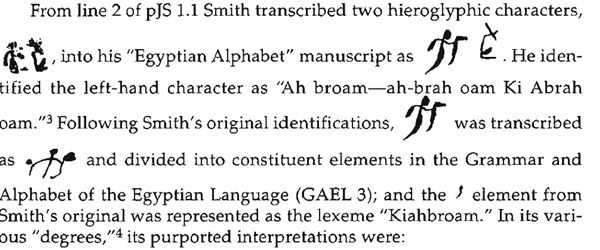
Image

This doesn't hold across the board, though. The last extant page of Williams' manuscript shows he moved back to full indentation a couple lines before the character appears, and then inexplicably moves all the way back to left justification. That doesn't line up with your assertion:


This is the exception though. Again, the dittograph provides numerous anomalies that demand explanation. You haven't explained them. We know why they used a margin. The purpose of a margin was to make room for the Egyptian character. The fact that page four concluded with Williams ignoring a margin in the last paragraph, proves he knew there would be no more Egyptian characters added and/or that the project was coming to a close. The big distinction here is that our theory accounts for more of the evidence while yours ignores it. You haven't even begun to explain why a margin was used off and on, nor have you explained why our explanation is unsound.

For me, no, Kevin Graham is not incorrect. Since I do not recognize JSJr's production of the BoAbr text to be a 'translation' (see above in this post), I would agree that the KEP was not used to 'translate' the BoAbr. Do I think the KEP were a preliminary development by JSJr leading later to his constructing or building the BoAbr? The EA and GAEL, yes. Kevin Graham may disagree.


I don't think there is any doubt that the GAEL has a strong relationship to the first three verses. To me it is really beside the point whether the GAEL "produced" those verses. I tend to think not. I think Joseph Smith likely provided the translation, or at least had in his mind what he wanted the first three verses to say, and then used that translation to help give meaning to the characters, chop them up into graphemes, add various levels of meaning to each jot and tittle, then came up with something resembling a Grammar and Alphabet, which is what he set out to do. But shortly after realizing what a tedious - or perhaps useless - endeavor that was, he then went ahead and just ranted off the translation from the papyrus beginning at verse 4. You can’t just begin with characters and manufacture a translation without some kind of knowledge what these characters mean, so this is why I have trouble accepting the idea that the GAEL was necessary to produce Abr 1:1-3. It certainly wasn’t necessary for the rest of the Book of Abraham, so why would it have been necessary for the first three verses?

I don't think it is possible to divorce Joseph Smith from the project - as Nibley, Gee and Schryver have chosen to do. It just boggles the mind to think the scribes were doing this without supervision. That is a huge assumption at play here; that a bunch of renegade employees were jealous of the Prophet's translation abilities. As if they thought they could actually produce the Book of Abraham on their own, using the wrong scroll, while restoring missing characters. It is really ludicrous if you step back and think about it.

The Manuscripts were not even used in the construction or building of BoAbr. The Manuscripts are themselves the first written embodiment of the BoAbr narrative.


Exactly. The argument by Schryver is circular because it is based on the assumption it is trying to prove. It assumes that Joseph Smith was providing a narrative on the fly, without any preconception of what that narrative already entailed. With this assumption firmly in place, it is no wonder Mormons later come across parallels - even those that exist in the Bible and other works - and say "Oh my Gosh, this proves he was inspired! The Church is true!"

However, if Joseph Smith already had a narrative in his mind, and merely used the papyri-translation to make it realized, then their preexistent text theory is meaningless since obviously the narrative did preexist, just not on paper. All the evidence suggests Joseph Smith borrowed from numerous sources to create his new scripture.
_maklelan
_Emeritus
Posts: 4999
Joined: Sat Jan 06, 2007 6:51 am

Re: Abr 1:1-3 and the KEP: the Chicken or the Egg Debate

Post by _maklelan »

Kevin Graham wrote:Consider the following examples:


Thanks for taking the time to put this together. I'll try to find time this weekend to take a close look at it.
I like you Betty...

My blog
_Kevin Graham
_Emeritus
Posts: 13037
Joined: Fri Oct 27, 2006 6:44 pm

Re: Abr 1:1-3 and the KEP: the Chicken or the Egg Debate

Post by _Kevin Graham »

Take your time. I'll probably be gone the rest of the week anyway... Gotta plan our ninth anniversary.
_wenglund
_Emeritus
Posts: 4947
Joined: Fri Oct 27, 2006 7:25 pm

Re: Abr 1:1-3 and the KEP: the Chicken or the Egg Debate

Post by _wenglund »

sock puppet wrote:All of the characters were taken from the Sensen papyri. They were written in the left hand margins of the manuscripts. They were in the very order as they appeared on the Sensen papyri except that at torn away spots (lacunae), the estimated number of characters were drawn from other places on the Sensen papyri and inserted as if part of the original order as appearing on an intact Sensen papyri.


Excellent. So, to your way of thinking, the characters were taken directly from the papyri, and not from the EA or GAEL. That makes sense.

And, based on what you went on to say, let me see if I correctly conceptualize how you view the internal production sequence for each of the Abr. Mss 1-3. Correct me if I am wrong, but is this how you understand it:

To begin the supposed dictation, Joseph had his scribe (Phelps), draw a line on a blank sheet of paper so as to create a left-hand margin for the purpose of drawing characters from the papyri and to dictate an English explanation, and this so Joseph could fool Phelps into believing that Joseph could translate Egyptian (and this after allegedly working with Phelps on the EA and GAEL for months). He then had Phelps write the word “Character” atop the left-hand margin, which Phelps did, though the word was so long as to run across or past the margin.

Once the line was drawn and the margin title written, Joseph then dictated the heading for the Book of Abraham—having decided months earlier what the general subject-matter would be.

After the introduction was complete, Joseph then supposedly pointed to a character on the Sense papyri, and had Phelps sketch that character in the left-hand margin, and put a “1” next to it. Next, Joseph had Phelps write another “1” to begin the first line of English translation and supposedly pretended to translate that character by opening up the EA and GAEL, which he and Phelps had worked on, and looking all around for the graphemes that matched the various parts of the first character, mentally cobbled together the following English explanation: “In the land of the Chaldeans, at the residence of my fathers, I”.

Then, Joseph point sequentially to the next Sensen character on the papyri, which Phelps sketched into the left margin and put a “2” by it. Another “2” was written after the “I” in the pretend translation, and Joseph, again, after searching for a match in the EA and GAEL, pretended to dictate the word “Abrah” and then revised it to read “Abraham”.

For whatever reason, it must have struck Joseph that he hadn’t fully translated the first Sensen character, and so he instructed Phelps to write the number “1” following “Abraham” , and then pretended to dictate five lines of text usig the previously cobbled together thoughts, though miraculously in flowing narrative, from the EA and GAEL.

Breaking again in mid sentence, Joseph pointed to the third Sensen character and had Phelps draw it into the left-hand margin, and after appealing a third time to the EA and GAEL, and without numbering the character or the associated translation, Joseph dictated the remainder of what is now referred to as verse three (there were no verse breaks at this point in the Phelps manuscript).

Before ending what appears to be the first session, Joseph had Phelps go back through the supposed dictation and make some deletions (there is a word struck out between “desire” and “one”) and emendations (like adding the phrase: “a possessor of great knowledge” and the word “the”)

Does this sound like how you envision the dictation so far?

Thanks, -Wade Englund-
"Why should I care about being consistent?" --Mister Scratch (MD, '08)
_Kevin Graham
_Emeritus
Posts: 13037
Joined: Fri Oct 27, 2006 6:44 pm

Re: Abr 1:1-3 and the KEP: the Chicken or the Egg Debate

Post by _Kevin Graham »

For whatever reason, it must have struck Joseph that he hadn’t fully translated the first Sensen character


Says who?

and so he instructed Phelps to write the number “1” following “Abraham” , and then pretended to dictate five lines of text usig the previously cobbled together thoughts, though miraculously in flowing narrative, from the EA and GAEL.


You're making no sense. Miraculously flowing? Three measly verses that consist mainly of a few run-on sentences, is supposed to be considered a miracle to accomplish? Good grief.

Breaking again in mid sentence, Joseph pointed to the third Sensen character and had Phelps draw it into the left-hand margin, and after appealing a third time to the EA and GAEL, and without numbering the character or the associated translation, Joseph dictated the remainder of what is now referred to as verse three (there were no verse breaks at this point in the Phelps manuscript).


The text wasn't divided into verses at that time. Each character began at its corresponding translated text. Usually they began sentences or paragraphs, but sometimes they began mid-sentence.

And I doubt he was constantly pointing to characters or running back to the GAEL. He probably just said, "next character."

Before ending what appears to be the first session, Joseph had Phelps go back through the supposed dictation and make some deletions (there is a word struck out between “desire” and “one”)


Two words actually, "to be" was crossed out. The emendation was likely made in transition, so no, I doubt he had to "go back" and delete it. Apparently, Smith couldn't get his crap together on the "miraculously flowing narrative" of a few sentences.
_wenglund
_Emeritus
Posts: 4947
Joined: Fri Oct 27, 2006 7:25 pm

Re: Abr 1:1-3 and the KEP: the Chicken or the Egg Debate

Post by _wenglund »

Kevin,

How does the hypothesized dictation scenario above comport with how you conceptualize it?

I am aware from your easrlier post that either in addition to appealing to the EA and GAEL, or rather in lieu of that, you believe the Joseph derived the words "Chaldean" and "resident" and "father of many nations" from Gen. 11:31 and 17:14, and so Joseph must have also had the Bible open and book-marked in several places while dictating the Abr. 1:1-3, right?

Thanks, -Wade Englund-
"Why should I care about being consistent?" --Mister Scratch (MD, '08)
_Kevin Graham
_Emeritus
Posts: 13037
Joined: Fri Oct 27, 2006 6:44 pm

Re: Abr 1:1-3 and the KEP: the Chicken or the Egg Debate

Post by _Kevin Graham »

wenglund wrote:Kevin,

How does the hypothesized dictation scenario above comport with how you conceptualize it?

I am aware from your easrlier post that either in addition to appealing to the EA and GAEL, or rather in lieu of that, you believe the Joseph derived the words "Chaldean" and "resident" and "father of many nations" from Gen. 11:31 and 17:14, and so Joseph must have also had the Bible open and book-marked in several places while dictating the Abr. 1:1-3, right?

Thanks, -Wade Englund-


No, not at all. Have you ever given a talk without notes? I've prepared talks in my head that were supposed to be twenty minutes, but lasted upwards to two hours. I remember when I was in fifth grade I totally forgot to do a short story report that we were supposed to write. I told the teacher I left it at home and she thought she'd call my bluff and have me give the report without any notes. So I stood up in class and invented a story from whole cloth that lasted about 15 minutes. She would interrupt me every minute or so with probing questions, but I managed to tack on more BS and everyone totally believed I had already committed this story to print, and that I had memorized it. But in reality I was just spitting it out as my brain was creating it. It was one of the best Ferris Bueller moments of my life, and the teacher gave me an A.

So I don't see the difficulty for Joseph Smith, or anyone else for that matter, to commit to memorizing a few phrases and then mix in some literary fluff that would take up less than half a page.

Having said that, we don't know much about how he went about translating the Papyrus. Did he use the urim and thummin? Did he use the hat again? Was he behind a curtain again? Did he have a Bible with him? I doubt it, but it is possible. I believe it was David Bokovoy who conceded that he used a Bible while translating the Book of Mormon. The parallels are just too overwhelming. Exact citations and concepts appear in the Book of Mormon when they have no business appearing anywhere until centuries later.

And I don't think it is just a coincidence that Oliver Cowdery mentions the teachings of Flavius Josephus and quote Thomas Dick, in LDS publications in late 1835. That was precisely the period when he was producing the Book of Abraham material.
_wenglund
_Emeritus
Posts: 4947
Joined: Fri Oct 27, 2006 7:25 pm

Re: Abr 1:1-3 and the KEP: the Chicken or the Egg Debate

Post by _wenglund »

Kevin Graham wrote:
For whatever reason, it must have struck Joseph that he hadn’t fully translated the first Sensen character


Says who?


Says your buddy Sock Puppet. See his description of the sequence in which the characters were drawn in relation to the associated English explanations.

And, you intimate as much yourself when you said: “Each character began at its corresponding translated text. Usually they began sentences or paragraphs, but sometimes they began mid-sentence.”

But, if you have a different explanation, I am ready to hear it.

You're making no sense. Miraculously flowing? Three measly verses that consist mainly of a few run-on sentences, is supposed to be considered a miracle to accomplish? Good grief.


Kevin, you aren't giving this enough thought. You have to consider from whence the verses are alleged to have been derived (EA and GAEL and/or Gen. 11:31 and 17:14), and what it would have taken to derive those verses. For example, if one assumes that Abr. 1:1-3 were derived from the EA and GAEL, then let’s start with the first Sensen character and see what Joseph would have needed to do to come up with the associated English text.

To begin with, he would have had to search through the EA and GAEL to find that character—which would have been located on page 4 of the Phelps’ EA (I am not sure if it is included in EA Joseph Smith, but if not, that would prove interesting), with the associated text of "the land of the Chaldees." Once Joseph had that explanation stored in his memory, he would then have needed to search the GAEL for the 7 or so graphemes that make up that first character, and then pick and choose from among those graphemes and memorize selective portions of the associated English explanations. These would have been found on page 20, and included sequentually: "first residence", "saw", "fathers", "seeing", "great place of happiness". With these bits and pieces in mind, he would have needed to mentally rearrange them so as to start dictating to Phelps in a way that Phelps would be fooled into believing he was translating the Sensen character. So, as explained, the alleged dictation would have begun: “In the land of the Chaldeans, at the residence of my fathers, I”.

At this point, Joseph is imagined to have, as you suggest, said something like “next character.” And, presumably, while Phelps was drawing the character in the left-hand margin of the manuscript, Joseph was busy looking through the EA and GEAL for a match. Fortunately, there it was, a grapheme on the same page as the graphemes for the first character. However, since the English explanation for that grapheme didn’t include the name “Abrah”, or later “Abraham”, then Joseph must have, for whatever reason, ignored the English explanations and derived it from the sound (“Kiahbroam”) , which he supposedly dictated to Phelps as “Abraham.”

But, Joseph must have remembered that there was more English explanations associated with the first character, and quickly picked up where he left off, and from his recollection of the reorganized 8 or so English words associated with the selected graphemes, continued to dictate thus: “saw, that it was needful for me to obtain another place of residence, and seeing there was great happiness and peace and rest, for me, I sought for the blessings of the fathers, and the right whereunto I should be ordained to administer the same: having been a follower of righteousness.”

Here, the third character comes into play, and I could walk you through all it would have taken for Joseph to have allegedly derived the next eleven lines of English text from that character, but hopefully what I have mentioned above will suffice in illuminating what I meant by “miraculously in flowing narrative.”

Thanks, -Wade Englund-
"Why should I care about being consistent?" --Mister Scratch (MD, '08)
Post Reply