What does that have to do with the price of tea in china? We are talking about the early part (PAGE 21!!!) of the History of the Church. It was authored by Joseph Smith, written by his scribes, reviewed by Joseph Smith, and published in the Times and Seasons. Your response is someone else wrote it. That is a lie since you have NO proof of that assertion.thews wrote:Tobin wrote:The History of the Church was composed by Joseph Smith and written by his scribes starting in 1839. http://en.wikipedia.org/wiki/History_of_the_Church_(Joseph_Smith) This is from the early part of the History of the Church and was published in the Times and Seasons and other church periodicals. This is something you are perfectly aware of (as I've already stated this to you many times in the past) and your feigned ignorance and questions reflects just more of your deceit. Here we have Joseph Smith directly contradicting you and you attempt to mislead people by implying that this wasn't originated by Joseph Smith OR your other deceit that anything Joseph Smith states later about the matter should not be considered. It is a completely ridiculous notion since Joseph Smith himself was supposedly witness to the events and free to reflect and comment on the matter.
Do you know what confirmation bias is Tobin?
That is just more of your idiotic line that we can't trust what Joseph Smith said later on. I've already told you that is the most ridiculous piece of non-sense out there. It is your preposterous assertion that what Joseph Smith said earlier is true and what Joseph Smith said later is not true because it was written later. That is utterly stupid.thews wrote:Let's take a look at footnote 13:13. The term Urim and Thummim, while used in this revelation and in the ms text does not appear in early publications of the revelation, nor does it seem to have been used in any contemporary document of the principals. No early ms of this revelation survives apparently. In the 1833 Book of Commandments, verse one read "Now, behold I say unto you, that because you delivered up so many writings, which you had power to translate, into the hands of a wicked man, you have lost them. . . ." Thus, the words "by the means of the Urim and Thummim" in verse one were not part of this verse in the Book of Commandments; nor was section 17, which also makes use of the term Urim and Thummim, printed in the Book of Commandments. Both section 17 and verse one of section 10, as we now have them, first appeared in the 1835 edition of the Doctrine and Covenants. Lyndon Cook writes:
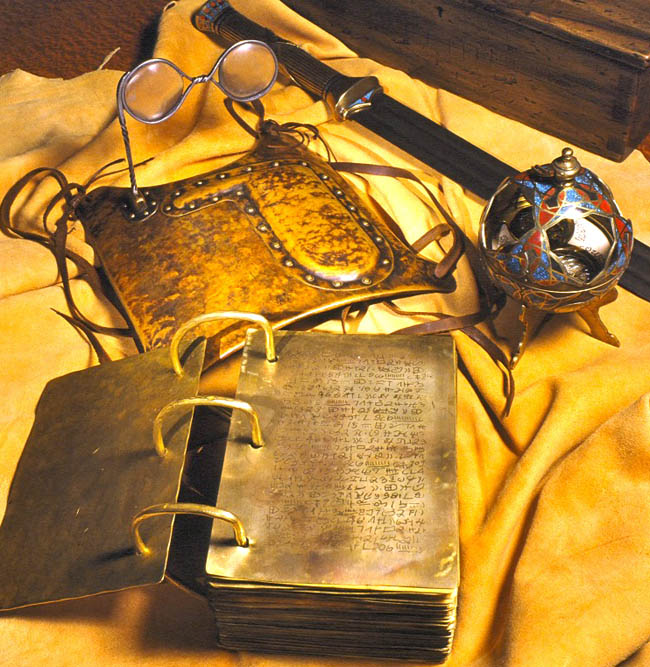
While the retroactive placement of the term in section 10 has led to some speculation relative to the Prophet's having the instrument in his possession, a preponderance of evidence confirms the Prophet's own testimony: "With the records was found a curious instrument, which the ancients called 'Urim and Thummim,' which consisted of two transparent stones set in the rim of a bow fastened to a breastplate" (History of the Church, 4:537 [Wentworth letter]). The problem here seems to be one of terminology, not whether or not the Prophet had possession of an ancient artifact. Until some time after the translation of the Book of Mormon, the sacred instruments may have been referred to as "Interpreters," or "spectacles." It is possible that Joseph Smith's inspired translation of the Bible played some part in designating the translating instrument "Urim and Thummim." The earliest use of the term Urim and Thummim in Mormon literature is in the Evening and Morning Star (January 1833). An article on the Book of Mormon, undoubtedly authored by W. W. Phelps, stated, "It was translated by the gift and power of God, by an unlearned man, through the aid of a pair of Interpreters, or spectacles--(known, perhaps in ancient days as Teraphim, or Urim and Thummim)." [RJS, 17]
The rest of your response is just you repeating the same non-sense over and over.
Actually, it does. You disregard inconvienent facts that refute what you say and use the most transparent and insipid of reasons to lie about it. It is a mixture of two pieces of non-sense. You assert:thews wrote:To summarize Tobin, the fact that I disagree with you, doesn't make me a "liar" as you assert. There is far more evidence to support my argument than your counter, and if you have anything to add, let's see it. Your claim, that undocumented history written after Joseph Smith's death (without any date for reference) is more accurate than the Book of Commandments is absurd in my opinion. Either the Urim and Thummim (a.k.a. Nephite spectacles) was returned to Joseph Smith and that's what he used to translate the Book of Mormon, or he used seer stones "for convince." If you don't suffer from confirmation bias the answer would be simple, but if your need to believe outweighs common sense, well, stick you head back in the sand pick and choose what information gives you the answer you need.
1) Joseph Smith didn't author it and someone else wrote it instead with no proof what-so-ever.
2) And even if Joseph Smith did write it, because it was written later he was lying.
Both excuses are bonkers for the obvious reasons that Joseph Smith published his response while he was alive and just because he published it later has nothing to do with whether or not he was lying about it.