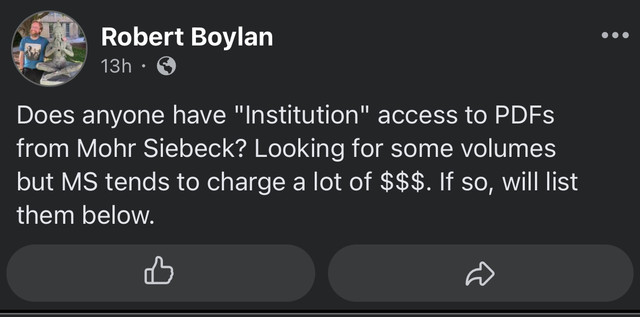
Perhaps it is because he posts things like this:


I have to admit that I've only visited a couple of Oxford and Cambridge colleges, briefly, a couple of times. How have I gotten this wrong?Physics Guy wrote: ↑Wed Sep 03, 2025 9:28 am... like an Oxbridge college, a relatively small place with a few permanent faculty who pursue their own callings, have no discernible teaching load, and meet occasionally for refined festivities.

I believe the motto is, “Enter to Learn, go forth to Tease.”

Thank you for a Master Class in Mopologetic history, Doctor Scratch. We are truly fortunate to have you leading our Mopologetic research and pedagogy at Cassius.Doctor Scratch wrote: ↑Wed Sep 03, 2025 9:19 pmAh, yes: what a pleasant trip down memory lane! I hope that Drs. Robbers and Shades will chime in, but I'm glad to elaborate a bit on the references.
--The "Tiers of Apologetics" likely refers to one of two things: either the "ranking" of the various Mopologists in terms of seniority--(e.g., Midgley and Gee are "Senior Tier" versus Smoot and Rappleye, who would be "junior tier"), or it may be in reference to various tiers of "window dressing" that are meant to lend credibility to the Mopologetic enterprise. Here, one tier would be (e.g.) METI or ISPART, where people closely aligned with Mopologetics are doing authentic scholarly work: i.e., "See? These *are* real scholars!" The next tier would be material that *can* be construed as Mopologetic, but on the surface seems like legitimate scholarship. So, this would be something like John Gee's peer-reviewed Egyptology articles. They pass muster in terms of peer review by outsiders, and by all appearances *do* constitute actual Egyptological scholarship. *But* if you are "in the know," then there are ways that this can be used to support Mopologetic claims. Other examples of this tier (and again, I would defer to the real expert here--Dean Robbers--but this is my understanding) would be Stubbs's linguistic research. It seems like all he is doing is actually studying Uto-Aztecan languages, but, again, there is a semi-buried "point" here that actually supports Book of Mormon authenticity.
Finally, there is the last tier, which is straight-up Mopologetics: stuff that argues that the Book of Mormon is real history, or that the Witnesses were unwavering and infallible, etc. Or, all the stuff that is straight-up attack/hit pieces, etc. Stuff that basically has no credibility whatsoever and would never pass peer review at a legitimate publication, but which, to certain believers, can "seem" legitimate in part because of the other two tiers, which exist to build up authority / credibility.
--As for the "Peak Oil" thing: I believe that this was just drawing a parallel between the idea of "peak oil" (i.e., that there is a finite amount of fossil fuels that humans will be able to harvest from the planet, and "peak oil" means we are extracting the maximum amount and from here on out, it's going to be dwindling returns) and the Church. I don't recall the exact specifics, but I can see this applying in all sorts of ways: "peak tithing," for instance, or "peak conversion." If memory serves, it may have been the latter of these that was the key idea: Mopologetics is necessary because the Church has reached "peak conversion/membership"--they are simply tapped out in terms of being able to rope large numbers of new members into the fold--and so you need Mopologetics to retain the people that you've got. At least, that's my recollection of the concept.
--And "The Gadianton Turn." Wow--now that is really a blast from the past. This one really makes me pause and shake m head at how much things have changed. Interestingly, back in the mid-aughts, the Mopologists were making very different arguments about the Book of Mormon: this was the era when they were name-dropping Peter Novick every other post, and insisting, PoMo-style, that there is no such thing as "fixed meaning," and that history is always inherently subjective, etc. Back then, they seemed to be actually leaning more towards a "literary" reading of the Book of Mormon, where you couldn't really treat it as "history," because (again), there is no such thing as "history"; it's all "subjective"; meaning is "unstable"; and so forth. I believe it was around this time that Grant Hardy published his book about the Book of Mormon, encouraging a more Humanities-centric reading of the text--read it as if it's a novel, in other words.
But there was a shift that happened right around 2012 or so--around the time of the big blow-up at the Maxwell Institute, where the Mopologists did an about-face and decided that, no, actually it was *heresy* to read the Book of Mormon as anything other than 100% authentic, legitimate history. You may recall that this was one of the main points of dispute between the "classic-FARMS" Mopologists and the so-called "New Maxwell Institute"/Mormon Studies people. The old-school Mopologists insisted that belief in a literal, historical Book of Mormon was a kind of "faith test," and anyone who didn't subscribe to that doctrinal orthodoxy was a closeted-apostate heretic who deserved to be ex'ed.
It's weird to think how far we've come: now it's unthinkable that the Afore would refer to Novick's That Noble Dream on SeN: instead, he needs to treat books as basically infallible so that he can bash away at anyone who dares to criticize his defense of a racist Brigham Young. He noted in one recent post that he would "refuse to talk" with anyone who hadn't read his favorite book on the topic! Quite hypocritical when you recall that, 15 years ago or so, anyone who insisted that *he* or any other Mopologist do the same would be told to read That Noble Dream so that they could learn that there is no such thing as "objective" history, and that whatever claims the author was making were biased, etc.
ETA: he keeps adducing Amy Tanner Thiriot's Slavery in Zion. What, I wonder, would Peter Novick have to say about this? Maybe the Afore should dust off his copy of That Noble Dream?
Indeed, it does have both. Cassius has all the usual appurtenances of university life.
Yes, he is looking for "institutional access" to certain materials. It is sad that vampiric corporations have placed research out of reach of the common person. This makes it hard for independent scholars to pursue their work. Most regrettable. I would be in favor of a world in which Mr. Boylan had access to all the materials he needed, but I don't see that happening anytime soon.

Would it be legal for someone who does have institutional access to documents that Boylan wants to obtain them for him?Kishkumen wrote: ↑Thu Sep 04, 2025 11:04 amYes, he is looking for "institutional access" to certain materials. It is sad that vampiric corporations have placed research out of reach of the common person. This makes it hard for independent scholars to pursue their work. Most regrettable. I would be in favor of a world in which Mr. Boylan had access to all the materials he needed, but I don't see that happening anytime soon.
I don’t know the technical legality of it. I am supposing it is OK to share the occasional article, but it is not OK to redistribute it widely or make it available widely. Very few university libraries have to funds to buy all the packages that cover every journal and book publisher, so academics rely on interlibrary loan and the generosity of colleagues to obtain all the research materials they need. Their own libraries can’t hope to make everything needed available.
Thanks, Rev.Kishkumen wrote: ↑Thu Sep 04, 2025 2:53 pmI don’t know the technical legality of it. I am supposing it is OK to share the occasional article, but it is not OK to redistribute it widely or make it available widely. Very few university libraries have to funds to buy all the packages that cover every journal and book publisher, so academics rely on interlibrary loan and the generosity of colleagues to obtain all the research materials they need. Their own libraries can’t hope to make everything needed available.