Trump has a lot of useful idiot followers who can take any lie he tells and spin it into a truth. Dan does the same with Mormonism. That’s why, honestly, Daniel’s criticism of Trump while true falls really flat when he can’t apply the same logic to his own religion.I Have Questions wrote: ↑Wed Aug 26, 2026 8:16 amIf you take the vision accounts in isolation you can sort of say they can’t be disproven. But the changing and increasingly embellished nature of the numerous retellings, make it much less easy to treat them as plausible. They are a good example of how a typical false narrative develops. Then, if you consider Joseph’s unreliability for being honest about important things, there needs to be more than just Joseph’s word about something before you can treat it as reliably accurate. For example, if Trump made the vision claims that Smith made, you could say they can’t be disproven. But is there really a possibility he’d be telling the truth?drumdude wrote: ↑Tue Aug 25, 2026 11:48 pmDan will always be right that there’s a possibility that Joseph Smith is telling the truth. That can’t be disproven. Neither can L Ron Hubbard’s claims. But you don’t see Dan signing up for Scientology classes. And you don’t see most of the world’s population lining up to believe that Jews sailed to the Americas 600 years before Christ.
Interpreter starts a “new” podcast
-
drumdude
- God
- Posts: 8058
- Joined: Thu Oct 29, 2020 5:29 am
Re: Interpreter starts a “new” podcast
-
I Have Questions
- God
- Posts: 4288
- Joined: Tue May 23, 2023 9:09 am
Re: Interpreter starts a “new” podcast
Ellen G. White had thousands of prophetic visions. Does Dan think she was mistaken, or lying? I guess what I’m wondering is whether Dan takes at face value everyone who claims to have had visions of or from God, or does he pick and choose, and if he picks and chooses, what is his criteria for accepting or not accepting the claim?drumdude wrote: ↑Wed Aug 26, 2026 1:55 pmEllen G. White claimed to have had thousands of visions. Does Dan think she was lying or mistaken?I Have Questions wrote: ↑Wed Aug 26, 2026 8:16 amIf you take the vision accounts in isolation you can sort of say they can’t be disproven. But the changing and increasingly embellished nature of the numerous retellings, make it much less easy to treat them as plausible. They are a good example of how a typical false narrative develops. Then, if you consider Joseph’s unreliability for being honest about important things, there needs to be more than just Joseph’s word about something before you can treat it as reliably accurate. For example, if Trump made the vision claims that Smith made, you could say they can’t be disproven. But is there really a possibility he’d be telling the truth?
Trump has a lot of useful idiot followers who can take any lie he tells and spin it into a truth. Dan does the same with Mormonism. That’s why, honestly, Daniel’s criticism of Trump while true falls really flat when he can’t apply the same logic to his own religion.
Premise 1. Eyewitness testimony is notoriously unreliable.
Premise 2. The best evidence for the Book of Mormon is eyewitness testimony.
Conclusion. Therefore, the best evidence for the Book of Mormon is notoriously unreliable.
Premise 2. The best evidence for the Book of Mormon is eyewitness testimony.
Conclusion. Therefore, the best evidence for the Book of Mormon is notoriously unreliable.
-
Rivendale

- God
- Posts: 1953
- Joined: Tue Mar 16, 2021 5:21 pm
Re: Interpreter starts a “new” podcast
This reminds me of the arguments for the resurrection. Why would people lie about something like that? What they forget is the fact that there was a fevered pitch of the messiah complex. Nero was claimed to have risen from the dead. In fact there were many imposters who claimed to be Nero. One was so convincing he raised an army to take back Rome and was subsequently killed. Same thing with Joseph Smith, Ellen (some called her egg White) White, Strang and many others. What DCP is doing is what has been done for millenia. Everyone's religion is wrong but mine.I Have Questions wrote: ↑Wed Aug 26, 2026 2:29 pmEllen G. White had thousands of prophetic visions. Does Dan think she was mistaken, or lying? I guess what I’m wondering is whether Dan takes at face value everyone who claims to have had visions of or from God, or does he pick and choose, and if he picks and chooses, what is his criteria for accepting or not accepting the claim?drumdude wrote: ↑Wed Aug 26, 2026 1:55 pmEllen G. White claimed to have had thousands of visions. Does Dan think she was lying or mistaken?
Trump has a lot of useful idiot followers who can take any lie he tells and spin it into a truth. Dan does the same with Mormonism. That’s why, honestly, Daniel’s criticism of Trump while true falls really flat when he can’t apply the same logic to his own religion.
-
drumdude
- God
- Posts: 8058
- Joined: Thu Oct 29, 2020 5:29 am
Re: Interpreter starts a “new” podcast
The cherry on top is that he has to argue that not believing in any religion (atheism) is itself its own religion. He won’t acknowledge that it’s the null hypothesis and is the most reasonable position given the lack of evidence for any one religion over any other.Rivendale wrote: ↑Wed Aug 26, 2026 4:10 pmThis reminds me of the arguments for the resurrection. Why would people lie about something like that? What they forget is the fact that there was a fevered pitch of the messiah complex. Nero was claimed to have risen from the dead. In fact there were many imposters who claimed to be Nero. One was so convincing he raised an army to take back Rome and was subsequently killed. Same thing with Joseph Smith, Ellen (some called her egg White) White, Strang and many others. What DCP is doing is what has been done for millenia. Everyone's religion is wrong but mine.I Have Questions wrote: ↑Wed Aug 26, 2026 2:29 pmEllen G. White had thousands of prophetic visions. Does Dan think she was mistaken, or lying? I guess what I’m wondering is whether Dan takes at face value everyone who claims to have had visions of or from God, or does he pick and choose, and if he picks and chooses, what is his criteria for accepting or not accepting the claim?
-
Physics Guy
- God
- Posts: 2313
- Joined: Tue Oct 27, 2020 7:40 am
- Location: on the battlefield of life
Re: Interpreter starts a “new” podcast
Simply not believing in any of the many religious variants is not atheism, though—at least, not by the oldest definition of the term "atheism". In this definition, atheism is being sure that nothing at all like any kind of God exists. Atheism in that sense really is a strong, definite statement, and not just a default, null hypothesis. It's a hard statement to uphold, because of the vagueness of "somewhat like some kind of God".
The only real null position is to say that strong, specific religious claims are probably not true, but then just to decline to take any stand, one way or another, on vague, general questions. That used to be called "agnosticism", not "atheism".
Maybe the terminology has been changing in recent decades, but if it has, this presents a danger. Blurring the distinction between atheism and agnosticism is a temptation to bait-and-switch thinking, in which one sits on the atheist side when thinking about how confident one is in one's understanding of reality, but then switches surreptitiously to the agnostic side as soon as it comes time to justify one's position.
You can't really have it both ways like that. There is no default bias for "No" over "Yes". The default position is silence.
The only real null position is to say that strong, specific religious claims are probably not true, but then just to decline to take any stand, one way or another, on vague, general questions. That used to be called "agnosticism", not "atheism".
Maybe the terminology has been changing in recent decades, but if it has, this presents a danger. Blurring the distinction between atheism and agnosticism is a temptation to bait-and-switch thinking, in which one sits on the atheist side when thinking about how confident one is in one's understanding of reality, but then switches surreptitiously to the agnostic side as soon as it comes time to justify one's position.
You can't really have it both ways like that. There is no default bias for "No" over "Yes". The default position is silence.
Join the Pirate Philosophers: We think, therefore we Arrr!
-
drumdude
- God
- Posts: 8058
- Joined: Thu Oct 29, 2020 5:29 am
Re: Interpreter starts a “new” podcast
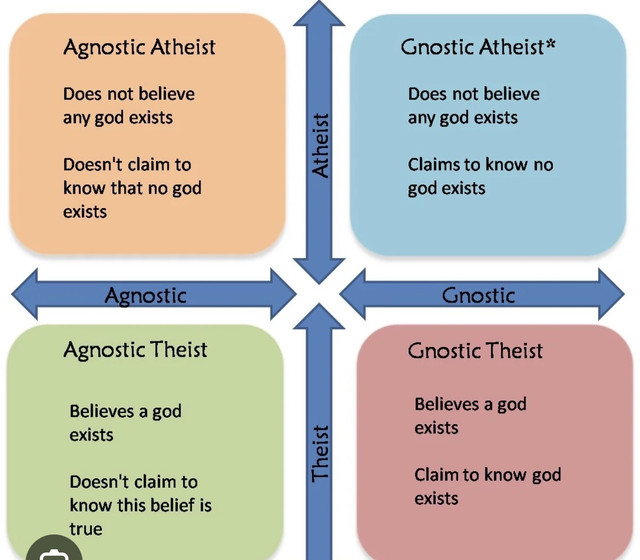
Linguistically atheism and agnosticism lie on two different axes. Colloquially though you are correct that most people assume agnosticism is some kind of middle ground between strong atheism and strong theism.Physics Guy wrote: ↑Thu Aug 27, 2026 5:32 pmSimply not believing in any of the many religious variants is not atheism, though—at least, not by the oldest definition of the term "atheism". In this definition, atheism is being sure that nothing at all like any kind of God exists. Atheism in that sense really is a strong, definite statement, and not just a default, null hypothesis. It's a hard statement to uphold, because of the vagueness of "somewhat like some kind of God".
The only real null position is to say that strong, specific religious claims are probably not true, but then just to decline to take any stand, one way or another, on vague, general questions. That used to be called "agnosticism", not "atheism".
Maybe the terminology has been changing in recent decades, but if it has, this presents a danger. Blurring the distinction between atheism and agnosticism is a temptation to bait-and-switch thinking, in which one sits on the atheist side when thinking about how confident one is in one's understanding of reality, but then switches surreptitiously to the agnostic side as soon as it comes time to justify one's position.
You can't really have it both ways like that. There is no default bias for "No" over "Yes". The default position is silence.
If you had a hypothetical person who was raised in a society with no conception of God they would be an atheist agnostic by definition. I think it’s the null hypothesis and I would agree with you that a gnostic atheist is not a valid null position.
-
Gadianton
- God
- Posts: 6745
- Joined: Sun Oct 25, 2020 11:56 pm
- Location: Elsewhere
Re: Interpreter starts a “new” podcast
I don't think the two words grew up bundled together such that they are that meaningful as a spectrum. A good example is A.J. Ayer, who used "atheism" colloquially but said strictly he was a "theological non-cognitivist" because for logical positivists, "God" is a meaningless word. He tried to shift what "atheism" might really refer to as "religious language", but he's a participant in that also and so I don't think it's worth investing in a technical definition. Since logical positivism may be the pinnacle of atheism, it's to such a fault that the word for disbelief can't even be fathomed.
And then people can mean totally different things by "disbelief", even granting the hypothetical "entity" as a coherent idea. The most popular position today is "agnostic atheism" because as science oriented people, they don't believe anything can be demonstrated 100%. This is the angle of Michael Shermer.
There are multiple problems here. The first is the typical "agnostic atheist" who aligns with Shermer is a falsificationist. The most famous paradigm for skeptics is Carl Sagan's dragon, an example of using falsification to show that religious claims are in principle "unfalsifiable", which Shermer leans on all the time. I'm not criticizing Sagan here, I think his dragon example is brilliant and sums up apologetics better than anything else out there. The Limited Geography theory, the way Mopologists have adopted it, is right out of Sagan. But similar to Ayer, if God is unfalsifiable, you can't say he doesn't exist. So in principle, you can't even be a "soft" disbeliever for something for which evidence is irrelevant to.
The skeptic could shift to atheism as a metaphysical theory, the way Popper talked about philosophy and anything he didn't want to outright destroy but can't fit into the lab. This is dicey, because science-oriented skeptics despise philosophy (even though that's what they're doing themselves) and only want to talk about real facts. The most famous metaphysical dismissal of God is the problem of evil, but if God is a formal self-contradiction, then that's like saying 2+3=6, and it's "hard" atheism that is justified because our certainty is 100% about analytic a priori terms. The point is, your reasons for going "soft" -- because evidence is never 100% -- fall apart the moment you abandon the lab for a different angle.
If you reject Popper, and make the dragon fit into the scientific method as a verification method vs. falsification -- as it is in textbooks -- then maybe you can be a soft atheist, especially if Mormonism is true. I recall a BYU chemist dismissing atheism in an Ensign article back in the 90s because no matter how much you look out at the universe, God could always be hiding somewhere. In other words, God is unfalsifiable for the same reason as the dragon, except for him that isn't ridiculous, it's the claim of atheism that is ridiculous, and he's right about that last part.
So even a non-philosophical God, an actual being, a dude that can do more pullups than Pete Hegseth, can't be proven false under the rubric of falsification, but he can be proven true under verification -- assuming we agree the word "God" is coherent. If we see a white duck, we are certain there are white ducks, but no mater how many white ducks we see, we can't say there are no black ducks or that there are only white ducks.
So what is the difference between a soft and hard atheist under verification assuming "God" isn't nonsensical? If the point is only that we can never be 100%, then since that's true about anything, it's counterproductive. Since relativity can never be proven 100% either, we can say that the Lochness Monster and relativity are on the same grounds. Apologists do this all the time. So it would need to come down to relative certainty, like, if only Joseph Smith saw God, then not good enough but if he came out of the sky and showed himself to everyone maybe that would work. So that must mean that soft atheists think the evidence for God is pretty good compared to hard atheists, which doesn't seem to be the intent of soft atheism.
And then people can mean totally different things by "disbelief", even granting the hypothetical "entity" as a coherent idea. The most popular position today is "agnostic atheism" because as science oriented people, they don't believe anything can be demonstrated 100%. This is the angle of Michael Shermer.
There are multiple problems here. The first is the typical "agnostic atheist" who aligns with Shermer is a falsificationist. The most famous paradigm for skeptics is Carl Sagan's dragon, an example of using falsification to show that religious claims are in principle "unfalsifiable", which Shermer leans on all the time. I'm not criticizing Sagan here, I think his dragon example is brilliant and sums up apologetics better than anything else out there. The Limited Geography theory, the way Mopologists have adopted it, is right out of Sagan. But similar to Ayer, if God is unfalsifiable, you can't say he doesn't exist. So in principle, you can't even be a "soft" disbeliever for something for which evidence is irrelevant to.
The skeptic could shift to atheism as a metaphysical theory, the way Popper talked about philosophy and anything he didn't want to outright destroy but can't fit into the lab. This is dicey, because science-oriented skeptics despise philosophy (even though that's what they're doing themselves) and only want to talk about real facts. The most famous metaphysical dismissal of God is the problem of evil, but if God is a formal self-contradiction, then that's like saying 2+3=6, and it's "hard" atheism that is justified because our certainty is 100% about analytic a priori terms. The point is, your reasons for going "soft" -- because evidence is never 100% -- fall apart the moment you abandon the lab for a different angle.
If you reject Popper, and make the dragon fit into the scientific method as a verification method vs. falsification -- as it is in textbooks -- then maybe you can be a soft atheist, especially if Mormonism is true. I recall a BYU chemist dismissing atheism in an Ensign article back in the 90s because no matter how much you look out at the universe, God could always be hiding somewhere. In other words, God is unfalsifiable for the same reason as the dragon, except for him that isn't ridiculous, it's the claim of atheism that is ridiculous, and he's right about that last part.
So even a non-philosophical God, an actual being, a dude that can do more pullups than Pete Hegseth, can't be proven false under the rubric of falsification, but he can be proven true under verification -- assuming we agree the word "God" is coherent. If we see a white duck, we are certain there are white ducks, but no mater how many white ducks we see, we can't say there are no black ducks or that there are only white ducks.
So what is the difference between a soft and hard atheist under verification assuming "God" isn't nonsensical? If the point is only that we can never be 100%, then since that's true about anything, it's counterproductive. Since relativity can never be proven 100% either, we can say that the Lochness Monster and relativity are on the same grounds. Apologists do this all the time. So it would need to come down to relative certainty, like, if only Joseph Smith saw God, then not good enough but if he came out of the sky and showed himself to everyone maybe that would work. So that must mean that soft atheists think the evidence for God is pretty good compared to hard atheists, which doesn't seem to be the intent of soft atheism.
"...gain control of land that FARMS owned..." -- Bill Hamblin
"Why did FARMS own land to begin with?" -- Me
"Why did FARMS own land to begin with?" -- Me
-
I Have Questions
- God
- Posts: 4288
- Joined: Tue May 23, 2023 9:09 am
Re: Interpreter starts a “new” podcast
The bottom line is that nobody can reliably and objectively answer the questions: Where did we come from? Why are we here? Where do we go when we die?
There’s lots of speculation, which is all religion is really, and generally speaking most people believe in whatever religion they were brought up in and conditioned to accept as the correct speculation. Relatively very few jump ship for a different set of speculative “answers” to those questions.
There is either something after we die, or there isn’t. And we won’t find out until after we are dead. That’s the only position to take if you’re dealing with the facts and don’t need to assuage your fear of death by using make believe as if it were facts.
There’s lots of speculation, which is all religion is really, and generally speaking most people believe in whatever religion they were brought up in and conditioned to accept as the correct speculation. Relatively very few jump ship for a different set of speculative “answers” to those questions.
There is either something after we die, or there isn’t. And we won’t find out until after we are dead. That’s the only position to take if you’re dealing with the facts and don’t need to assuage your fear of death by using make believe as if it were facts.
Premise 1. Eyewitness testimony is notoriously unreliable.
Premise 2. The best evidence for the Book of Mormon is eyewitness testimony.
Conclusion. Therefore, the best evidence for the Book of Mormon is notoriously unreliable.
Premise 2. The best evidence for the Book of Mormon is eyewitness testimony.
Conclusion. Therefore, the best evidence for the Book of Mormon is notoriously unreliable.
-
Physics Guy
- God
- Posts: 2313
- Joined: Tue Oct 27, 2020 7:40 am
- Location: on the battlefield of life
Re: Interpreter starts a “new” podcast
I feel that we often speak of belief or disbelief in terms of certainty or confidence, but that this is actually missing the main point. I think the focus on knowledge and certainty is a kind of holdover from medieval times, when logical inference was the best tool we had, and so our highest goal was to prove things. Since then, science has unlocked more tools, and I'm not sure that we're accurately understanding how they work by thinking of them as better ways of attaining certainty, or ways of getting closer to certainty. That may be like touting a power drill as a better hammer.
I'm not getting at some kind of "two magisteria" idea that science and philosophy are addressing separate subjects. That's not my point here. What I mean is that certainty just isn't the only thing that we want, even when we are saying that we want certainty. I think that there's actually something else that we want, besides certainty, maybe even more than certainty.
I think that in practice our desire that we may describe as a desire for certainty can often be satisfied simply by bandwidth. We just want more detail, more resolution, more story. We may say that we want that clickbait news headline to be confirmed by seeing the video, but the truth is just that we want to see video. Seeing is believing: not because seeing something logically proves it, but because seeing is what we actually mean when we speak of believing.
Our brains are machines for recognising and manipulating patterns in complex data, and what we want is something into which we can sink mental teeth. We like certainty, rather than ignorance, because if we don't have enough usable data, then our brains have nothing to chew; we like certainty, rather than self-contradiction, because patterns that don't work irritate our brains. Give us a big, absorbing story in which everything hangs together nicely, and we can keep on looking more closely wherever we like, and we are happy.
The reason we want to escape the Matrix isn't that the Matrix is only illusion. We don't want to awaken into the real world because the real world is true. We're just afraid that if we stay in the Matrix then we could be missing out on a bigger and better illusion.
In comparison with philosophy, natural science delivers bandwidth galore. You may be stuck playing with dumb little things like electrons, instead of Beauty or Truth, but you get to play with a lot of electrons. Science is like Minecraft. There's just so much to look at, and so much you can do.
So there's a kind of authority in detail itself, if the detail does hang together. The problem with religious traditions isn't really that we can't be confident enough that they are true. The advantage of science isn't that it's more reliable. The advantage that science has over theology is the advantage that Grand Theft Auto 6 has over a woodcut. There's just a lot more to do in it.
At least, that's how it seems to me. It's how I explain to myself my own lack of interest in epistemology. I'm happy with my physicalism, and I'm bored with discussions about how to justify it, especially with people who don't seem to know what they're missing. I just want to get back to my game.
Just as science is a lot more than a set of propositions whose merit is that they are reliably true, so also religion is not really just about being sure about a few propositions. Beyond the low-resolution, woodcut-like formulations of religious doctrine, religious people often also find that living their lives in faith is a high-bandwidth game, with a lot of stuff going on, and patterns that all hang together. I think that this is most often what belief is really about, and that discussing faith in terms of knowledge and certainty is like trying to take apart an engine with a hammer.
I'm not getting at some kind of "two magisteria" idea that science and philosophy are addressing separate subjects. That's not my point here. What I mean is that certainty just isn't the only thing that we want, even when we are saying that we want certainty. I think that there's actually something else that we want, besides certainty, maybe even more than certainty.
I think that in practice our desire that we may describe as a desire for certainty can often be satisfied simply by bandwidth. We just want more detail, more resolution, more story. We may say that we want that clickbait news headline to be confirmed by seeing the video, but the truth is just that we want to see video. Seeing is believing: not because seeing something logically proves it, but because seeing is what we actually mean when we speak of believing.
Our brains are machines for recognising and manipulating patterns in complex data, and what we want is something into which we can sink mental teeth. We like certainty, rather than ignorance, because if we don't have enough usable data, then our brains have nothing to chew; we like certainty, rather than self-contradiction, because patterns that don't work irritate our brains. Give us a big, absorbing story in which everything hangs together nicely, and we can keep on looking more closely wherever we like, and we are happy.
The reason we want to escape the Matrix isn't that the Matrix is only illusion. We don't want to awaken into the real world because the real world is true. We're just afraid that if we stay in the Matrix then we could be missing out on a bigger and better illusion.
In comparison with philosophy, natural science delivers bandwidth galore. You may be stuck playing with dumb little things like electrons, instead of Beauty or Truth, but you get to play with a lot of electrons. Science is like Minecraft. There's just so much to look at, and so much you can do.
So there's a kind of authority in detail itself, if the detail does hang together. The problem with religious traditions isn't really that we can't be confident enough that they are true. The advantage of science isn't that it's more reliable. The advantage that science has over theology is the advantage that Grand Theft Auto 6 has over a woodcut. There's just a lot more to do in it.
At least, that's how it seems to me. It's how I explain to myself my own lack of interest in epistemology. I'm happy with my physicalism, and I'm bored with discussions about how to justify it, especially with people who don't seem to know what they're missing. I just want to get back to my game.
Just as science is a lot more than a set of propositions whose merit is that they are reliably true, so also religion is not really just about being sure about a few propositions. Beyond the low-resolution, woodcut-like formulations of religious doctrine, religious people often also find that living their lives in faith is a high-bandwidth game, with a lot of stuff going on, and patterns that all hang together. I think that this is most often what belief is really about, and that discussing faith in terms of knowledge and certainty is like trying to take apart an engine with a hammer.
Join the Pirate Philosophers: We think, therefore we Arrr!
-
drumdude
- God
- Posts: 8058
- Joined: Thu Oct 29, 2020 5:29 am
Re: Interpreter starts a “new” podcast
Mormonism is very much steeped in modern scientific post-enlightenment culture. Joseph was claiming to actually translate the ancient texts, methodically as a real translation. He set up schools to foster learning other languages. He said God was a material man of flesh and blood. God lives on a physical planet. Mormons today still testify that they “know” the church is true.
It’s a very distinct departure from how I understand Catholicism. Catholics are okay believing in a non-material God and heaven. They are okay with mysteries that are beyond our comprehension. They are okay believing instead of knowing.
Personally I prefer the latter view of religion. It’s a lot more mature, being 2000 years old versus 200.
It’s a very distinct departure from how I understand Catholicism. Catholics are okay believing in a non-material God and heaven. They are okay with mysteries that are beyond our comprehension. They are okay believing instead of knowing.
Personally I prefer the latter view of religion. It’s a lot more mature, being 2000 years old versus 200.