I Have Questions wrote: ↑Wed Sep 09, 2026 8:44 pm
Marcus wrote: ↑Wed Sep 09, 2026 6:50 pm
No, as a statistician, I disagree. "Some" has a significantly different meaning than "many," in this context from a geneticist, and using it so loosely is not honest.
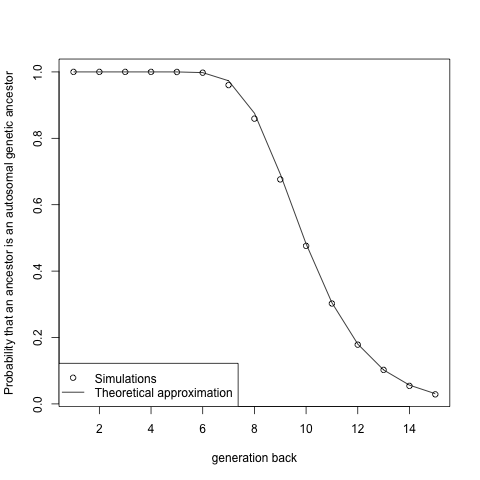
Taking what's been agreed upon; we already know we have 100% of our 64 ancestors represented in gen 6, and about 50% in gen 10 (~500/1024).
Using simple extrapolation, going from 100% to 50% in 4 generations would mean a loss of 12.5% each generation.
So, 7th generation: loss of 12.5% to 87.5% represented. That loss is not "many" compared to what's retained.
8th gen: loss of 25%, 75% retained. That loss is definitely "some" but stll not "many."
9th gen: loss of 37.5%, 62.5% retained. Still "some" but not "many" unless you add that "many more" were retained.
10th gen: loss of 50%, 50% retained.
Finally, in the 10th generation I might agree "many" ancestors' inputs may have been lost, but only in the context of saying "and many" were retained.
So it's not a quibble, it's a matter of specificity and accuracy one can expect from a geneticist. Especially since "quibbles" like this are time-honored ways for Mormons to ease what the rest of the world considers a lie into their research.
Eta:
Couldn't agree more.
I’ll have a final stab at defending Perego’s statement. When he says “It is increasingly likely around 6+ generations back that you have no DNA in your genome at all from many of your ancestors in that generation.” he is correct that the amount of ancestors DNA dropping out of your genome does increase from zero to “many” as you track back from 7 generations onwards. It may not be “many” at 7 generations but it becomes an increasingly larger proportion with each generation until it reaches the threshold of “many” (whatever proportion is designated by Perego as “many”).
No, i disagree, that's still not an accurate assessment of how one would normally interprete what he's saying, especially in the context in which he states it. The sentence is misleading with the intent of supporting something completely and scientifically insupportable, and I don't have a problem with Southerton saying it is a lie, in contrast with his other statements.
Regarding the review:
...A Dr Antonio Tonneli reviewed the book in which Perego makes that claim, and said “ Although I am not in a position to vouch for the historical and religious aspects presented in this volume, I consider the principles of population genetics and the scientific approach described in this volume by Dr. Ugo Perego and Dr. John Butler as carefully outlined and a useful resource for anyone interested in learning more about ancient expansion and migratory events that contributed to the first peopling of the Americas.”
You're talking about the book put out by Deseret Books, right? Categorized as a religious book, published by the Mormon church? Unvetted by an academic press?
Sorry, I don't find anything from that publisher credible, particularly not unvetted scientific things published in an attempt to support the utterly nonscientific claim of Book of Mormon historicity.
...His main point that Lamanite DNA might have disappeared from today’s population on the basis that 100% of some ancestors DNA drops out of today’s populations DNA is accurate...
I'll let Simon take this one, but based on what I've read, I'm pretty sure that point is not correct.
Just because an individual ancestor may not show up is NOT a scientifically valid reason to conclude that all of the dna from an entire population containing that ancestor plus all related ancestors would disappear.